Capacitors - exam practice
Capacitors
Question 1 of 10
1 of 10
The initial potential difference across a capacitor is V0. The capacitor discharges through a circuit of time constant T. The base of natural logarithms is e.
What is the potential difference across the capacitor after time T?
Question 2 of 10
2 of 10
An uncharged capacitor is connected to a power supply which supplies a constant current of 10 μA.
After 100 ms, the potential difference across the capacitor is 5.0 kV.
What is the capacitance of the capacitor?
Question 3 of 10
3 of 10
A 10 μF capacitor stores 4.5 mJ of energy.
It then discharges through a 25 Ω resistor.
What is the maximum current during the discharge of the capacitor?
Question 4 of 10
4 of 10
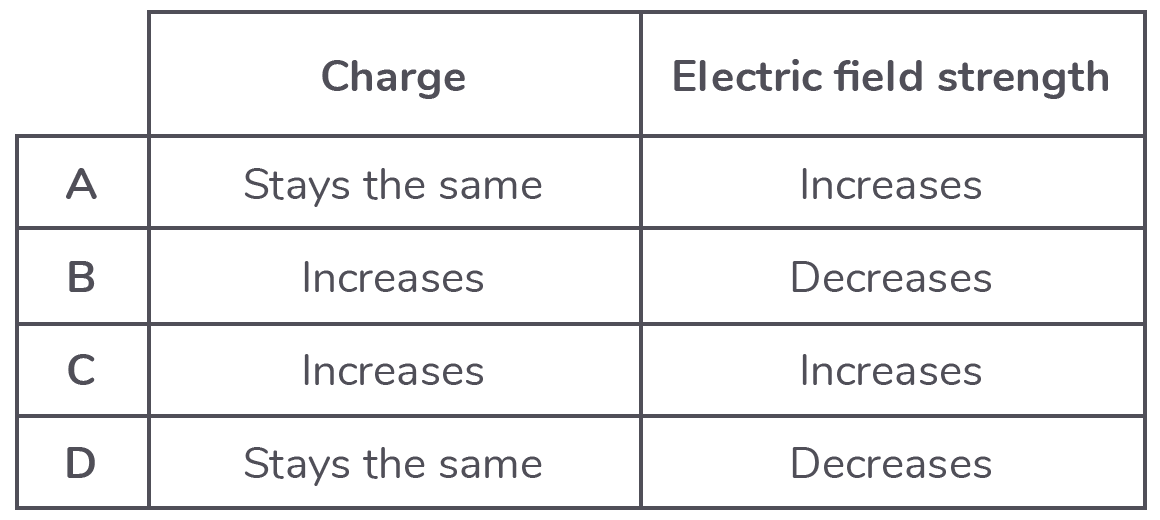
A parallel-plate capacitor is fully charged and then disconnected from the power supply.
A dielectric is then inserted between the plates.
Which row correctly identifies the charge on the plates and the electric field strength between the plates?
Question 5 of 10
5 of 10
A capacitor of capacitance C has a charge of Q stored on the plates. The potential difference between the plates is doubled.
What is the change in the energy stored by the capacitor?
Question 6 of 10
6 of 10
A capacitor consists of two parallel square plates of side l separated by distance d.
The capacitance of the arrangement is C.
What is the capacitance of a capacitor with square plates of side 2l separated by a distance ?
Question 7 of 10
7 of 10
A capacitor of capacitance 120 µF is charged and then discharged through a 20 kΩ resistor.
What fraction of the original charge remains on the capacitor 4.8 s after the discharge begins?
Question 8 of 10
8 of 10
Which of the following statements about a parallel plate capacitor is incorrect?
Question 9 of 10
9 of 10
A 1.0 µF capacitor is charged for 20 s using a constant current of 10 µA.
What is the energy transferred to the capacitor?
Question 10 of 10
10 of 10
A 1.0 µF capacitor initially stores 15 µC of charge. It then discharges through a 25 Ω resistor.
What is the maximum current during the discharge of the capacitor?