1.9 - Work Done
- 1
Definition and formula of work
- 2
Criteria for When Work is Done or Not Done by a Force
- 3
Power: The Rate of Doing Work
- 4
Formula for Calculating Power Using Force and Velocity
- 5
Understanding Power in Overcoming Frictional Forces, with Examples in Vehicles
Work done
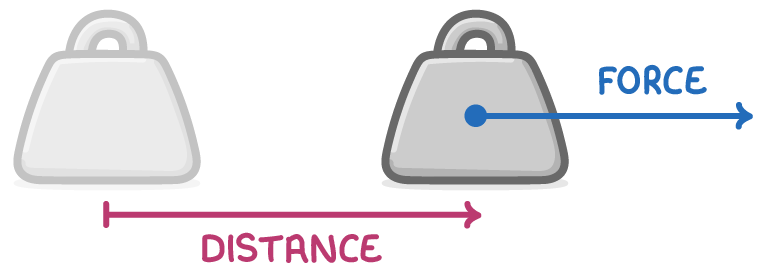
Work is a concept that describes energy transfer when a force causes an object to move over a distance.
The work done is calculated using the equation:
W = F x s
Where:
- W = work done (J)
- F = applied force in direction of motion(N)
- s = distance moved in the direction of the force (m)
Key points:
- Work is only done when there's a component of force in the direction of the object's movement.
- Movement perpendicular to the force results in zero work.
- Work done by a varying force is calculated using the average force in the direction of movement.
Worked example - Calculating work done
Calculate the work done when a box is pushed 5 m across the ground by a force of 30 N.
Step 1: Formula
W = F x s
Step 2: Substitution and correct evaluation
W = 30 x 5 = 150 J
Work done by a force at an angleSometimes the applied force isn’t in the direction of motion. When this is the case, we need to resolve the force to find the component that does act in the direction of motion.
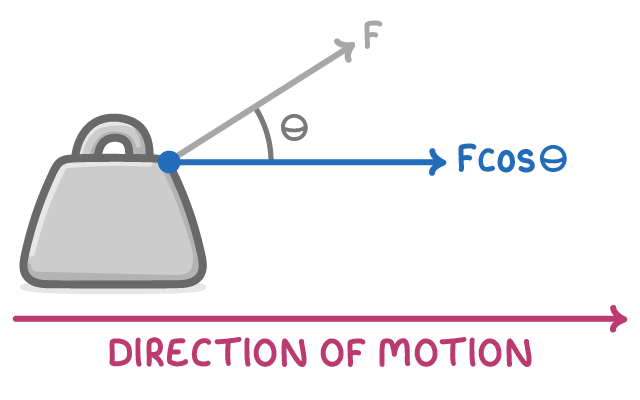
The component of the force acting in the direction of motion is given by F cos().
The work done by the force is therefore given by:
W = F s cosθ
Where:
- W = work done (J)
- F = magnitude of the force applied (N)
- s = displacement of the object (m)
- θ = angle between the force and the direction of the displacement.
Note: When = 90°, no work is done as cos(90) = 0.
Worked example - Calculating work done
Calculate the work done when a pulled 6 m across the ground by a force of 10 N at an angle of 25° to the direction of motion.
Step 1: Formula
W = F s cos()
Step 2: Substitution and correct evaluation
W = 10 x 6 x cos(25) = 54.4 J
Power is the rate of energy transfer
Power (P) in physics is defined as the rate at which work is done or energy is transferred. It is calculated using the formula:
Where:
- P = power (W)
- W = work done (J)
- t = time taken (s)
Calculating power from force and velocity
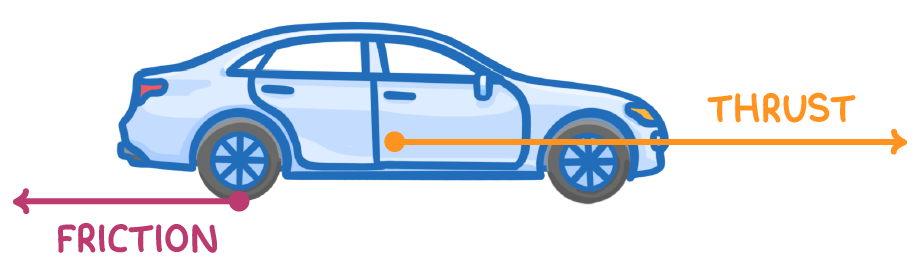
Power can also be calculated using force and velocity, especially in scenarios involving movement. The formula is:
P = F x v
Where:
- P = power (W)
- F = resultant force in the direction of motion (N)
- v = velocity (m s^-1^)
Worked example - Calculating power
A machine lifting an object does 500 J of work in 10 s. Calculate the power.
Step 1: Formula
Step 2: Substitution and correct evaluation