7.5 - Particle Tracks
- 1
How charged particles create ionisation trails
- 2
Cloud chambers and bubble chambers for particle detection
- 3
The effect of magnetic fields on charged particle tracks
- 4
Detection of neutral particles through decay
Ionisation trails from charged particles
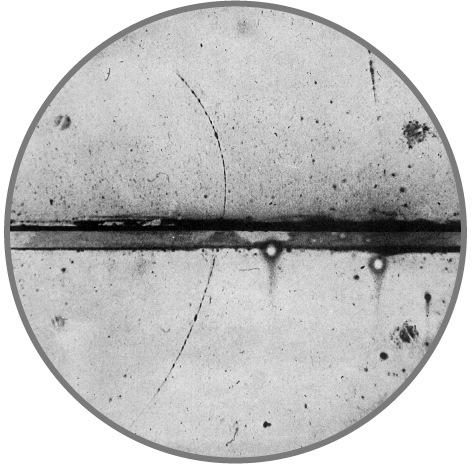
When a charged particle moves through a substance, it causes ionisation by knocking electrons out of atoms. This process leaves behind a trail of ions, which can be used to detect the particle's path.
Particle detection using cloud and bubble chambers
Two common methods for detecting charged particles are cloud chambers and bubble chambers.
Cloud chambers:
- Use supercooled vapour
- Ions cause vapour to condense, forming visible trails
- Heavy, short tracks indicate high ionisation (e.g., α-particles)
- Faint, long tracks suggest less ionisation (e.g., β-particles)
Bubble chambers:
- Contain liquid hydrogen above its boiling point
- Pressure reduction causes bubbles to form along ion trails
- Quick photography is essential before bubbles grow too large
Both chambers are effective for detecting charged particles.
Magnetic field effects on charged particle tracks
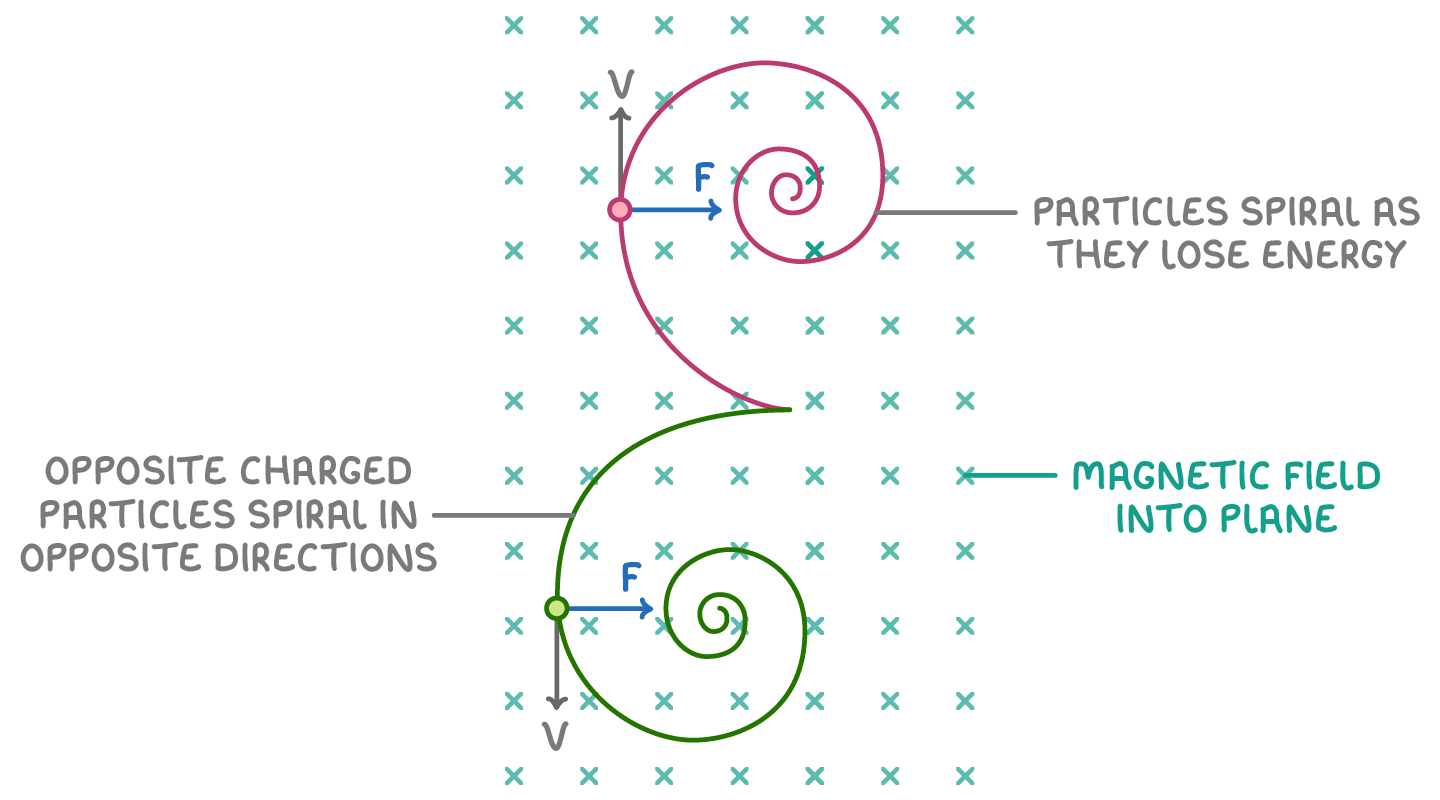
Charged particles moving through a magnetic field experience a force, causing their tracks to curve. The radius of curvature (r) is given by:
Where:
- p = particle momentum (kg m s-1)
- B = magnetic flux density (T)
- Q = particle charge (C)
Key points:
- A larger curve radius indicates greater particle momentum
- Positive and negative particles curve in opposite directions
- Particle tracks form spirals as they lose energy
Worked example - calculating particle momentum
A charged particle with a charge of 1.6 × 10⁻¹⁹ C moves in a circular path of radius 0.5 m in a magnetic field of 0.2 T.
Calculate the particle's momentum.
Step 1: Identify the equation
Step 2: Rearrange the equation to solve for p
Step 3: Substitute known values and calculate
Detecting neutral particles
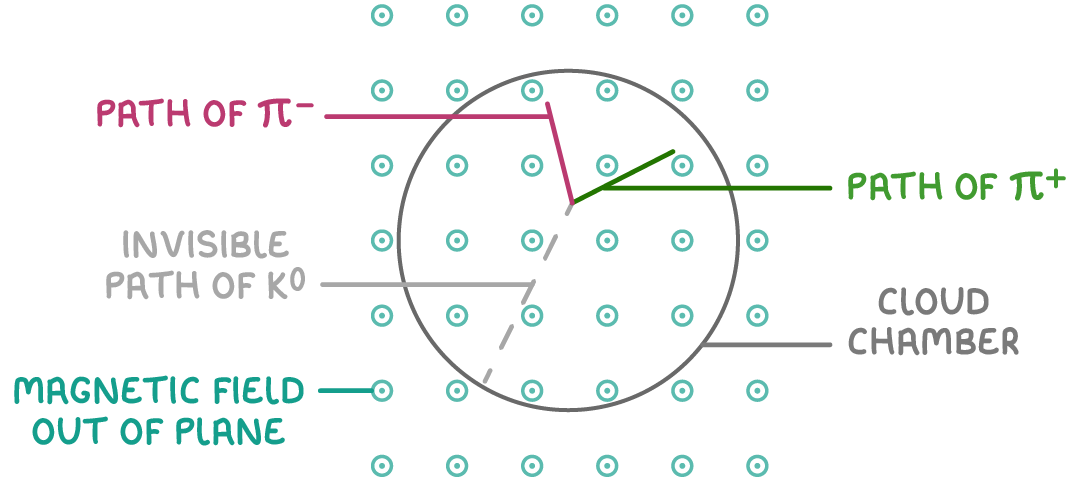
Neutral particles do not create ionisation trails and are only detectable when they decay or interact with other particles.
- Decay products often form a characteristic V-shape
- The distance from the interaction point to the V depends on the particle's half-life
- Relativistic time dilation affects the observed decay distance
Example decay:
Tracks produced by alpha particles
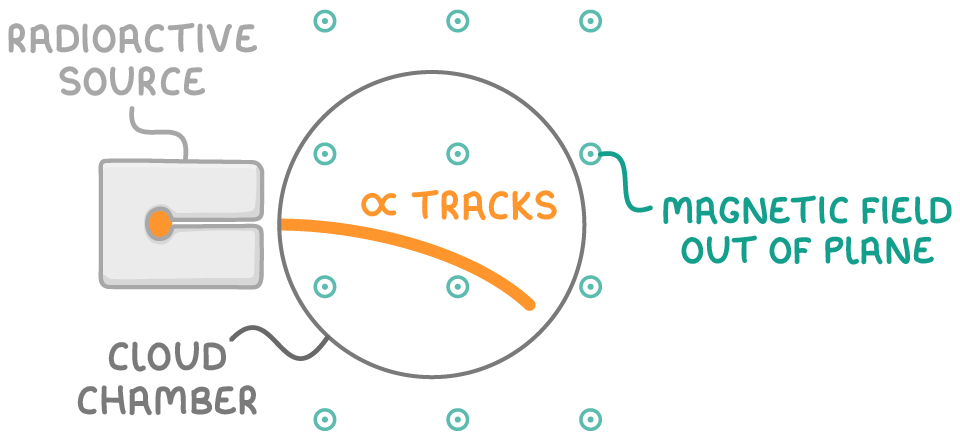
Alpha particles (α) form distinctive tracks:
- Create short, thick tracks in cloud or bubble chambers
- Tracks have very little bending due to their large mass
- Have a short range due to rapid energy loss
Tracks produced by beta particles
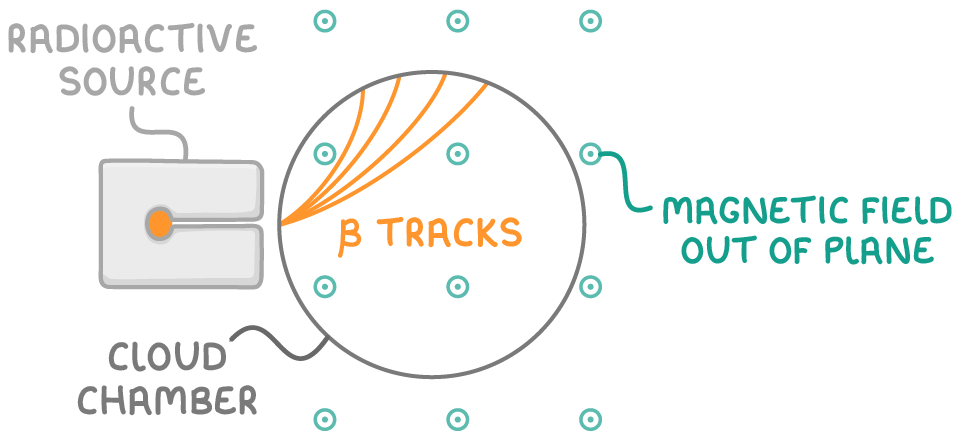
Beta particles (β) can also be identified by their tracks:
- Produce long, thin tracks in detection chambers
- Often show erratic paths due to their light mass
- Cause less ionisation per unit length compared to alpha particles
- Have a longer range than alpha particles
Tracks produced by gamma rays
Gamma rays (γ) are high-energy photons:
- Do not produce direct tracks as they are uncharged
- Can be detected indirectly through secondary ionisation events
- May cause electron-positron pair production, resulting in V-shaped tracks
Comparison of alpha, beta, and gamma tracks
The table below summarises the appearance of tracks produced by alpha, beta and gamma radiation in a detection chamber.
| Radiation Type | Track Appearance | Ionisation Density | Range in Chamber |
|---|---|---|---|
| Alpha (α) | Short, thick, straight | Very high | Short |
| Beta (β) | Long, thin, often curved | Low to moderate | Long |
| Gamma (γ) | No direct track, secondary effects visible | Indirect | N/A (secondary effects visible) |