8.5 - Kinetic Theory Of Gases
- 1
How gas particles move and collide with container walls
- 2
Assumptions of the kinetic theory of gases
- 3
Definition and significance of root mean square speed
- 4
Maxwell-Boltzmann distribution of molecular speeds
- 5
Effect of temperature on speed distribution
Assumptions of kinetic theory
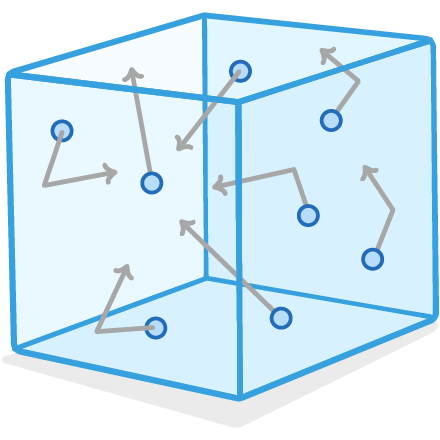
The kinetic theory makes several key assumptions to simplify the complex behaviours of gases.
Assumptions:
- A large number of particles are in motion.
- Particles move rapidly and randomly.
- The volume of individual particles is negligible compared to the container.
- Collisions between particles and with the container walls are perfectly elastic.
- Collisions occur instantaneously.
- No forces act between particles except during collisions.
Gas particle motion and collisions
In an ideal gas, the particles are in constant, rapid motion, travelling in random directions. These particles frequently collide with one another and with the walls of their container.
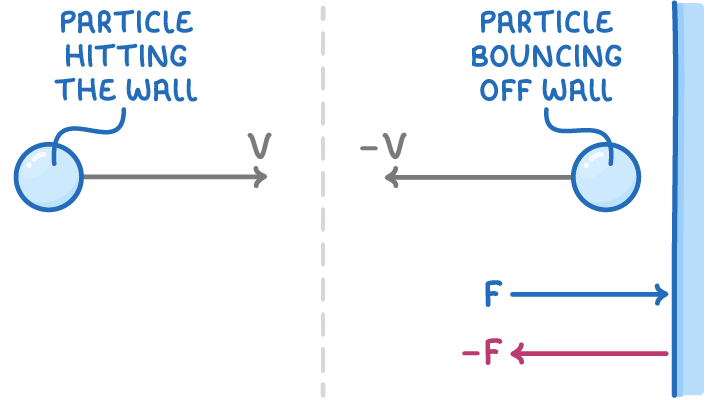
During these collisions, forces are exerted on the container walls. This process is best understood through Newton's three laws of motion:
- 1st law - A particle moves at a constant velocity unless acted upon by an external force.
- 2nd law - The force exerted by a particle is equal to its rate of change of momentum.
- 3rd law - For every action, there is an equal and opposite reaction, meaning the wall exerts a force equal in magnitude but opposite in direction to that of the particle.
These random and frequent collisions result in a uniform pressure being exerted on the container walls.
Step 1: Consider the change in momentum for a particle collision with the container in the x direction
Initial momentum = mc_x_
Final momentum = -mc_x_
p = -mv - mv = -2mc_x_
Step 2: Consider the force experienced by a particle (using Newton's second law)
Step 3: Consider the force experienced by the container due to a particle collision
Newton's third law states that every action will have an equal and opposite reaction. The force experienced by the container is given by:
F =
Step 4: Identify the time between collisions
The particle travels from one wall to the opposite wall and back before colliding again. This total distance = 2l.
time =
Step 5: Substitution for time
Step 6: Consider the pressure experienced due to the particle collisions
The volume of the container is given by V = l = l A. The formula for pressure becomes:
Step 7: Identify the pressure from N particles
Step 8: Consider motion in 3 dimensions
The pressure in step 7 only considers motion from N particles in one dimension. In reality, the particles will be moving randomly in 3 dimensions (x, y, and z). Splitting the velocity into its components, c^2^ (the square of the average speed) can be defined using Pythagoras' theorem:
The speed in each direction is the same, therefore:
Step 9: Rewrite the formula for pressure
Step 10: Rearranged formula
Calculating pressure using kinetic theory
The pressure of a gas is directly related to the volume of the container, the number of particles, their individual masses, and their average speed.
The kinetic theory of gases provides an equation to calculate the pressure exerted by an ideal gas:
Where:
- p = pressure of the gas (Pa)
- V = volume of the container (m3)
- N = number of gas particles
- m = mass of each particle (kg)
- = average of the squared speeds of the particles (m2 s-2)
Worked example - Calculating pressure of an ideal gas
A container with a volume of 0.5 m3 holds 2 × 10²³ nitrogen gas particles (N2), each with a mass of 4.65 × 10⁻²⁶ kg. Determine the pressure inside the container, given the mean of the squared speeds () of the particles is 5 × 10⁴ m2 s-2.
Step 1: Formula
Step 2: Substitution and correct evaluation
Maxwell-Boltzmann distribution
The speeds of gas particles follow a Maxwell-Boltzmann distribution:
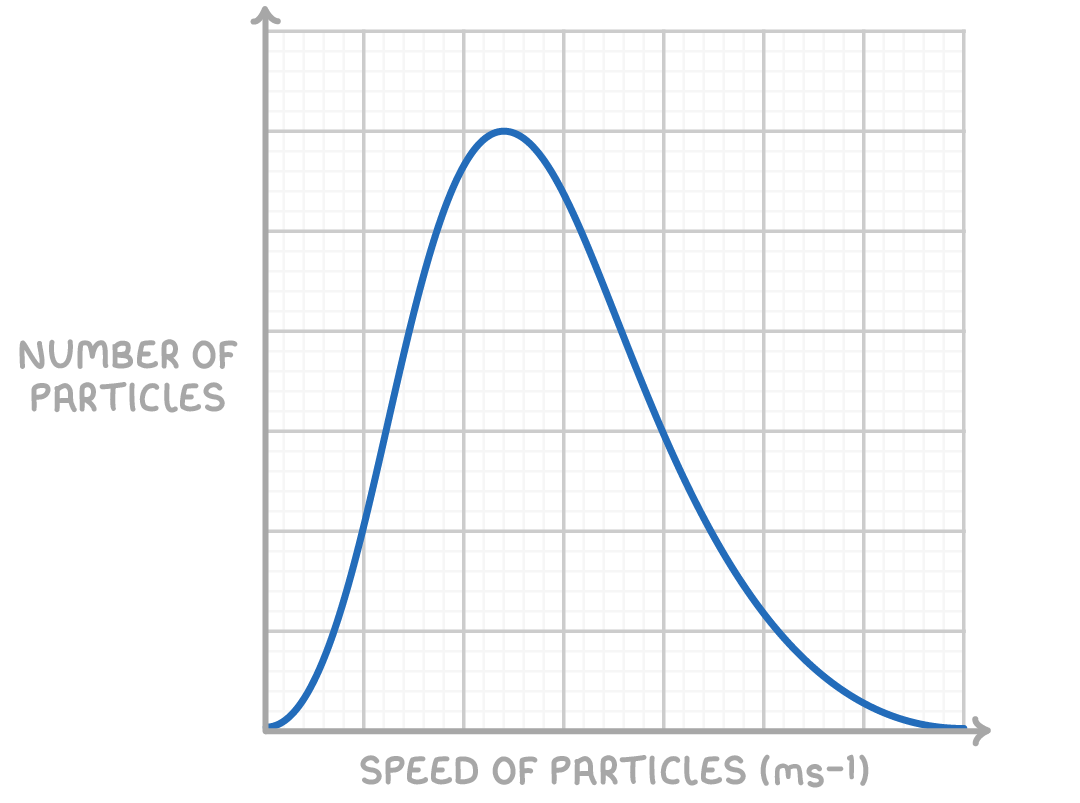
This distribution highlights that:
- A majority of particles have moderate speeds.
- A smaller number move very slowly.
- A few particles move at high speeds.
This speed distribution also applies to the kinetic energies of the particles.
Effect of temperature
Temperature significantly influences the Maxwell-Boltzmann distribution:
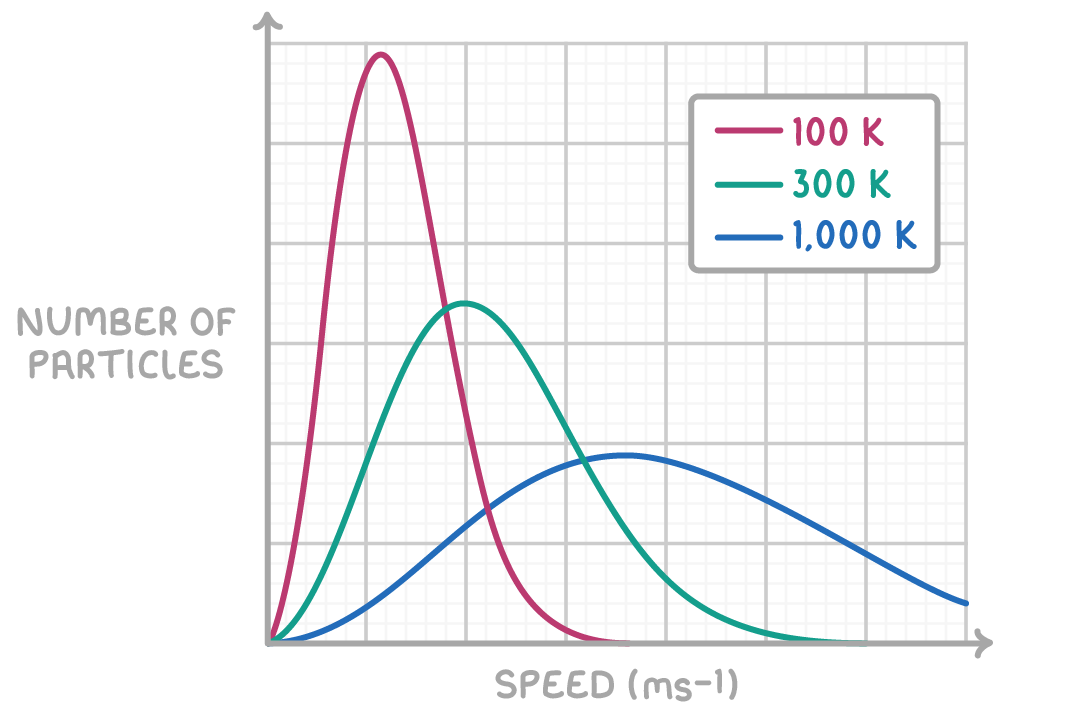
Key effects of temperature include:
- A broader distribution of speeds at higher temperatures.
- An increase in the peak speed with temperature.
- A direct proportionality between average kinetic energy and absolute temperature.
Derivation of average kinetic energy
Let's derive the average kinetic energy of a gas particle:
Step 1: Write out the ideal gas law
Step 2: Write out the kinetic theory expression
Step 3: Equate the two equations
Step 4: Cancel N from both sides
kT =
Step 5: Multiply both sides of our equation by 3
Step 6: Divide both sides by 2
Remember, is the average kinetic energy (KE) of a particle, similar to the kinetic energy formula