4.8 - Variable Components
- 1
The variation of resistance with temperature for thermistors
- 2
The variation of resistance with light intensity for LDRs
- 3
How sensing circuits can be created using variable resistance components
Semiconductors
Semiconductors, having greater resistivity than metals, become more conductive when energy is added, as this process releases more charge carriers, thereby reducing resistance. This characteristic renders them ideal for sensors detecting variations in temperature, light, and other factors.
Key examples include:
- Thermistors
- LDRs (Light Dependent Resistors)
- Diodes
Lattice vibrations and conduction electronsLattice Vibrations:
Atoms in a solid are arranged in a lattice structure. When temperature increases, these atoms vibrate more intensely. Increased lattice vibrations result in more frequent collisions between the lattice ions and conduction electrons, impeding the flow of current.
Conduction Electrons:
Conduction electrons are free electrons that move through a material and carry electric charge. The number of conduction electrons can change with temperature, influencing the material's overall resistance.
Metallic conductors
At constant temperature, metallic conductors have a fixed resistance.
As temperature increases, resistance increases due to:
- Increased lattice vibrations resulting in more frequent collisions between the lattice ions and conduction electrons.
- The number of conduction electrons remains stable as temperature is increased.
Thermistors

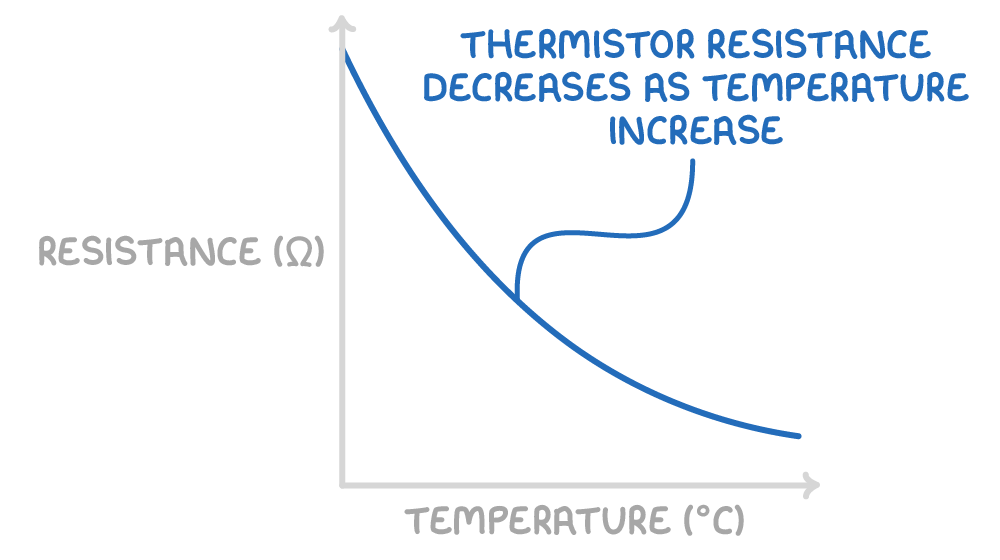
Thermistors are special resistors with temperature-dependent resistance. In NTC (Negative Temperature Coefficient) thermistors, resistance decreases as temperature increases because there is a significant increase in the number of conduction electrons, which enhances the material's conductivity.
Key points:
- Heating a thermistor provides energy to release additional conduction electrons.
- An increase in charge carriers leads to reduced resistance.
- The I-V graph for a thermistor curves upwards, indicating decreasing resistance with increased current due to temperature rise.
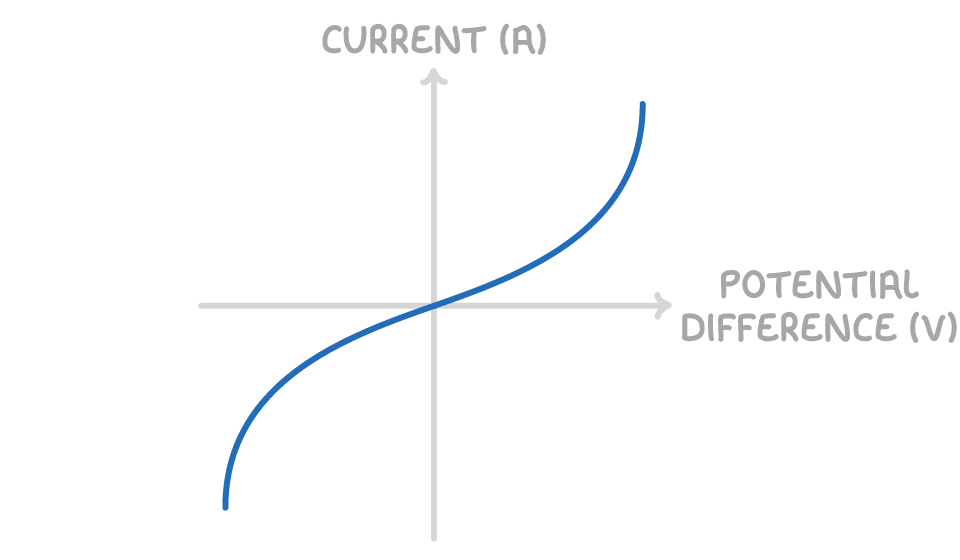
It is often useful to think about how the resistance of the thermistor varies with temperature:
Light dependent resistors
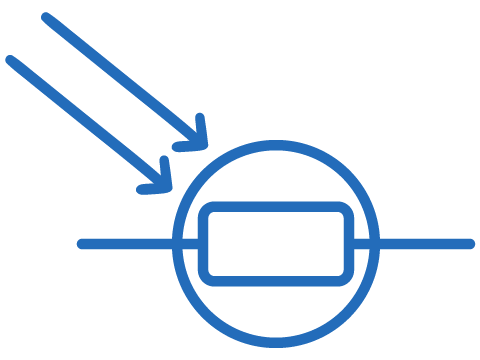
An LDR, or Light Dependent Resistor, exhibits resistance that inversely correlates with light intensity.
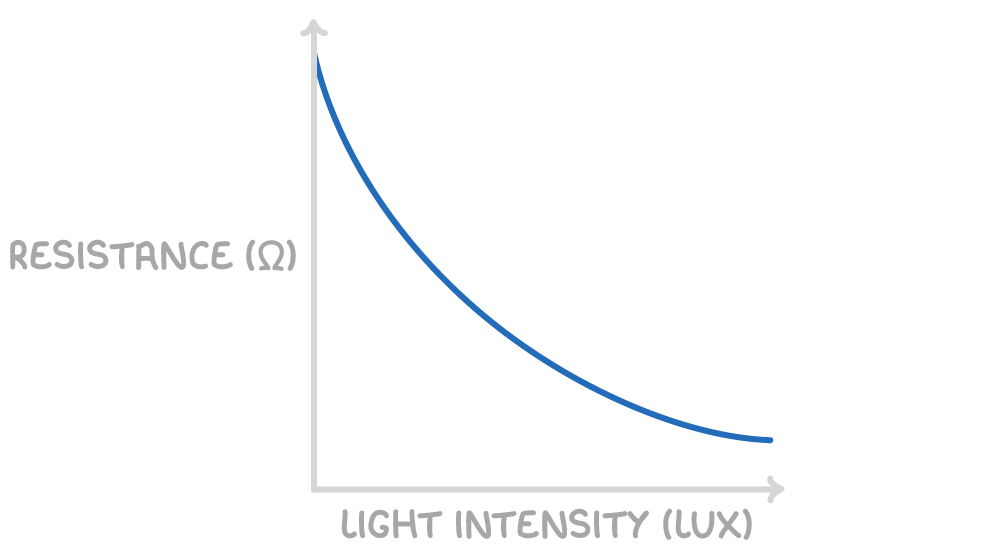
When light intensity increases:
- The number of conduction electrons increases.
- This results in lower resistance.
Sensing circuits
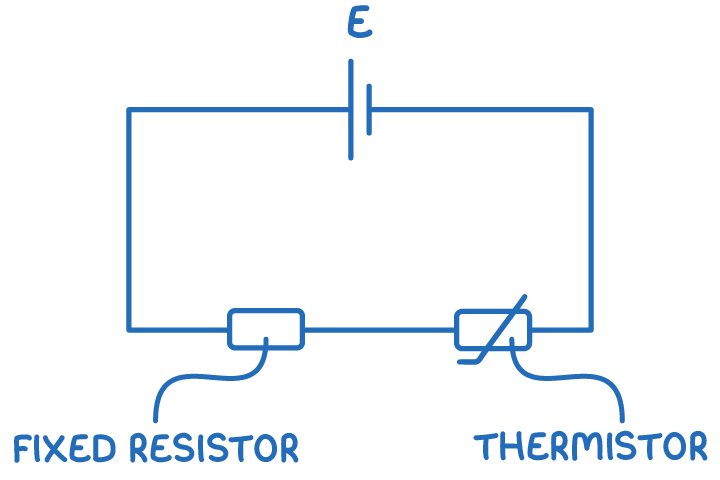
A temperature sensor can be formed by placing the thermistor in series with a fixed resistor.
How it works:
- As the temperature of the thermistor increases, its resistance decreases.
- This reduces the overall circuit resistance and so the circuit current increases.
- This causes the voltage across the fixed resistor to increase and the voltage across the thermistor to decrease.
Similar sensing circuits can be created using LDRs to monitor light intensity.