2.2 - Stoke's Law
- 1
Examining the forces acting on a falling sphere
- 2
Stokes' law and its assumptions
- 3
Calculating the drag force on a sphere moving through a fluid
- 4
Definitions of laminar and turbulent flow
- 5
Characteristics and differences between laminar and turbulent flow
- 6
Examples of laminar and turbulent flow in real-world scenarios
Forces acting on a falling sphere
When a sphere falls through a fluid under the influence of gravity, three forces act on it.
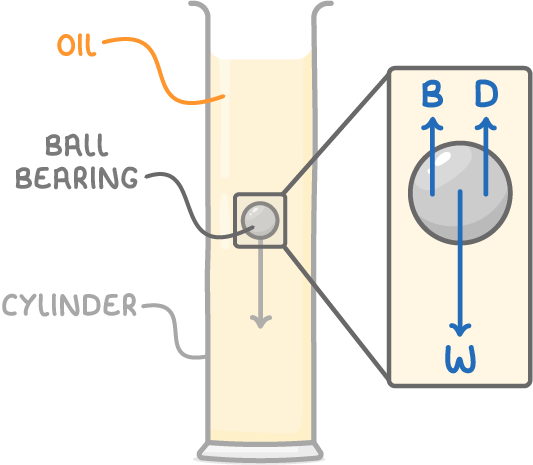
- Weight (W) - Downwards force due to gravity acting on the mass of the sphere.
- Viscous Drag force (D) - Upwards resistive force due to the motion through the fluid.
- Buoyancy force (B) - Upwards force equal to the weight of the displaced fluid.
Fluid viscosity
The dynamic viscosity () is a measure of a fluid's resistance to deformation.
Fluids with high viscosity, like honey, have a higher resistance to flow compared to more runny, low-viscosity fluids like water.
The table below summarises the viscosity of some common substances.
| Substance | Viscosity (mPa s) |
|---|---|
| Whole milk | 2.12 |
| Water | 1.00 |
| Honey | 2,000+ |
| Olive Oil | 56.2 |
Stokes' law for viscous drag
In 1851, George Stokes derived a theory for the viscous drag force acting on a small sphere moving through a viscous fluid. This law, known as Stokes' law, applies to both gases and liquids. However, Stokes made the following assumptions:
- The fluid flow is laminar, meaning layers flow smoothly without mixing.
- The moving particles are smooth spheres.
- The fluid is homogeneous (uniform in composition).
- The particles do not interact with each other.
Calculating viscous drag
According to Stokes' law, the drag force (Fd) on a sphere of radius r moving with speed v through a fluid with dynamic viscosity is given by:
Where:
- Fd = viscous drag force (N)
- = dynamic viscosity of the fluid (Pa s)
- r = radius of the sphere (m)
- v = speed of the sphere (m s-1)
Worked example 1 - Calculating drag force on a sphere
A small steel ball with a radius of 1.5 mm moves through oil with a dynamic viscosity of 0.1 Pa s at a speed of 0.2 m s-1. Calculate the drag force acting on the ball.
Step 1: Formula
Step 2: Identify known quantities
r = 1.5 mm = 1.5 × 10⁻³ m
= 0.1 Pa s
v = 0.2 m s^-1^
Step 3: Substitution and correct evaluation
Laminar flow
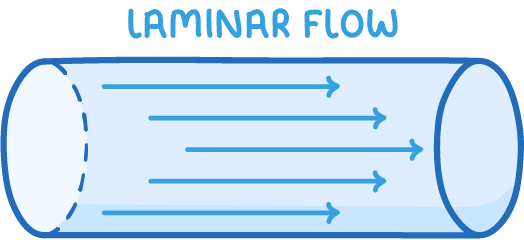
Laminar flow occurs when a fluid flows in parallel layers with no disruption between them. In this type of flow, the fluid particles move smoothly and orderly along well-defined paths or streamlines.
Characteristics of Laminar Flow:
- Smooth and orderly - Fluid layers glide past one another without mixing.
- Predictable - The flow pattern is steady and repeatable.
- Low velocity - Often occurs at lower velocities and with fluids of higher viscosity.
Examples of Laminar Flow:
- Water flowing slowly through a straight, smooth pipe.
- Blood flow in small blood vessels.
- Flow of honey or syrup out of a bottle.
- Oil moving through narrow channels in machinery.
Turbulent flow
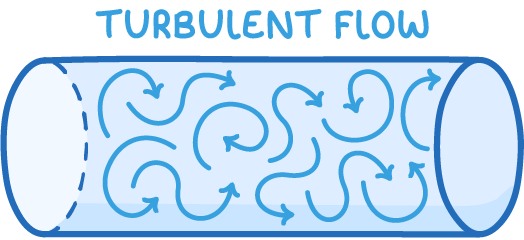
Turbulent flow, in contrast, is chaotic and irregular. The fluid particles move in random, swirling patterns, often creating eddies and vortices. This type of flow results in the mixing of the fluid layers.
Characteristics of turbulent flow:
- Chaotic and irregular - Fluid motion is disordered and constantly changing.
- Unpredictable - The flow pattern varies over time and position.
- High velocity - Often occurs at higher velocities and with fluids of lower viscosity.
Examples of turbulent flow:
- Water flowing rapidly through a rough, large-diameter pipe.
- Airflow around a speeding car.
- Water flowing over rocks in a river
- Smoke rising from a chimney.
Comparing laminar and turbulent flow
The table below summarises the key differences between turbulent and laminar flow.
| Feature | Laminar Flow | Turbulent Flow |
|---|---|---|
| flow pattern | smooth and orderly | chaotic and irregular |
| velocity | lower velocities | higher velocities |
| predictability | steady and predictable | unsteady and unpredictable |
| energy loss | lower energy loss | higher energy loss |
| occurrence | small pipes, high viscosity fluids, low speed | large pipes, low viscosity fluids, high speed |