Electric Fields - exam practice
Electric Fields
Question 1 of 9
This question is about the electric field around a +1 C charge.
Draw arrows on the diagram below to show the electric field around the positive charge.
State what the direction of the electric field lines represent.
A +2 nC charge is placed 4 cm away from the +1 C charge.
Calculate the force experienced by the +2 nC charge.
Add an arrow to the diagram below to show the direction of force on the +2 nC charge.
This question is about the electric field between two point charges.
State Coulomb's law for the force between two point charges.
A student is investigating the force between a -2 nC charge and a -4 nC charge.
Plot a graph to show how the force experienced varies with separation. Label your axes with suitable values.
The -4 nC charge is removed.
Calculate the electric field strength at a distance of 8 cm from the -2 nC charge.
A +1 nC test charge is placed 8 cm from the -2 nC charge.
Calculate the work done on the positive test charge when it is moved to a distance of 20 cm from the -2 nC charge.
A student is investigating the electric field between two parallel metal plates.
The metal plates are separated by 15 cm and have a potential difference of 1.2 kV applied across them.
Calculate the electric field strength E.
Draw the electric field between the two metal plates.
A 1 C charge is placed in the field as shown below.
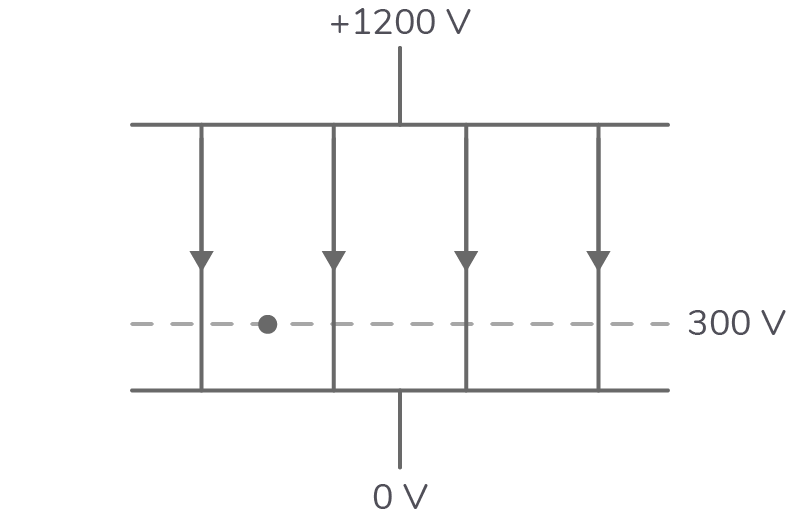
The charge is held in equilibrium by the electric field.
State the polarity of the 1 C charge.
The charge is held in equilibrium.
Calculate the mass of the 1 C charge.
The charge moves along the 300 V equipotential from left to right.
State the work done on the charge.
This question is about the electric field around point charges.
The diagram below shows the radial field around a +1 C charge.
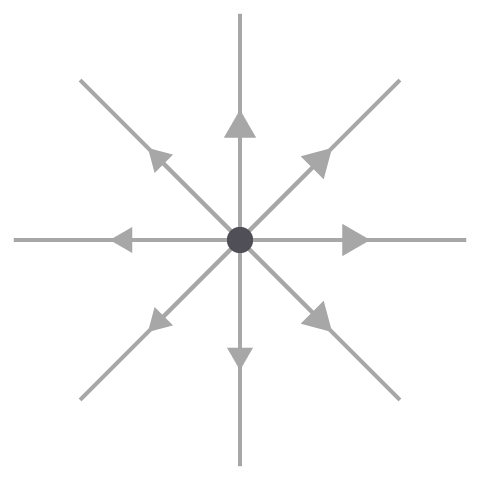
Draw the electric field around a +2 C charge.
The +2 C is placed 1 m from the +1 C charge.
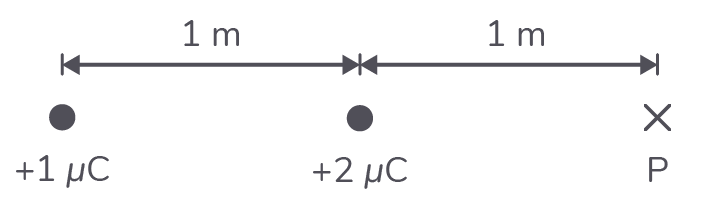
Calculate the electric potential V at point P.
A +1 nC charge is placed at P.
Calculate the work done on the +1 nC charge when it is moved left by 50 cm.
The +1 nC charge is released when it is 0.5m from the +2 C charge.
Calculate the initial acceleration of the +1 nC charge if it has a mass of 10 mg.
A charged ball is suspended on a nylon thread between to parallel metal plates.
A potential difference is applied across the plates as shown.
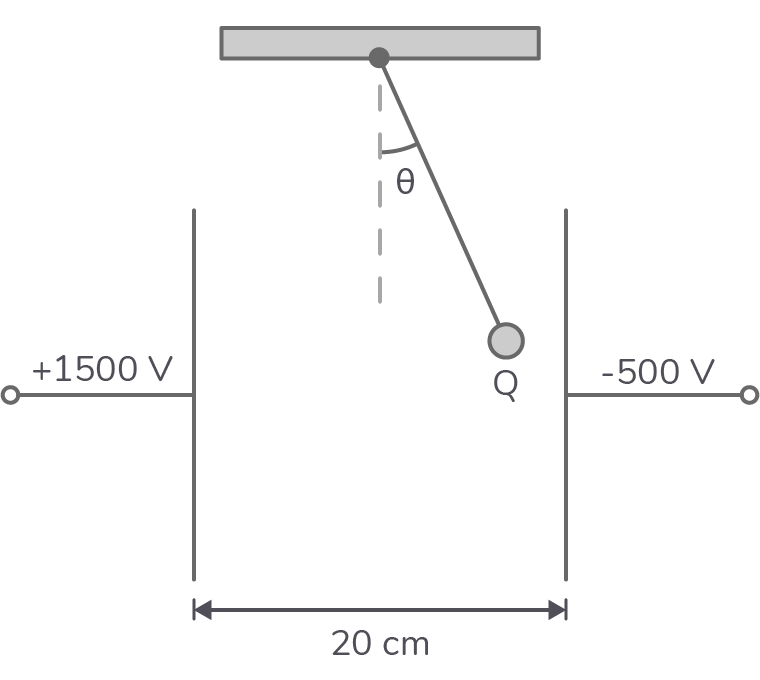
Draw the electric field between the two metal plates.
State the polarity of the charge Q.
Calculate the electric field strength between the metal plates.
The mass of the charge Q is 2 g.
The angle between the thread and vertical is 27°.
Calculate the charge of Q.
The plates are moved closer together and the potential difference between the plates is increased slowly to 4 kV.
Explain the effect that this has on the deflection of the ball and explain why the ball begins oscillating between the two plates.
The diagram below shows two parallel metal plates of length 10 cm.
A potential difference is applied across the plates.
Draw field lines on the diagram below to show the electric field between the two metal plates.
The plates are separated by 20 cm.
Calculate the electric field strength between the plates.
An electron enters the electric field half way between the plates, travelling at 0.8c, where c is the speed of light in a vacuum.
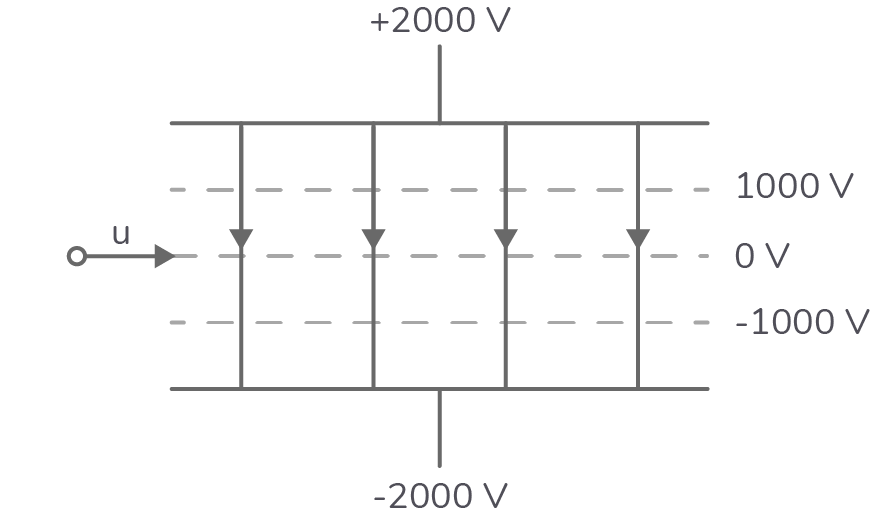
Calculate the acceleration of the electron in the vertical direction due to the electric field.
Calculate the vertical displacement of the electron while it is in the field.
This question is about electric fields.
Define electric potential at a point in an electric field.
Points X, Y and Z are points in the electric field of charge Q.
The electric potential at point Y is 9 V.
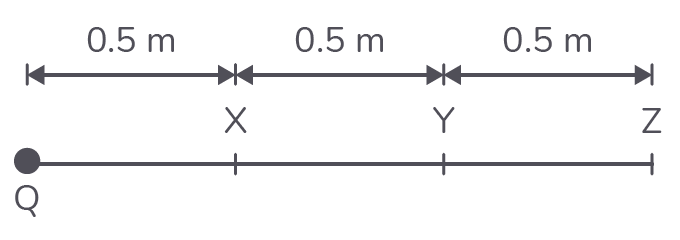
Calculate the charge of Q.
A +1 nC charge is placed at Z.
Calculate the force of repulsion between the two charges.
The 1 nC charge at Z is brought to point X.
Calculate the work done on the 1 nC in moving it from point Z to point X.
A charged particle is held at rest 20 cm above a uniform electric field.
The particle has a charge of - 1 x 10⁻⁶ C.
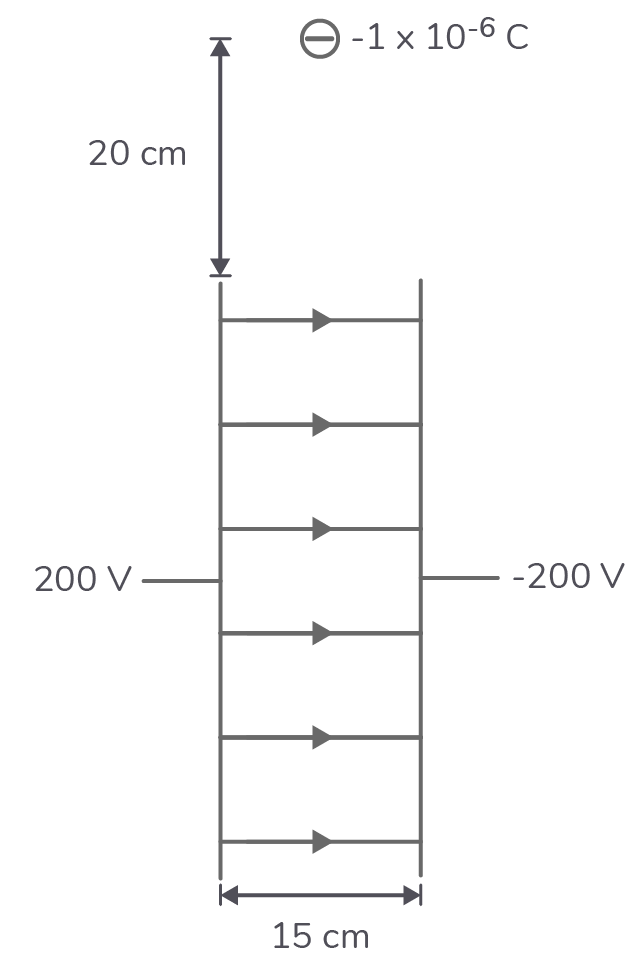
The charged particle is released and it falls through the electric field.
Calculate the speed of the charged particle as it enters the electric field.
Calculate the electric field strength between the two metal plates.
The charged particle enters the electric field at the midpoint between the two plates.
Draw the path of the charged particle on the diagram.
The mass of the charged particle is 0.6 grams.
Calculate the vertical distance travelled by the charged particle from when it is released to when it touches the metal plate.
Two particles are held at rest in a uniform electric field. The electric field strength is 2,500 V m-1.
Particle X is uncharged.
Particle Y has a charge of +1 C, and a mass of 75 g.
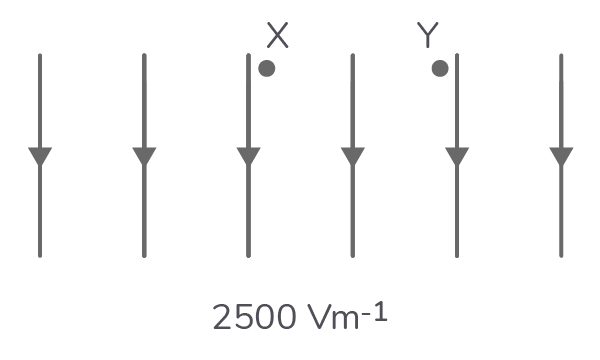
State the feature of the diagram above that shows the electric field is uniform.
Both particles are released from rest and they fall through the electric field.
State the acceleration of particle X.
Calculate the acceleration of particle Y.
Both particles fall a distance of 10 m before hitting the ground.
Calculate how the time taken between the two particles hitting the ground.