Radioactive Decay - exam practice
Radioactive Decay
Question 1 of 9
A teacher is comparing the activity of 3 different radioactive sources.
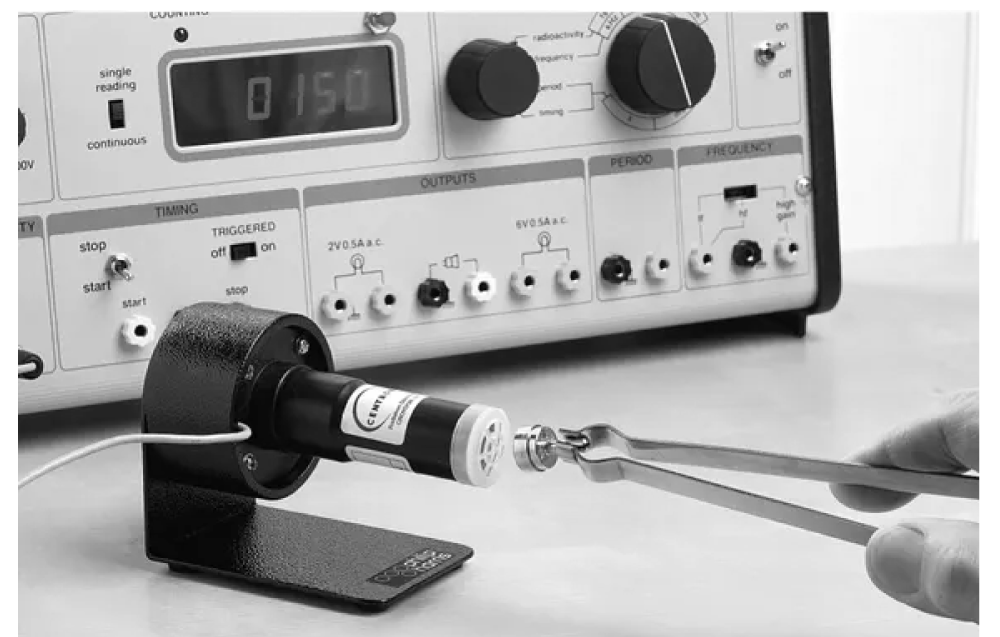
State the name of the piece of equipment used to measure ionising radiation.
The teacher holds the radioactive source using tongs instead of their bare hands.
Describe another precaution the teacher should take when using radioactive sources.
Describe how the teacher can use the piece of equipment to compare the corrected count rate of three different sources.
State one control variable for the teacher's demonstration.
An alpha particle is emitted from one of the sources with a speed of 1.2 x 10⁷ ms-1.
The alpha particle travels 1.3 cm in air before being stopped.
Calculate the average force on the alpha particle as it is stopped by the air.
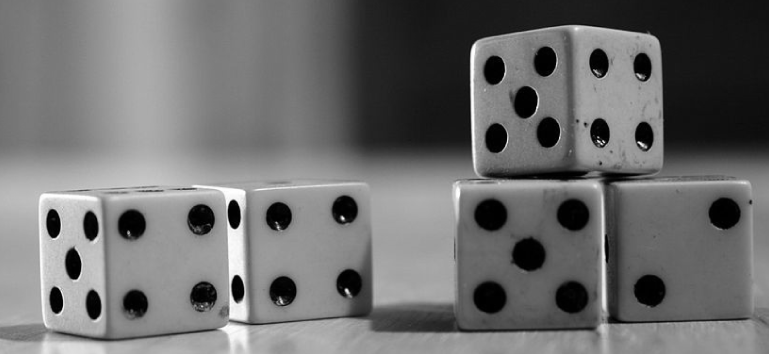
Dice can be used to model radioactive decay.
Explain what is meant by the random nature of radioactive decay.
Explain what is meant by the term half-life.
The student's method is below.
- Roll 50 dice.
- Remove any dice that land with a 1 face up.
- Record the number of dice remaining.
- Roll the remaining dice and repeat steps 2 and 3 until all dice have been removed.
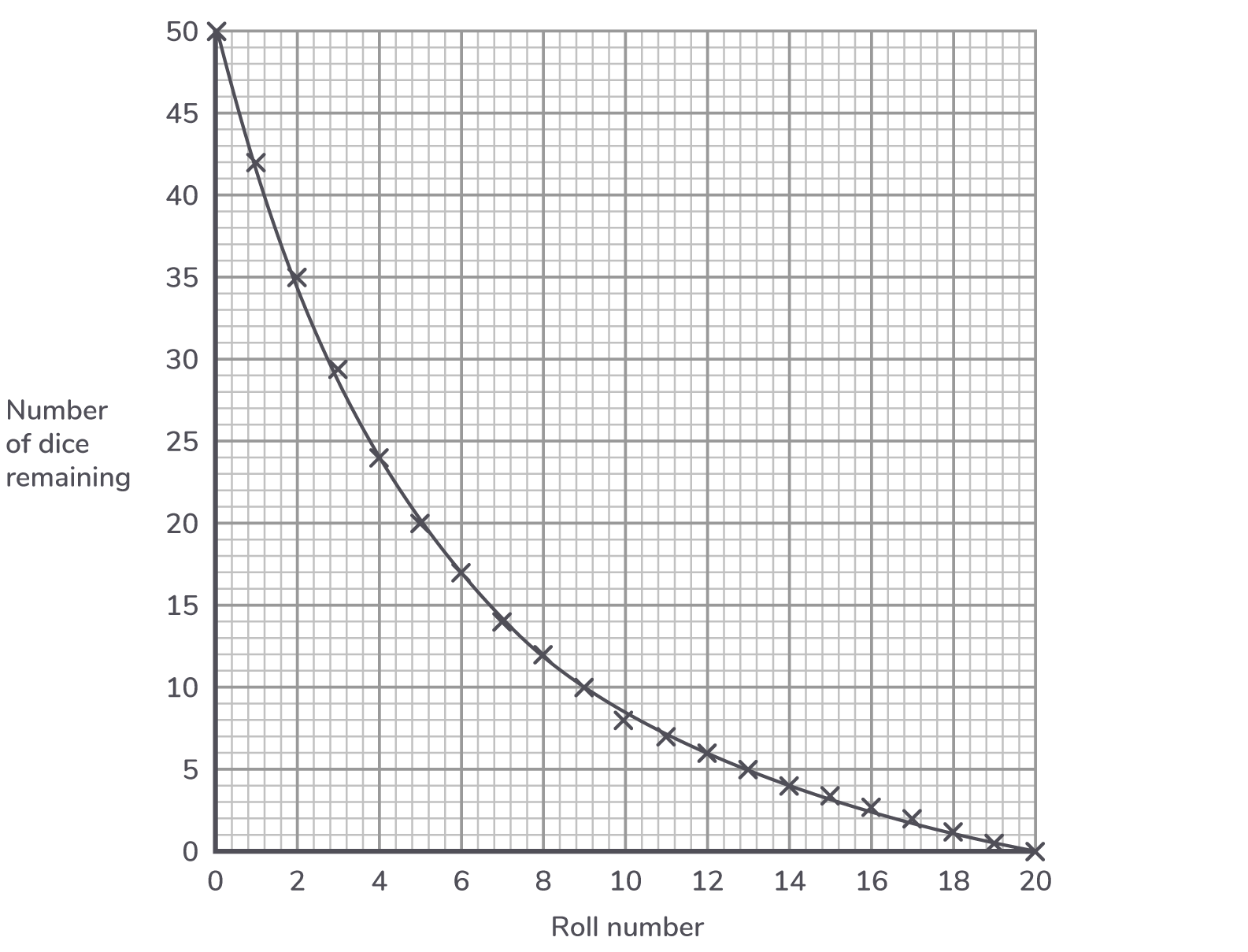
The student plotted a graph of roll number vs number of dice remaining.
Use the graph to identify the half-life of the dice.
A student repeats the experiment with 200 dice.
Estimate how many dice they would expect to have remaining after 12 rolls.
Scientists can estimate the age of historical artefacts by using carbon dating.
Carbon dating relies on the calculations using the half-life of carbon-14.
Explain what is meant by the term half-life.
The atomic number of carbon-14 is 6.
Calculate the number of neutrons in carbon-14.
A scientist has a table of results showing the percentage of a sample of carbon-14 remaining.
Plot the percentage of sample remaining against time.
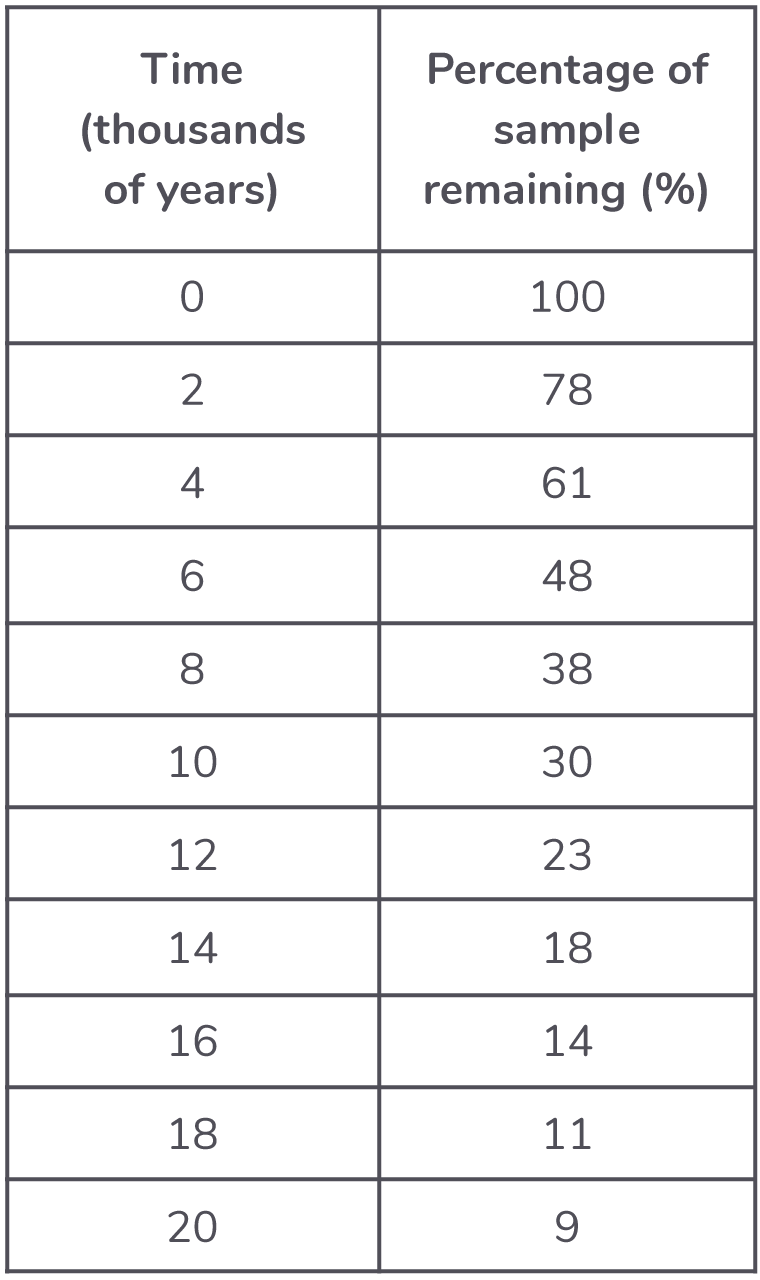
State the half-life of carbon-14.
The scientist is asked to identify the age of a wooden artefact.
A living sample of carbon-14 has an activity of 250 Bq.
A sample with the same mass as the living sample is taken and the activity is measured. The activity of the sample taken is 26 Bq.
Calculate the age of the wooden artefact.
Explain why it is impossible to age fossils using carbon dating.
Alpha, beta and gamma are types of nuclear radiation.
Draw a line from each type of radiation to what it is made from.
A teacher is demonstrating the penetration ability of alpha, beta and gamma radiation.
Complete the table below to show which materials absorb each type of radiation.
Describe how the teacher would know if the alpha, beta, or gamma radiation had been absorbed by the materials above.
Give two safety precautions the teacher should take when using radioactive sources.
Radium is a radioactive isotope which emits alpha particles when it decays.
Describe the structure of an alpha particle.
Radium decays to form an isotope of radon and an alpha particle.
Complete the decay equation below to show this decay.
Explain why it would be dangerous to ingest alpha radiation.
Smoke alarms in houses contain a source of alpha radiation.
Explain why it is safe to have an alpha emitter in a smoke alarm.
This question is about radioactive isotopes.
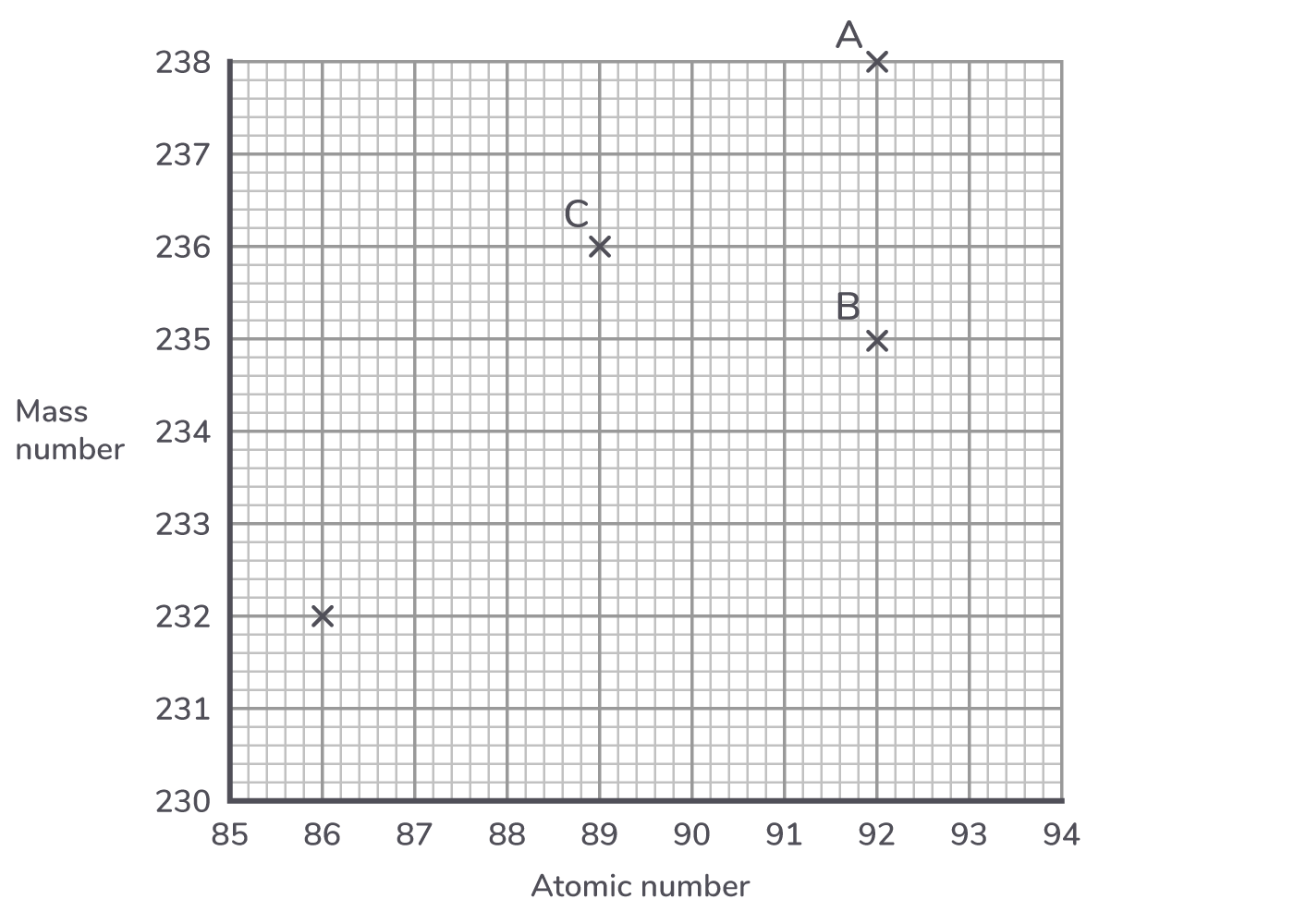
Explain what is meant by the term isotope.
State which two letters are isotopes of Uranium.
State which isotope has 147 neutrons.
Carbon-14 is a radioactive isotope which decays via beta emission.
Complete the decay equation below to show this decay.
Alpha, beta and gamma are all forms of ionising radiation.
This question is about the properties of alpha, beta and gamma.
Complete the diagram by putting one tick in each row.
Gamma radiation is used to irradiate fruit.
Explain why it is safe to eat fruit that has been irradiated with gamma rays.
Explain the hazards of ionising radiation entering the body.
Carbon-14 is a radioactive isotope of Carbon with a half life of 5,700 years.
State what is meant by an isotope.
Explain what is meant by the random nature of radioactive decay.
Show that the decay constant of Carbon-14 is approximately 3.9 x 10⁻¹² s-1.
A sample is taken from a wooden artefact and the activity is measured to be 80 Bq.
A sample of living wood has an activity of 250 Bq.
Calculate the age of the artefact in seconds.
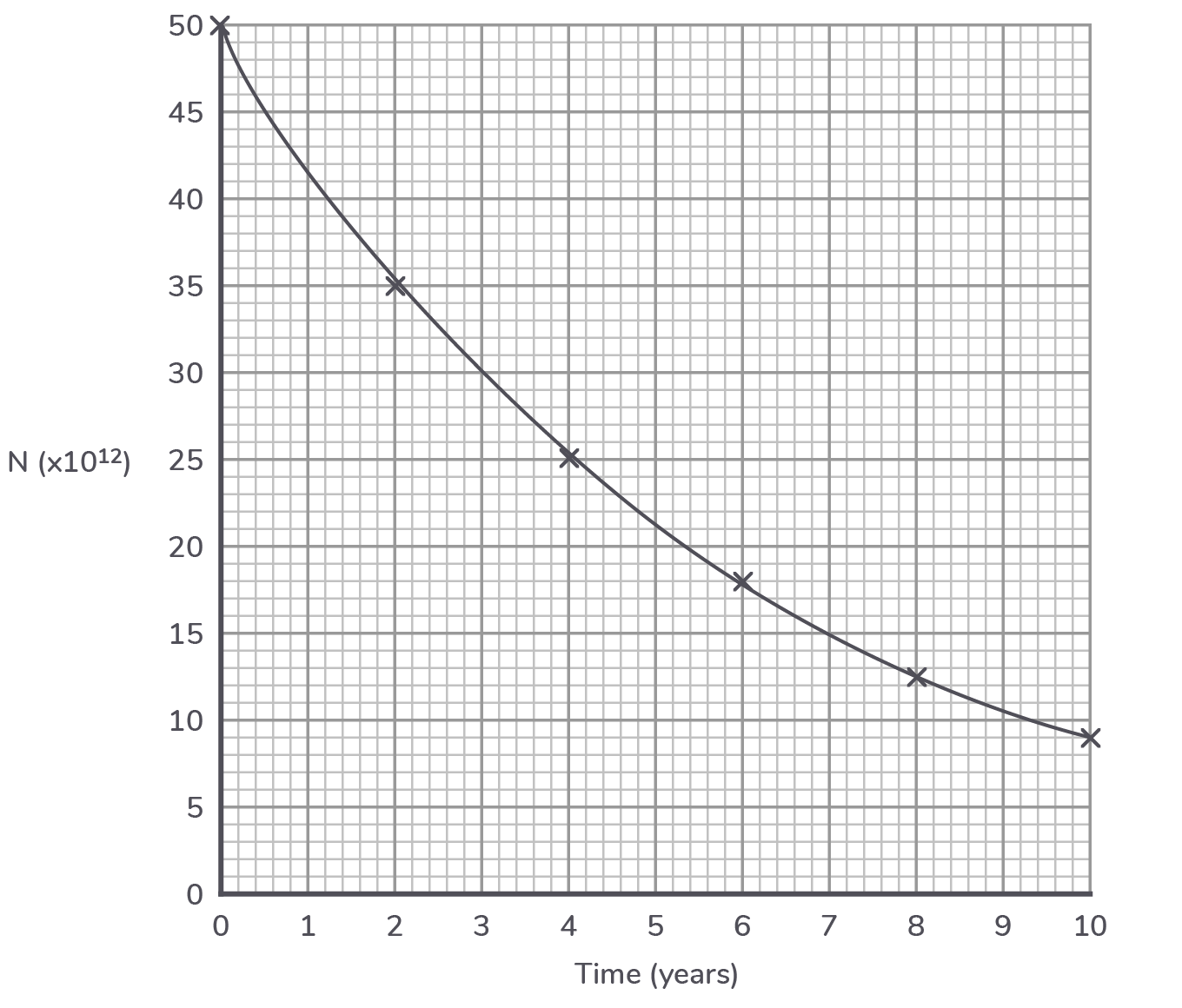
The graph below shows how the number of radioactive nuclei in a sample varies with time.
State what is meant by the random nature of radioactive decay.
State the half life of the radioactive sample.
Calculate the decay constant of the radioactive sample.
Calculate the activity of the radioactive sample after 15 years.