Alpha, Beta, Gamma - exam practice
Alpha, Beta, Gamma
Question 1 of 9
1 of 9
Which statement about alpha, beta and gamma radiation is correct?
Question 2 of 9
2 of 9
A radioactive nucleus emits a β− particle then an α particle and finally another β− particle. The final nuclide is
Question 3 of 9
3 of 9
The diagram shows an area of 0.10 m2 normal to a line connecting it to a point source of
gamma radiation. The source emits photons uniformly in all directions.
The area and the source are separated by a distance of 2.0 m.
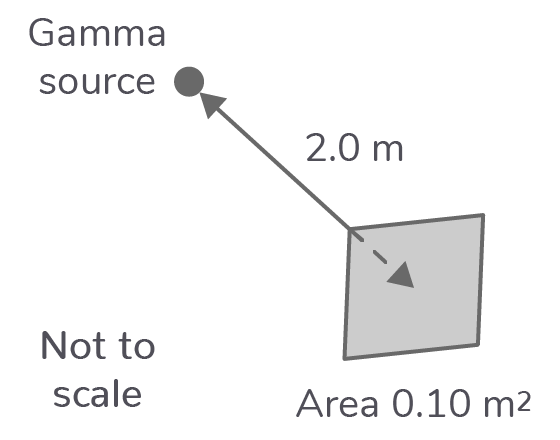
The source emits 5,000 gamma photons per second.
How many photons pass through the area every second?
Question 4 of 9
4 of 9
When a small radioactive source is placed in a cloud chamber, straight tracks about 4 cm long are observed. The same source is placed 10 cm from a Geiger tube and a count rate is detected. When a sheet of aluminium 5 mm thick is placed between the source and the Geiger tube the count rate falls to the background count rate.
Which types of radiation are emitted by the source?
Question 5 of 9
5 of 9
The first artificial radioactive substance was made by bombarding aluminium, with alpha particles. This produced an unstable isotope of phosphorus.
What was the by-product of this reaction?
Question 6 of 9
6 of 9
Which statement about nuclei is correct?
Question 7 of 9
7 of 9
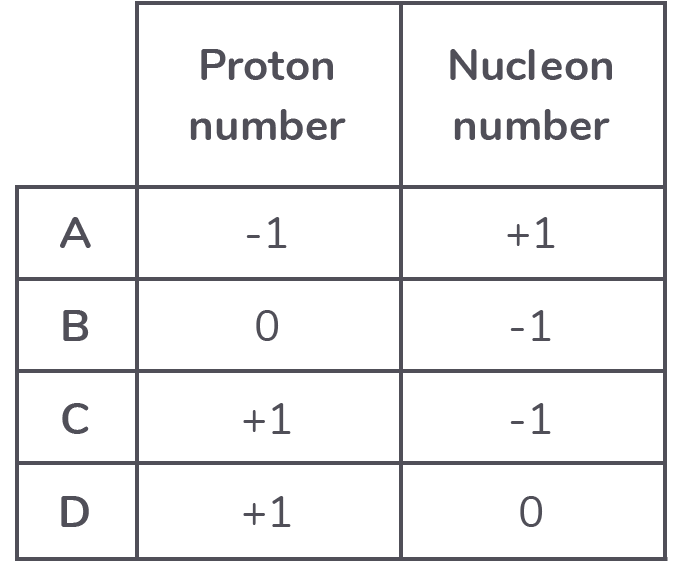
An atomic nucleus emits a β-particle.
What change does this cause to the proton number and the nucleon number of the nucleus?
Question 8 of 9
8 of 9
It was once thought that the mass of an atom is spread uniformly through the volume of the atom.
When α-particles are directed at a piece of gold foil, the results led scientists to believe instead that nearly all the mass of the gold atom is concentrated at a point inside the atom.
Which effect is possible onlyif nearly all the mass of the gold atom is concentrated at a point?
Question 9 of 9
9 of 9
When α-particles are fired at a thin metal foil, most of the particles pass straight through but a few are deflected by a large angle.
Which change would increase the proportion of α-particles deflected by a large angle?