2.7 - Momentum
- 1
Defining linear momentum and how to calculate it
- 2
The principle of conservation of momentum
- 3
Applying conservation of momentum to solve collision problems
- 4
Distinguishing between elastic and inelastic collisions
What is momentum?
Momentum is a vector quantity defined as the product of mass and velocity.
Here's the momentum equation:
Where:
- p = momentum (kg m s-1)
- m = object's mass (kg)
- v = velocity (m s-1)
Conservation of momentum
Momentum is always conserved in a closed system without external forces. This means the total momentum of all objects before an interaction is equal to their total momentum after the interaction.
Using this principle, we can calculate unknown velocities after collisions.
Worked example: Applying the principle of conservation of momentum
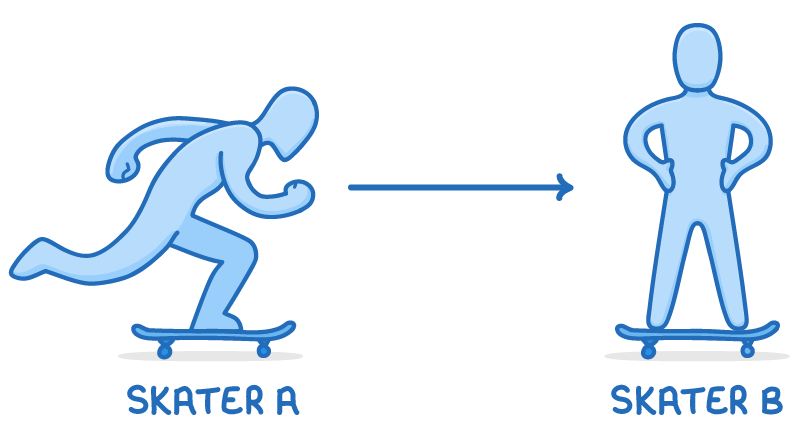
Skater A has a mass of 75 kg and is moving at 4 m s^-1^ collides with Skater B, who is stationary. Skater B has a mass of 50 kg. They stick together after the collision. Calculate their final velocity using momentum conservation.
Step 1: Calculate total initial momentum
Momentum of skater A:
m = 75 kg
v = 4 m s^-1^
p = ?
p = m x v
p = 75 x 4 = 300 kg m s^-1^
Momentum of skater B:
Skater B is stationary so their initial momentum = 0 kg m s-1
Total momentum before:
Total momentum = 300 kg m s-1
Step 2: Calculate final velocity
p = 300 kg m s^-1^
m = 75 + 50 = 125 kg
Elastic and inelastic collisions
Collisions are categorised as:
- Elastic - where kinetic energy is conserved, and there's no energy loss to heat or sound.
- Inelastic - where some kinetic energy is converted into other forms, like heat or sound.
Momentum is conserved in both types of collisions.
To determine the type of collision, compare the kinetic energy before and after the event.