10.3 - Hubble's Law & Age Of The Universe
- 1
The historical belief in a static, infinite universe
- 2
Edwin Hubble's discovery of galactic red shift indicating an expanding universe
- 3
Definitions of key concepts: recessional velocity, Hubble's law, and Hubble's constant
- 4
The direct correlation between a galaxy's recessional velocity and its distance from Earth
- 5
Applying Hubble's law to compute recessional velocities of galaxies
- 6
Estimating the universe's age using the Hubble constant (H0)
The static universe
For many years, the prevailing belief among cosmologists was that the universe had always existed and would always exist, essentially unchanged, in both space and time. This notion of an infinite, static universe was considered necessary for its overall stability.
Galactic red shift signifies recessional velocity
The paradigm shifted with Edwin Hubble's observations of the light spectrum from distant galaxies. He noted that the spectral lines of these galaxies were displaced towards the red end of the spectrum, a phenomenon not observed in the few galaxies close to our own.
This red shift is indicative of the galaxies' recessional velocity - their speed as they move away from us. Interestingly, a few nearby galaxies exhibit a blue shift, indicating they are moving closer due to gravitational attraction.
Recessional velocity is proportional to distance
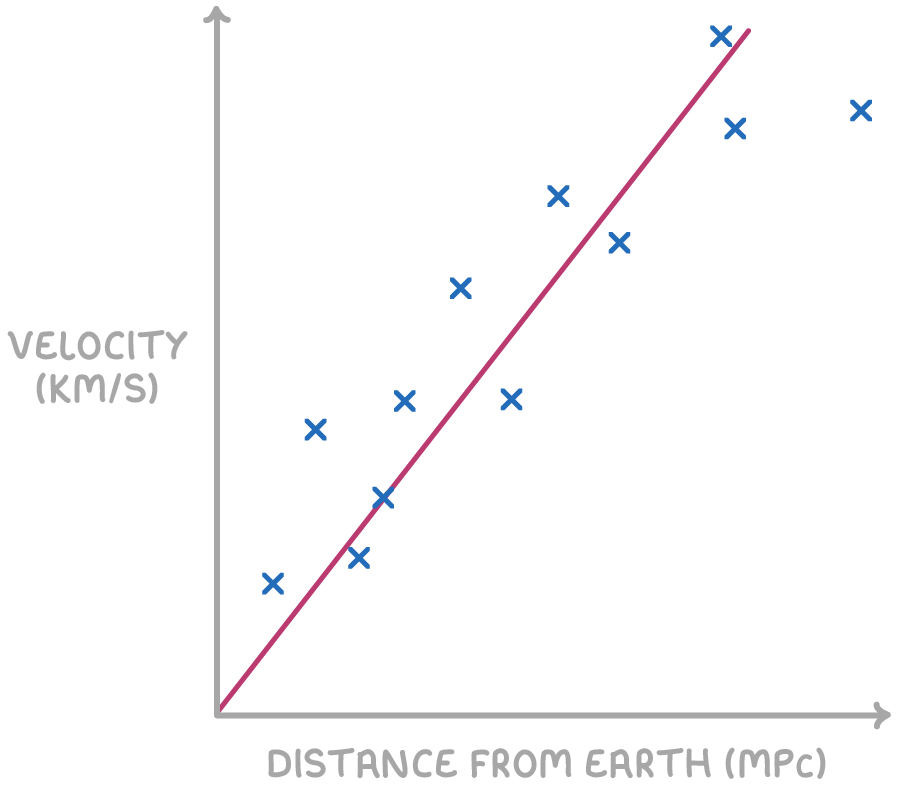
Hubble's meticulous plotting of recessional velocity against the distance of numerous galaxies revealed a proportional relationship.
This observation led to the conclusion that the universe is expanding: galaxies further away from us are moving away faster than those closer to us.
Hubble's Law
The formula encapsulating this relationship is known as Hubble's law:
Where:
- v = recessional velocity (km s-1)
- d = distance to the galaxy (Mpc)
- H0 = Hubble constant (km s-1 Mpc)-1)
Worked example - Calculating recessional velocity using Hubble's law
Calculate the recessional velocity of a galaxy located 50 Mpc away, using a Hubble constant of 72 km s-1 Mpc-1.
Step 1: Formula
v = H0 d
Step 2: Substitution and correct evaluation
v = 72 x 50 = 3,600 km s-1
Estimating the age of the Universe
The universe's age can be inferred by examining its expansion rate, represented by the Hubble constant (H0).
The formula given below provides a simplified method to estimate the age of the universe:
Where:
- t = age of the universe (s)
- H0 = Hubble constant (s-1)
This method assumes a constant expansion rate, which is a simplification. The actual expansion rate has varied over time, and precise knowledge of H0 is elusive, making the universe's age subject to estimation.
Worked example - Calculating the age of the universe
Given that H0 = 65 km s-1 MPc-1, estimate the age of the universe.
Step 1: Formula
Step 2: Convert km s-1 MPc-1 to s-1
1 parsec = 3.08 x 10¹⁶ m
65 km s -1 MPc-1 = 2.11 x 10⁻¹⁸ s-1
Step 3: Substitution and correct evaluation