Astrophysics & Cosmology - exam practice
Astrophysics & Cosmology
Question 1 of 10
This question is about the evolution of stars.
Stars begin their life cycle as a stellar nebula.
Describe what a nebula is.
State the name of the stage of stellar evolution that our Sun is in.
During this stage, the star is stable.
Explain why the star is stable during this stage of its evolution.
Describe what will happen to our Sun between this stage and the end of its stellar life cycle.
Rigel is a blue star in the constellation of Orion.
The table below shows some data about Rigel and our Sun.
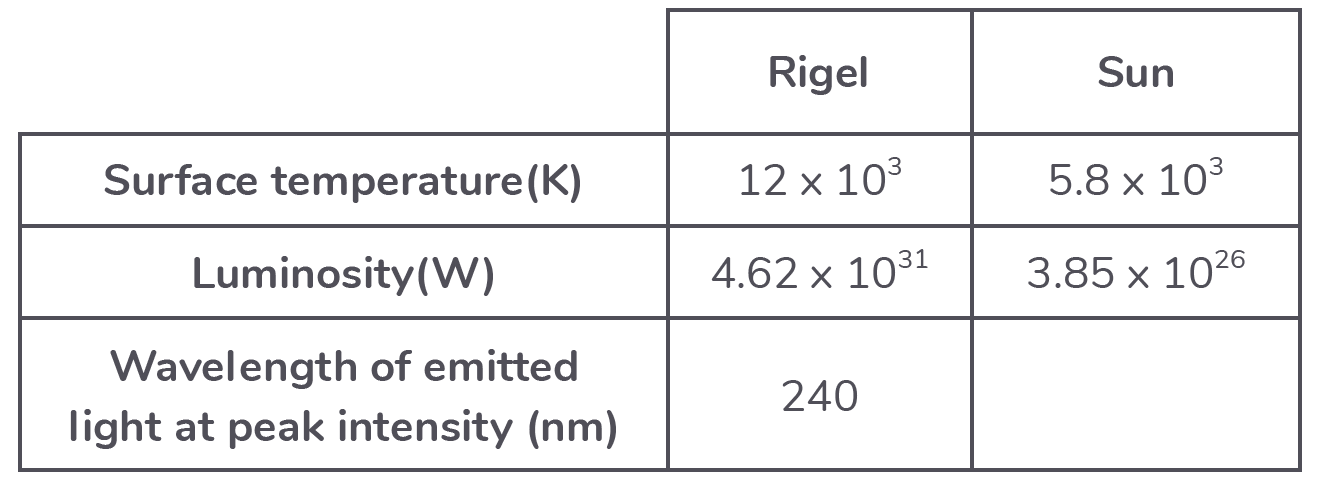
Show that the wavelength of emitted light at peak intensity for the Sun is around 500 nm.
Rigel is a star that is much larger than the Sun.
Describe the evolution of Rigel through its stellar life cycle.
State the name of the gas fused during the early stages of the stellar life cycle.
Rigel has a surface temperature of 12,000 K and a luminosity of 4.62 x 1031 W.
Calculate the radius of Rigel.
This question is about the life cycle of our Sun.
Fill in the blanks to name the stages in the evolution of our Sun.
Explain why the Sun is described as stable during the main sequence phase.
Stars undergo nuclear fusion during the main sequence phase of their life cycle.
Describe the process of nuclear fusion in stars.
The equation below shows the fusion of deuterium and tritium in the core of a star.
Calculate the energy released by the fusion of deuterium and tritium.
This question is about the life cycle of a star with a similar mass to our Sun.
Describe the evolution of a star with a mass similar to our Sun.
Calculate the luminosity of a star which has a surface temperature of 9000 K and a diameter of 15.3 x 10⁶ m.
Sketch the shape of the graph to show how intensity varies with wavelength for a star of surface temperature 9,000 K.
This question is about the Hertzsprung-Russell diagram (HR diagram) and the classification of stars.
Stars can be classified by their colour.
Describe the relationship between the temperature and the colour of a star.
The diagram below shows the axes for a HR diagram.
Complete the diagram by adding the main sequence, red giant and white dwarf regions.
This question is about the classification of stars and the HR diagram.
Explain why the Moon does not appear on the HR diagram.
A student has drawn a HR diagram below.
Mark the following on the students diagram.
- A main sequence star much larger than the sun. Label this star A.
- A star with the lower temperature than the Sun but much greater brightness. Label this star B.
- A star with the same temperature as the sun but lower brightness when compared at the same distance from Earth. Label this star C.
- A white dwarf star. Label this star D.
This question is about the work of Edwin Hubble.
Explain how Hubble could tell that all galaxies were moving away from Earth.
The table below shows some of Hubble's data.
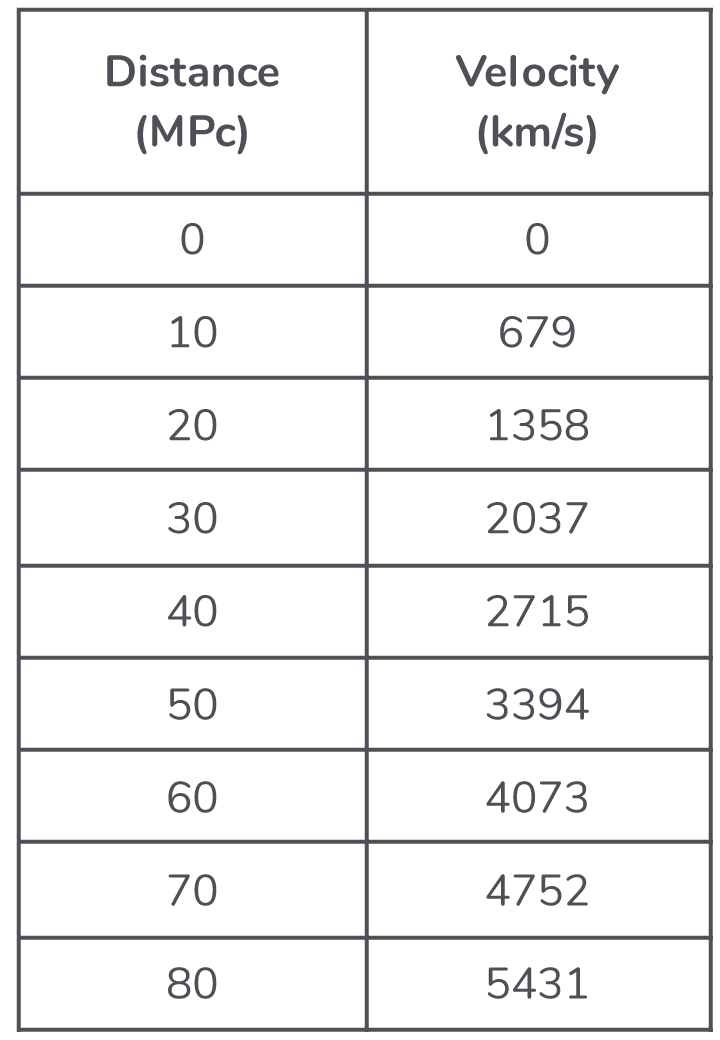
Plot a graph of distance against velocity of galaxy.
Describe the relationship shown by the graph.
A galaxy is 35 MPc away from Earth.
Use the graph to determine the velocity of this galaxy.
This question is about the Hubble telescope.
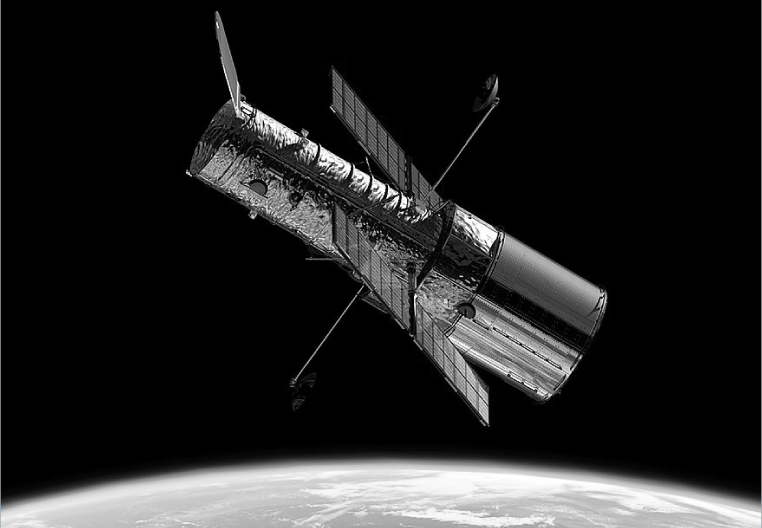
The Hubble space telescope is in orbit around the Earth.
State the name of the force holding the telescope in orbit.
The Hubble space telescope detects light from distant galaxies.
Explain how the light from these galaxies provides evidence for the big bang.
Define the Hubble constant.
The velocity of a galaxy was 4,073 km/s.
Calculate the distance of the galaxy from Earth. Give your answer in standard form in km.
The Hubble constant has a value of 2.2 x 10⁻¹⁸ s-1.
This question is about the expansion of the universe.
The diagram below shows light emitted from 4 distant galaxies compared to the same light here on earth (laboratory source).
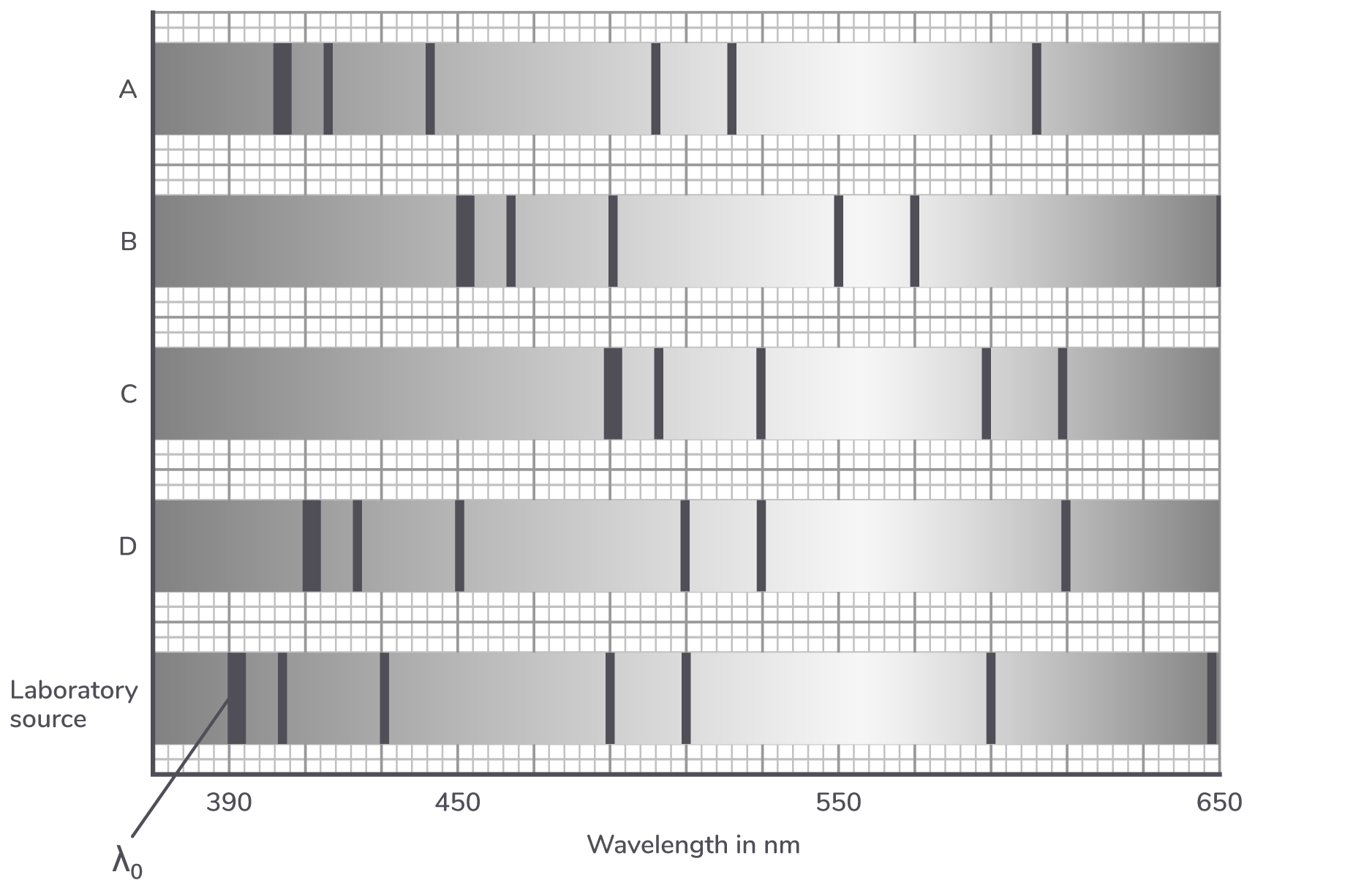
Explain how the image above provides evidence for the expansion of the universe.
Which galaxy is the furthest away from Earth?
State the equation linking change in wavelength, reference wavelength, recessional speed of galaxy, and the speed of light.
Calculate the recessional speed of galaxy B.
The reference wavelength is 390 nm.
This question is about the light emitted from distant galaxies.
Describe how light from distant galaxies provides evidence of the universe expanding.
Andromeda is a galaxy which is moving towards Earth.
Explain how the light form Andromeda appears to astronomers on Earth.
The light received from a distant galaxy has a wavelength of 430 nm. An astronomer is using the light with a reference wavelength of 390 nm.
Calculate the speed of the distant galaxy.
The speed of light is 3 x 10⁸ m/s.