Circular Motion - exam practice
Circular Motion
Question 1 of 7
A car is travelling around a circular track of radius 50 m at a constant speed of 10 m s-1.
Calculate the centripetal acceleration of the car.
Calculate the centripetal force acting on the car if its mass is 1,000 kg.
Describe what provides the centripetal force acting on the car.
The driver accelerates up to 20 ms-1.
Describe the effect of travelling at 20 ms-1 on the required centripetal force.
In the current weather conditions, the maximum frictional force between the tyres and the road is 2,250 N.
Deduce whether the car travelling at 20 ms-1 will slip.
A ball attached to a string is spun in a horizontal circular motion with a radius of 1.5 m.
The ball has a constant speed of 8 ms-1.
Calculate the centripetal acceleration of the 200 g ball.
The maximum tension force the string can withstand before snapping is 50 N.
Deduce whether the string will snap when the ball is travelling at 8 ms-1.
The ball is now spun in a vertical circle.
Calculate the maximum speed the ball can travel before the string snaps.
The student gradually increases the speed of the ball until the string snaps.
Draw the trajectory of the ball on the diagram below.
A roller coaster car enters a vertical circular loop of radius 10 m at a speed of 20 ms-1.
State what provides the centripetal force on the roller coaster car at the top of the loop.
Calculate the minimum speed of the roller coaster car needed to complete the loop without falling.
A roller coaster car travels around the loop at 12 ms-1. The mass of the roller coaster car is 350 kg.
Calculate the reaction force of the track on car when it is at the bottom of the loop.
A spinning washing machine drum has a radius of 30 cm and rotates at 600 rpm.
Calculate the centripetal acceleration at the edge of the drum.
Calculate the force acting on a 0.5 kg object at the edge of the drum.
State what provides the centripetal force on the object.
An identical object is placed in a washing machine that spins at 1,200 rpm with a radius of 60 cm.
Describe how the centripetal force varies compared to the first washing machine.
A pendulum bob of mass 2 kg swings in a horizontal circle at the end of a string of length 2 m.
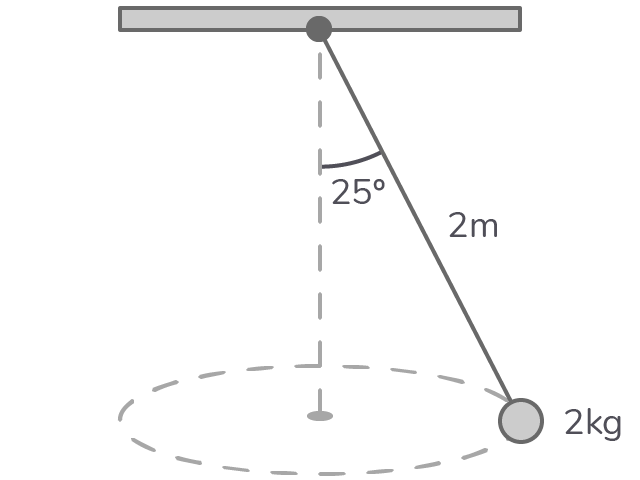
Calculate the radius of the circular path that the pendulum bob follows.
Calculate the tension in the string.
Calculate the linear speed of the pendulum bob.
A child of mass 40 kg sits 2 m from the centre of a merry-go-round rotating at 0.5 rev s-1.
Calculate the centripetal acceleration of the child.
Determine the minimum frictional force to prevent the child sliding outwards.
The maximum frictional force between the child and the merry-go-round is 950 N.
Calculate the maximum revolutions per minute possible without the child slipping.
The child moves closer to the centre of the merry-go-round.
Describe the effect on the size of the frictional force experienced by the child.
A car of mass 1,200 kg drives over a hump back bridge at a constant speed of 15 ms-1.
The bridge can be approximated as a circular ark with a radius of 80 m.
Calculate the centripetal acceleration of the car as it goes over the top of the bridge.
Calculate the maximum speed the car can travel over the bridge without losing contact with the surface.
Calculate the reaction force of the road on the car when travelling at 10 m s-1.