Particle Accelerators - exam practice
Particle Accelerators
Question 1 of 7
Radiotherapy machines contain a linear accelerator to accelerate electrons to high speeds.
Describe how electrons are produced by a filament.
The diagram below shows the configuration of a LINAC accelerator.
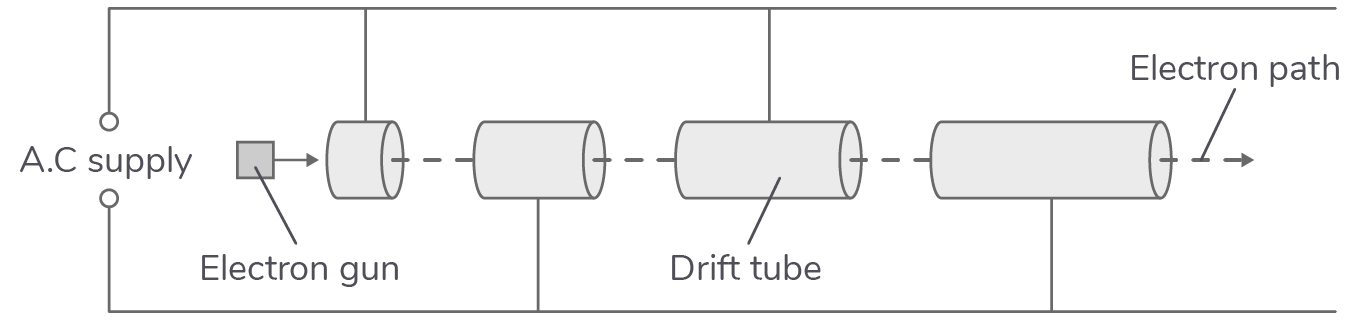
Explain why the drift tubes increase in length as the electron passes through the accelerator.
An electron enters the linac from an electron gun with a speed of 2.2 x 10^6^ m s^-1^.
The electron passes through 40 drift tubes.
The potential difference between adjacent drift tubes = 75 kV.
Calculate the energy of the electron as it leaves the last drift tube.
Linac accelerators are used to accelerate charged particles to high speeds.
One particle accelerator accelerates protons to energies of 160 MeV.
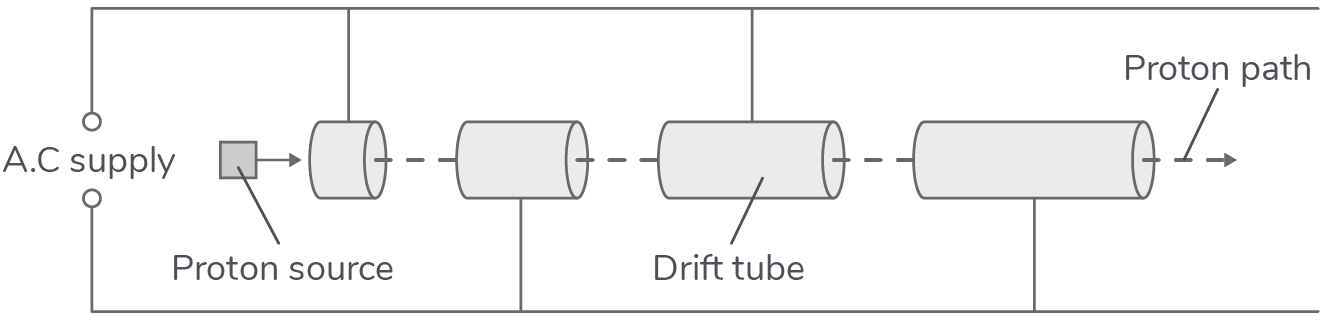
Explain how the linac accelerates the protons.
The alternating power supply has a frequency of 198 MHz.
Calculate the time period of the supply.
The diagram shows part of the path of a proton in the linac. Point A and B are at the centres of two successive gaps between drift tubes.
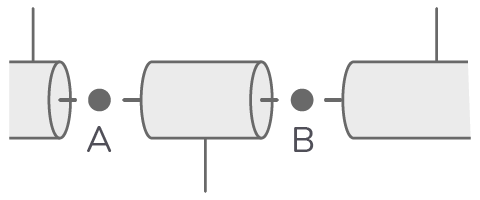
Calculate the distance between A and B if the average kinetic energy of the proton as it moves from A to B is 1.7 MeV.
A cyclotron has two D-shaped regions where the magnetic flux density is constant.
The D-shaped regions are separated by a small gap.
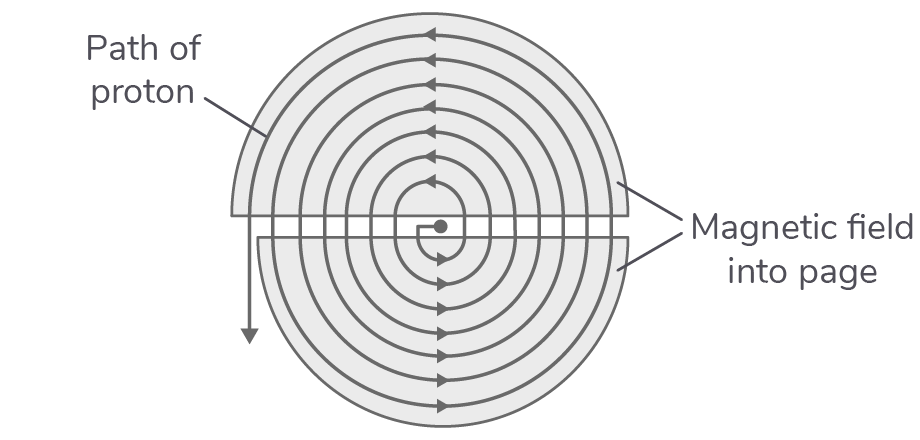
Explain how charged particles are accelerated across the gap between the two D-shaped regions.
Explain what happens to the speed of the protons as they travel through one of the D-shaped regions.
Derive an expression to show that the time taken by a proton to travel round one semi-circular path is independent of the radius of the path.
The radius of one of the D-shaped regions is 0.7 m and the magnetic flux density is 0.35 T.
Calculate the maximum kinetic energy of the proton in eV when it leaves the cyclotron.
Ignore any relativistic effects.
The two D-shaped regions are separated by 3 cm. The electric field strength between the two D-shaped regions is 1.917 x 10^5^ V m^-1^.
Show that the number of times the proton will cross the gap between the two D-shaped regions before leaving the cyclotron is approximately 500.
A cyclotron is used to accelerate a proton to high speeds using electric and magnetic fields.
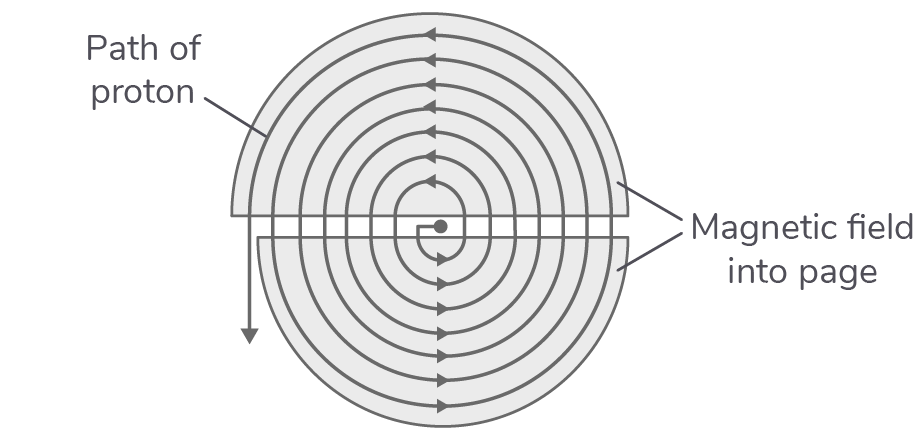
Describe how electric and magnetic fields are used in cyclotrons to accelerate protons to high speeds.
The peak potential difference of the alternating power supply is 10.0 kV.
The proton moves across the gap 1,400 times before leaving the cyclotron.
Calculate the energy in MeV of the proton as it leaves the cyclotron.
Derive an expression for the time t, for a particle of charge Q and mass m to complete a circular path in a uniform magnetic field of magnetic flux density B.
A charged particle is placed in a magnetic field.
State two situations in which the charged particle will experience no magnetic force when placed in a magnetic field.
A proton follows a spiral path in a cyclotron as it gains energy as shown by the diagram below.
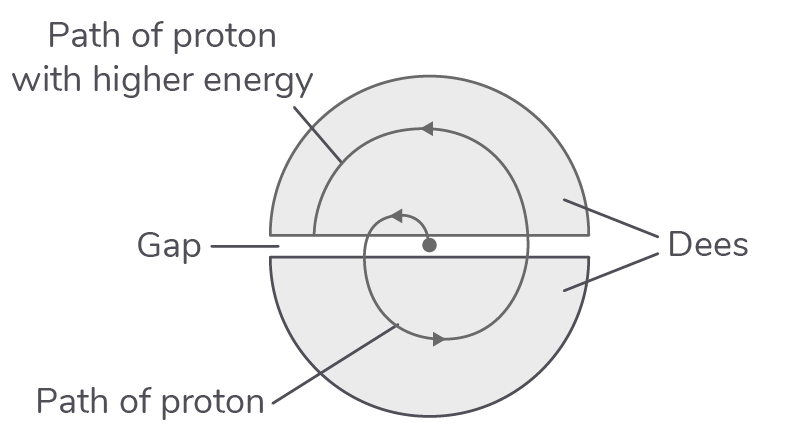
State the direction of the applied magnetic field which causes the proton to follow the path shown.
The magnetic field strength in the cyclotron is 0.6 T.
Calculate the speed of the proton when the radius of its path inside the dee is 250 mm.
Explain why the proton speed does not change while inside one of the dees.
Particle accelerators are used to accelerate subatomic particles to high velocities before colliding them into each other to reveal further details about their structure and behaviour.
Explain how electric fields are used to accelerate charged particles in a cyclotron.
Show that the number of revolutions completed per second, f, by the protons in a cyclotron is given by
Explain why the applied potential difference must be an alternating supply.
The image below shows the decay of a D^0^ meson into a positively charged kaon and a negatively charged pion.
Mark on the diagram the point at which the decay occurs.
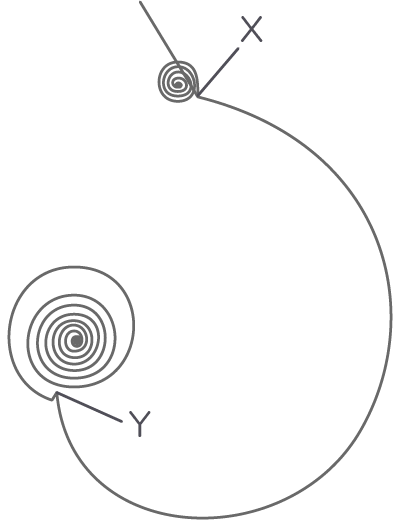
Charged particles leave tracks in a particle detector.
The image below shows tracks made in a particle detector.
Explain the role of a magnetic field in a particle detector.
Explain why charged particles spiral in a particle detector.
The magnetic field is directed out of the plane of the photograph.
State the charge on the particle which produced the path from X to Y.