Diffraction - exam practice
Diffraction
Question 1 of 3
A student is investigating the diffraction of light using a diffraction grating.
The student uses a diffraction grating with 600 lines per mm. The diffraction grating is placed 1.5 m from the screen and uses a laser with a wavelength of 500 nm.
Calculate the angle angle () for the second order maximum.
Calculate the maximum observable order using the diffraction grating in part a).
Explain with reference to path difference why the diffraction grating results in bright and dark spots of light on the screen.
A student is investigating the properties of waves using a microwave transmitter, receiver and a metal sheet with a variable width slit.
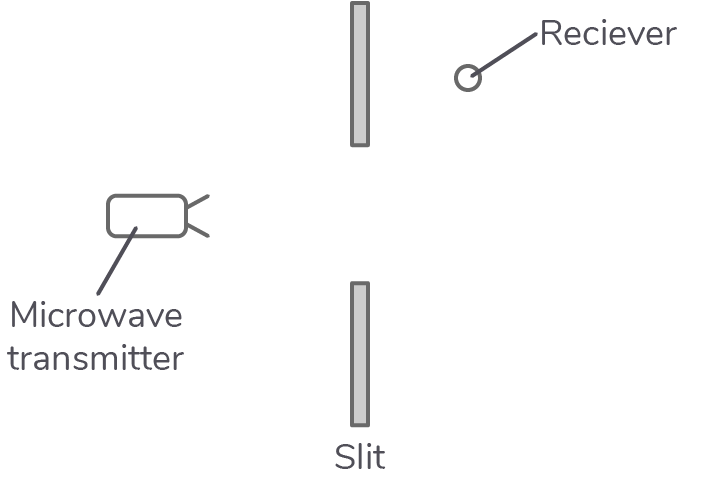
The microwaves the student uses has a frequency of 11 GHz.
Calculate the wavelength of the microwaves.
The receives does not detect and microwaves in the position shown.
Explain how the student should modify the slit to enable the receiver to detect the microwaves.
Diffraction demonstrates the wave properties of electromagnetic waves.
State one experiment which demonstrates the particle properties of light.
A student wishes to identify how many lines per mm an unlabelled diffraction grating has.
The student shines a laser of wavelength 500 nm through the diffraction grating and records the angles for each observable order.
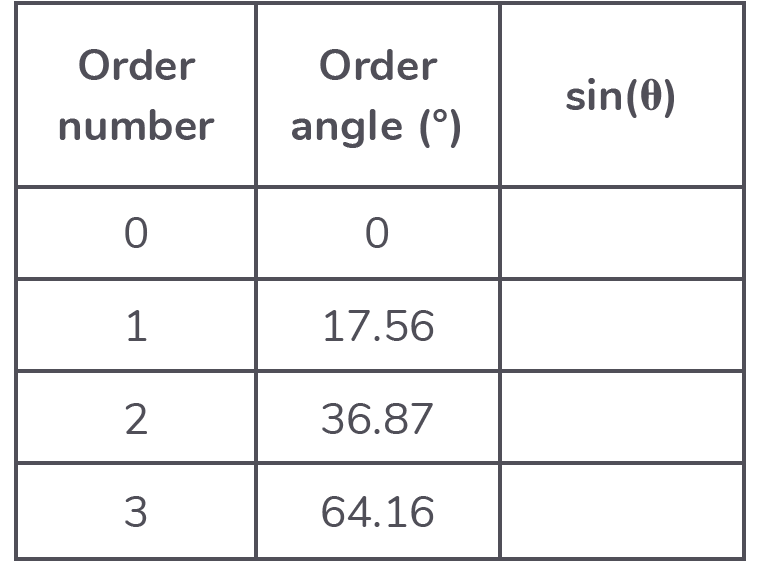
Plot a graph of order number against sin().
State what the gradient of the graph represents.
Calculate the number of lines per mm for the diffraction grating used in the student's experiment.