Circular Motion - exam practice
Circular Motion
Question 1 of 7
1 of 7
A particle travels in a straight line with speed v.
The particle slows down and changes direction. The new speed of the particle is .
The new velocity has a component of in the same direction as the initial path of the particle.
Through which angle has the particle turned?
Question 2 of 7
2 of 7
The diagram shows two points P and Q which lie 90° apart on a circle of radius r.
A positive point charge at the centre of the circle creates an electric field of magnitude E at both P
and Q.
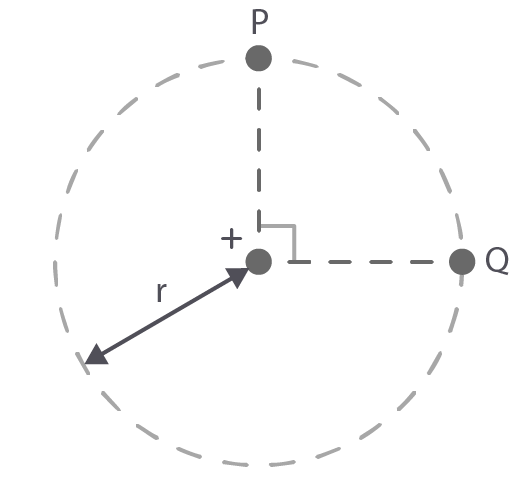
Which expression gives the work done in moving a unit positive charge from P to Q?
Question 3 of 7
3 of 7
A bob of mass 0.50 kg is suspended from the end of a piece of string 0.45 m long.
The bob is rotated in a vertical circle at a constant rate of 120 revolutions per minute.
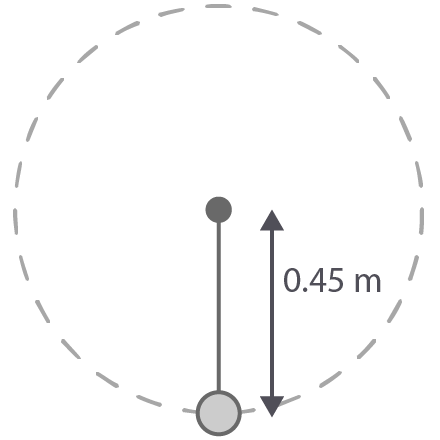
What is the tension in the string when the bob is at the bottom of the circle?
Question 4 of 7
4 of 7
A string passes through a smooth thin tube. Masses m and M are attached to the ends of the string. The tube is moved so that the mass m travels in a horizontalcircle of constant radius r and at constant speed v.
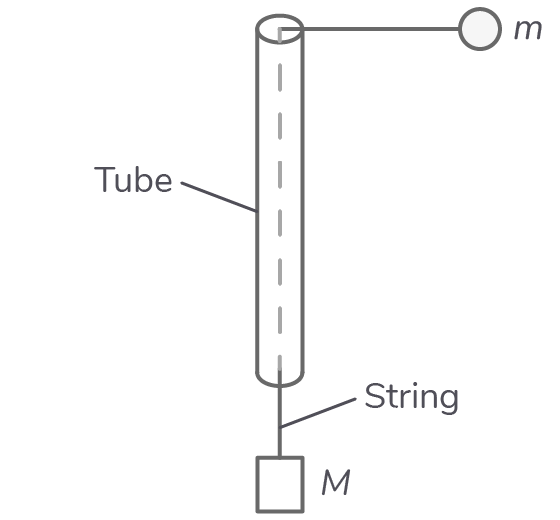
Which of the following expressions is equal to M ?
Question 5 of 7
5 of 7
What is the angular speed of a satellite in a geostationary orbit around the Earth?
Question 6 of 7
6 of 7
Satellites N and F have the same mass and are in circular orbits about the same planet.
The orbital radius of F is greater than that of N.
Which is greater for F than for N?
Question 7 of 7
7 of 7
An object of mass m moves in a circle of radius r. It completes n revolutions every second.
What is the kinetic energy of the object?