Electric Current - exam practice
Electric Current
Question 1 of 11
1 of 11
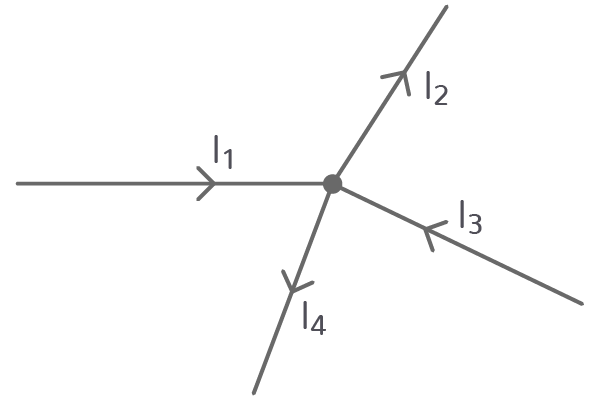
The diagram shows the conventional currents entering and leaving a junction in an electric circuit.
I1 , I2 , I3 and I4 are all positive.
Which statement is always true?
Question 2 of 11
2 of 11
A copper wire is connected across a cell. The conduction electrons within the copper wire move.
Which statement is correct about these electrons?
Question 3 of 11
3 of 11
One of Kirchhoff’s laws is stated below.
The sum of the currents entering a point in a circuit is equal to the sum of the currents leaving the same point.
Which quantity is conserved according to this law?
Question 4 of 11
4 of 11
The potential difference across a lamp is 2.5 V. The current in the lamp is 20 mA.
What is the energy dissipated in the lamp in 3.0 hours?
Question 5 of 11
5 of 11
The current in a wire is 20 mA.
How many electrons pass a point in the wire in 2 minutes?
Question 6 of 11
6 of 11
The diagram shows the currents in a set of wires.
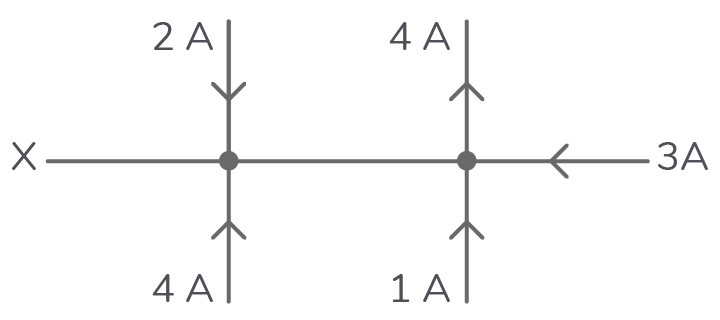
What is the magnitude of the current at X?
Question 7 of 11
7 of 11
A gas containing doubly-charged ions flows to give an electric current of 0.64 A
How many ions pass a point in 1.0 minute?
Question 8 of 11
8 of 11
A mobile phone operates at a constant power of 200 mW
It has a 3.7 V lithium-ion battery that has a charge capacity of 9,400 C
What is the time taken for the battery to discharge completely?
Question 9 of 11
9 of 11
Which electrical quantity has S.I. units ampere-second (As)?
Question 10 of 11
10 of 11
The diagram below shows the motion of positive and negative particles in a conducting solution.
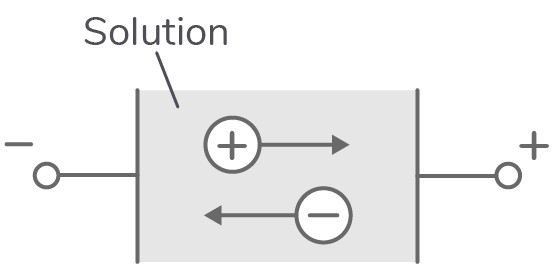
Which statement is correct?
Question 11 of 11
11 of 11
One million electrons travel between two points in a circuit.
The total energy gained by the electrons is 1.6 × 10⁻¹⁰ J.
What is the potential difference between the two points?