5.5 - Particles & Antiparticles
- 1
How every type of particle has a corresponding antiparticle
- 2
The properties of antiparticles compared to their normal particle counterparts
- 3
Pair production - creating particles and antiparticles from energy
- 4
Annihilation - particle-antiparticle pairs reverting to energy
Particles and antiparticles
For each type of particle, there is an antiparticle which has:
- Same mass and energy as the original particle
- Opposite charge, strangeness, lepton number and baryon number as the original particle
Examples of antiparticles:
| Particle | Antiparticle |
|---|---|
| electron | positron |
| proton | anti-proton |
| neutron | antineutron |
| neutrino | antineutrino |
Matter consists of normal particles, antimatter consists of antiparticles.
Pair production
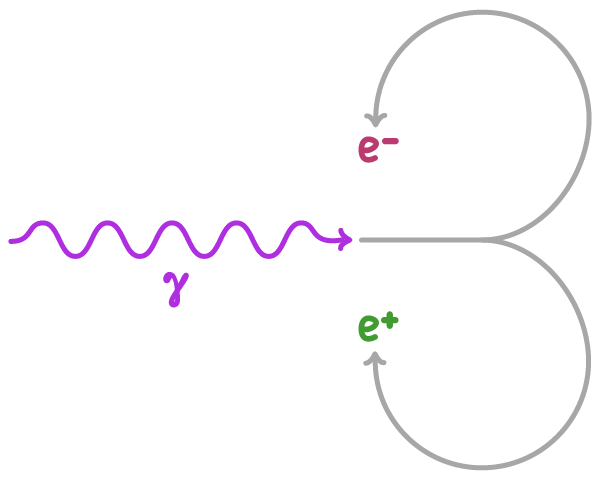
If a photon has sufficient energy, it can be converted into a particle and its corresponding antiparticle. This often happens near atomic nuclei.
This process is called pair production.
It must make a particle and matching antiparticle to conserve charge and mass-energy.
The minimum energy required to create the particle-antiparticle pair is equal to the rest energy of the particles produced (E)
Where:
Emin = minimum energy (J)
h = Planck's constant (6.63 x 10⁻³⁴ J s)
fmin = minimum frequency (Hz)
Eo = rest energy (J)
Worked example - Calculating threshold frequency
Calculate the minimum photon frequency which can produce a proton-antiproton pair through pair production.
Step 1: Formula
Step 2: Rearrangement
Step 3: Convert MeV into J
The rest energy of a proton is 938.257 MeV
to convert from MeV to J, multiply by 1.6 x 10⁻¹³
938.257 MeV = 1.501 x 10⁻¹⁰ J
Step 4: Substitution and correct evaluation
Annihilation
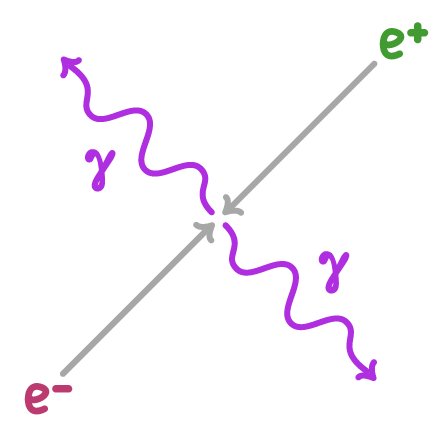
A particle meeting its antiparticle causes annihilation. Their mass-energy is converted into two equal energy photons.
Since antiparticles rapidly annihilate when encountering normal matter, they do not persist in everyday materials.
Each photon needs to have a minimum energy (Emin). The total energy of both photons (2Emin) must meet the rest energy of the particle and antiparticle (2Eo) for energy to be conserved.
2Emin = 2E0
Emin = E0
We can calculate the photon frequency using the relationship between photon energy, frequency and Planck's constant (E=hf):
Emin = hfmin = E0
Note: This is the minimum energy of the photons when the particle and antiparticle are stationary. If the particle and antiparticle are not initially stationary, the energy of each photon will exceed Emin.
Worked example 2 - Calculating photon frequency
A stationary electron annihilated with a positron, producing two equal energy photons. Calculate the frequency of the photons released.
Step 1: Formula
Emin = hf = E0
Step 2: Rearrangement
Step 3: Convert MeV to J
The rest energy of an electron is 0.510999 MeV.
To convert from MeV to J, multiply by 1.6 x 10⁻¹³
0.510999 MeV = 8.17598 x 10⁻¹⁴ J
Step 4: Substitution and correct evaluation