Nuclear Fission & Fusion - exam practice
Nuclear Fission & Fusion
Question 1 of 7
This question is about the fission of uranium-235.
Explain the process of nuclear fission.
The diagram shows a nuclear fission reactor.
Label the following parts on the diagram:
- control rod
- moderator
- fuel rod
- shielding
- reactor
Explain why the kinetic energy of neutrons is reduced in a thermal nuclear reactor.
One possible fission event is shown below.
State the number of neutrons released in this fission event.
Calculate the energy released in MeV from the fission reaction in part d).
This question is about nuclear fusion.
Explain the process of nuclear fusion.
State the conditions necessary for nuclear fusion to occur.
Explain why these conditions are needed for fusion to occur.
Scientists at Joint European Torus (JET) are trying to reproduce nuclear fusion on earth for electricity production.
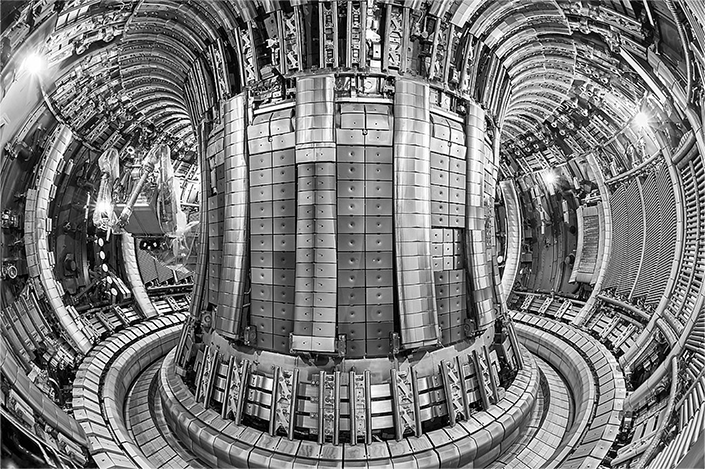
Explain why nuclear fusion is more desireable than nuclear fission.
It is difficult to achieve nuclear fusion on earth.
State the conditions required for nuclear fusion to occur.
Nuclear fusion naturally occurs in stars.
Describe what happens during nuclear fusion.
Nuclear fusion takes place in stars, producing huge amounts of energy.
During a single fusion reaction, deuterium fuses with tritium to form helium and a neutron.
Complete the nuclear equation for this process.
Explain why it is difficult to replicate the nuclear fusion of hydrogen on Earth.
Nuclear fission is widely used in nuclear power stations.
Compare the similarities and differences between nuclear fission and fusion.
This question is about nuclear fission power stations.
When U-235 absorbs a neutron, it becomes U-236, an isotope of uranium.
State what is meant by the term isotope.
Calculate the number of neutrons in .
The equation below shows a possible nuclear fission reaction.

Calculate the number of neutrons released by this fission reaction.
Some of the isotopes produced from the fission of uranium are highly radioactive.
Discuss how radioactive waste is disposed of and potential concerns.
One of the radioactive isotopes produced in a nuclear fission reactor is iodine-129.
Iodine-129 has a half-life of approximately 15 million years. A sample of Iodine-129 has an activity of 96 kBq.
Calculate how long it would take for the activity of the sample to drop to 3 kBq.
This question is about energy sources and their efficiencies.
A nuclear power station converts 35% of the energy from nuclear fission into energy which is transferred electrically through the National Grid. Fission reactions release 1000 MJ per second.
Calculate the power of the energy distributed.
During peak demand the fission reactor is required to provide a higher output.
Explain with reference to the parts of the nuclear reactor how the rate of fission could be increased to provide a higher output power.
The required output is 700 MW.
The nuclear fission power station converts 35% of the energy from fission into useful energy for transmission.
Calculate the energy released by fission reactions per second to meet this demand.
State two disadvantages of using nuclear fission power stations compared to solar farms.
State two advantages of using a solar panel farm compared to a coal-fired power station.
Uranium-235 is used as a source of fissionable fuel for nuclear power stations.
Describe the process of nuclear fission.
One possible pathway is for uranium to split into krypton and barium.
Complete the missing numbers in the equation for the fission of uranium.
Describe the purpose of the moderator in a nuclear fission power station.