Diffraction - Double Slit, & Diffraction Gratings - exam practice
Diffraction - Double Slit, & Diffraction Gratings
Question 1 of 5
A student is investigating the interference pattern produced by light as it passes through a single slit and then two narrow slits.
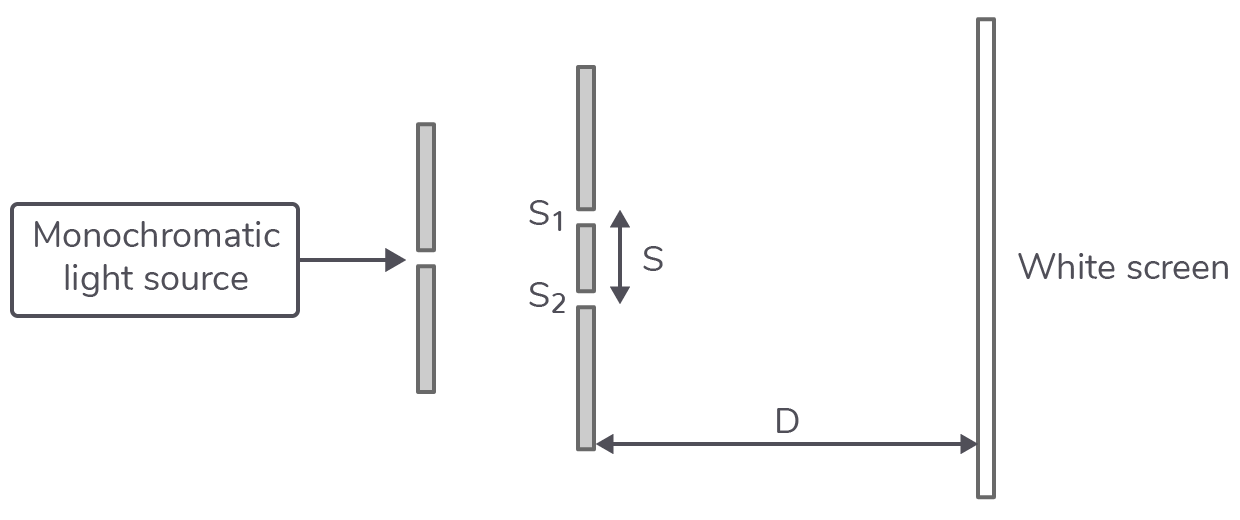
The student uses a monochromatic light source.
Explain what is meant by a monochromatic light source.
Describe the interference pattern that the student would observe on the white screen.
The student uses a laser of frequency 4.29 x 10¹⁴ Hz.
The distance between the double slits and the screen is 120 cm. The slit spacing is 0.50 mm.
Calculate the fringe spacing observed by the student.
Suggest one way the student could modify the setup to increase the fringe separation without changing the light source.
The monochromatic light source is replaced with a source of white light.
Describe the pattern now observed on the screen.
A student is investigating the diffraction of light using a diffraction grating.
The student uses a diffraction grating with 600 lines per mm. The diffraction grating is placed 1.5 m from the screen and uses a laser with a wavelength of 500 nm.
Calculate the angle angle () for the second order maximum.
Calculate the maximum observable order using the diffraction grating in part a).
Explain with reference to path difference why the diffraction grating results in bright and dark spots of light on the screen.
A student wishes to identify how many lines per mm an unlabelled diffraction grating has.
The student shines a laser of wavelength 500 nm through the diffraction grating and records the angles for each observable order.
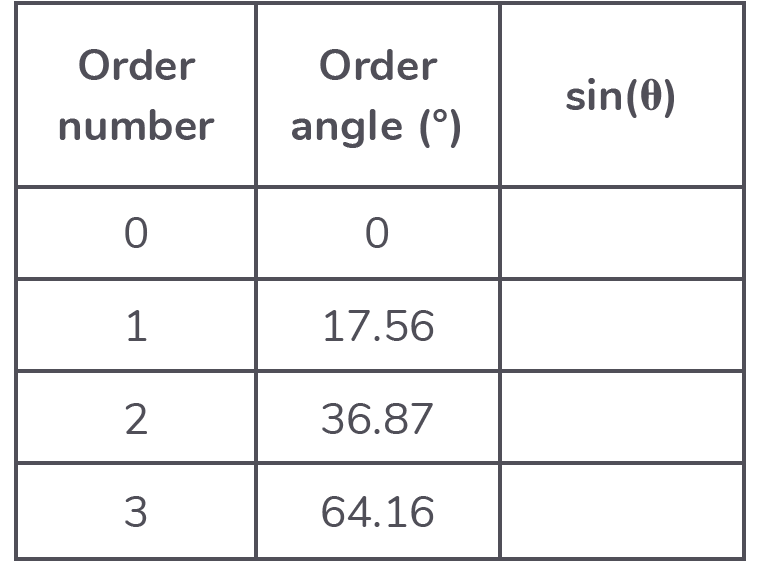
Plot a graph of order number against sin().
State what the gradient of the graph represents.
Calculate the number of lines per mm for the diffraction grating used in the student's experiment.
A student is investigating the interference pattern produced by two slits.
The light emerging from the double slits is coherent.
Explain what is meant by the term coherent.
The student wants to increase the fringe spacing to obtain a more accurate value.
Explain how the student can increase the fringe spacing without changing the double slits or the light source.
When the distance from the double slits to the screen is 1 m, the student records a fringe separation of 1.15 mm.
Calculate the fringe separation when the distance from the slits to the screen is increased to 1.25 m.
The student used a laser of wavelength 575 nm.
Calculate the slit separation of the two slits.
A student shines a laser through two slits and observes the interference pattern on a screen.
Describe the pattern the student would observe on the screen.
Explain why points of bright light are observed at discrete locations.
The diagram below shows the student's experimental setup.
The point labelled x represents the position of the first maxima above the central maxima.
The light travels a different distance from each of the two slits.
State what the path difference represents.
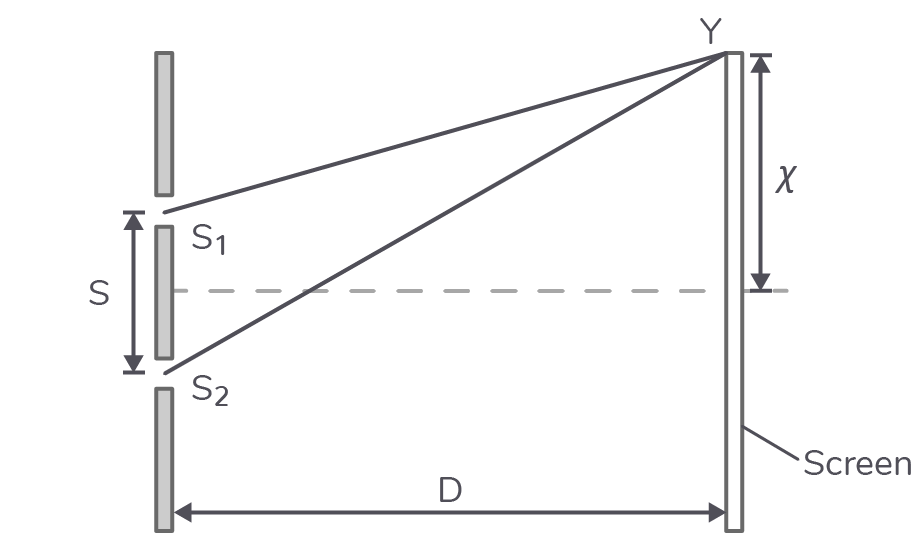
The student measures the distance from the central maxima to the point labelled x to be 2 mm.
The distance from the slits to the screen is 2 m. The slits have a separation of S = 0.5 mm.
Calculate the length of the path from S2 to point X. Give your full unrounded answer.
The length of the path S1X is 2.000000766 m.
Calculate the wavelength of the laser.