Young Modulus & Deformation Of Solids - exam practice
Young Modulus & Deformation Of Solids
Question 1 of 5
A student is investigating the properties of solids by putting them under tension.
State what is meant by tensile stress.
State what is meant by tensile strain.
A student suspends a 10 kg mass from a wire of diameter 1.2 mm.
Calculate the tensile stress in the wire.
The graph below shows the stress strain characteristics for two different wires.
Draw an x on the diagram to show where the wire stops obeying Hooke's law.
State what the gradient of the graph represents.
Draw a line on the graph to show a wire which has higher Young modulus.
A tightrope walker connects a tightrope of diameter 2 cm between two trees which are 15 m apart.
They use a ratchet to increase the tension in the rope to 4 x 10³ N.
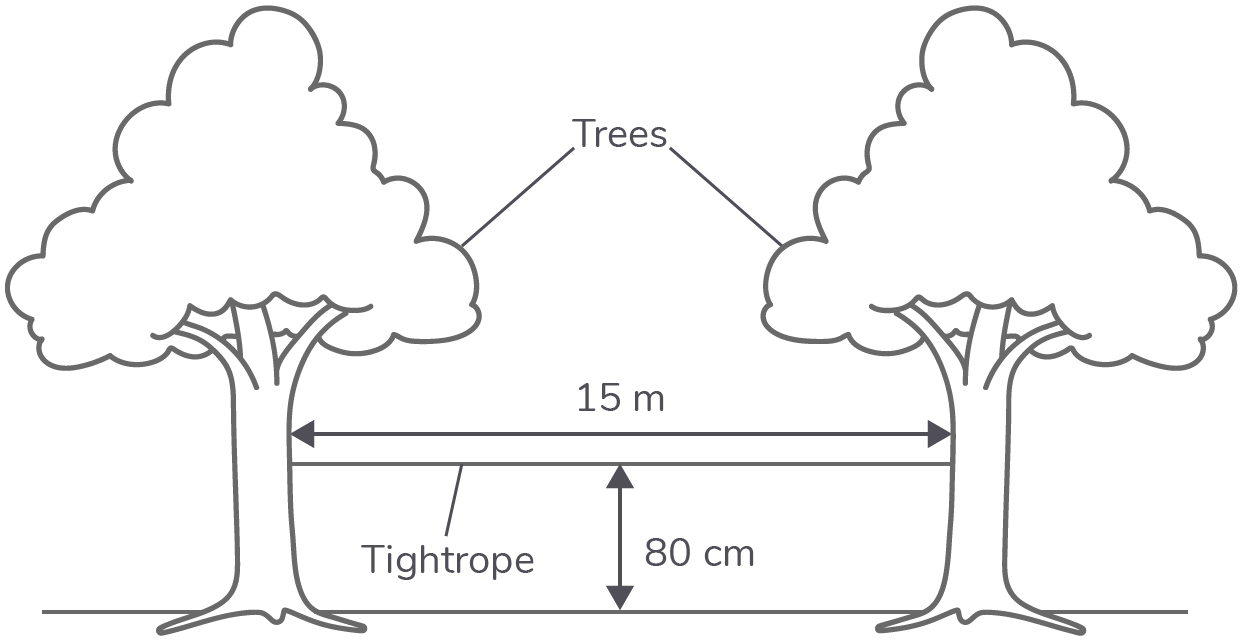
The Young modulus of the rope is 80 GPa.
Calculate the extension of the tightrope when the tension is 4 x 10³ N.
Another tightrope walker picks up a rope made of rubber. The dimensions of the rope are the same as those in part a). The Young modulus of rubber is 0.01 GPa.
The initial tension in the tightrope is 4 x 10³ N. When a tightrope walker stands on the tightrope the tension increases by 650 N. Calculate the additional extension of the tightrope due to the tightrope walker standing on the rope and explain why the rubber tightrope is not suitable for its purpose.
The graph below shows the stress strain relationship for 3 different materials.
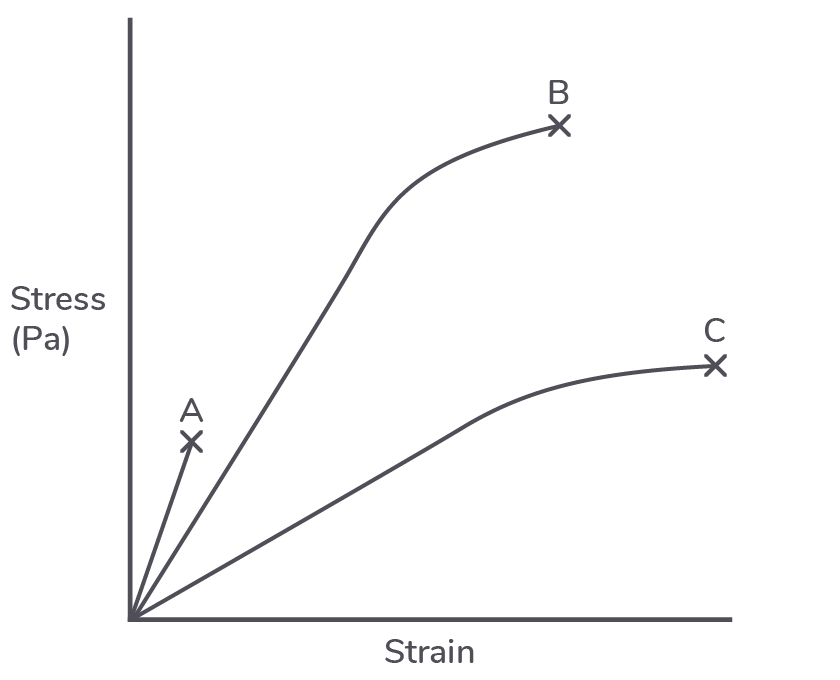
Explain which material would make the best tightrope.
A student is investigating the Young's modulus of a wire.
Describe how the student could take measurements to determine the Young modulus of the wire.
Describe how the student can obtain an accurate measurement for the diameter of the wire using a micrometer.
The student's graph is below.
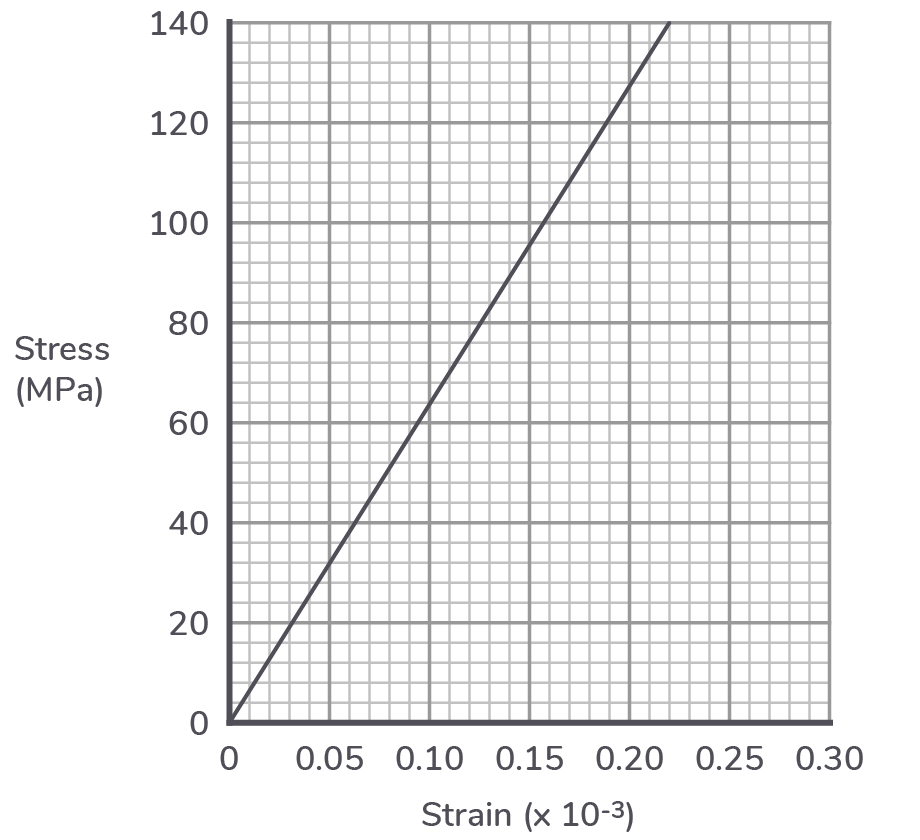
Calculate the Young modulus of the wire.
A student is investigating the identify the Young modulus of a metal wire.
The student's table of results is below.
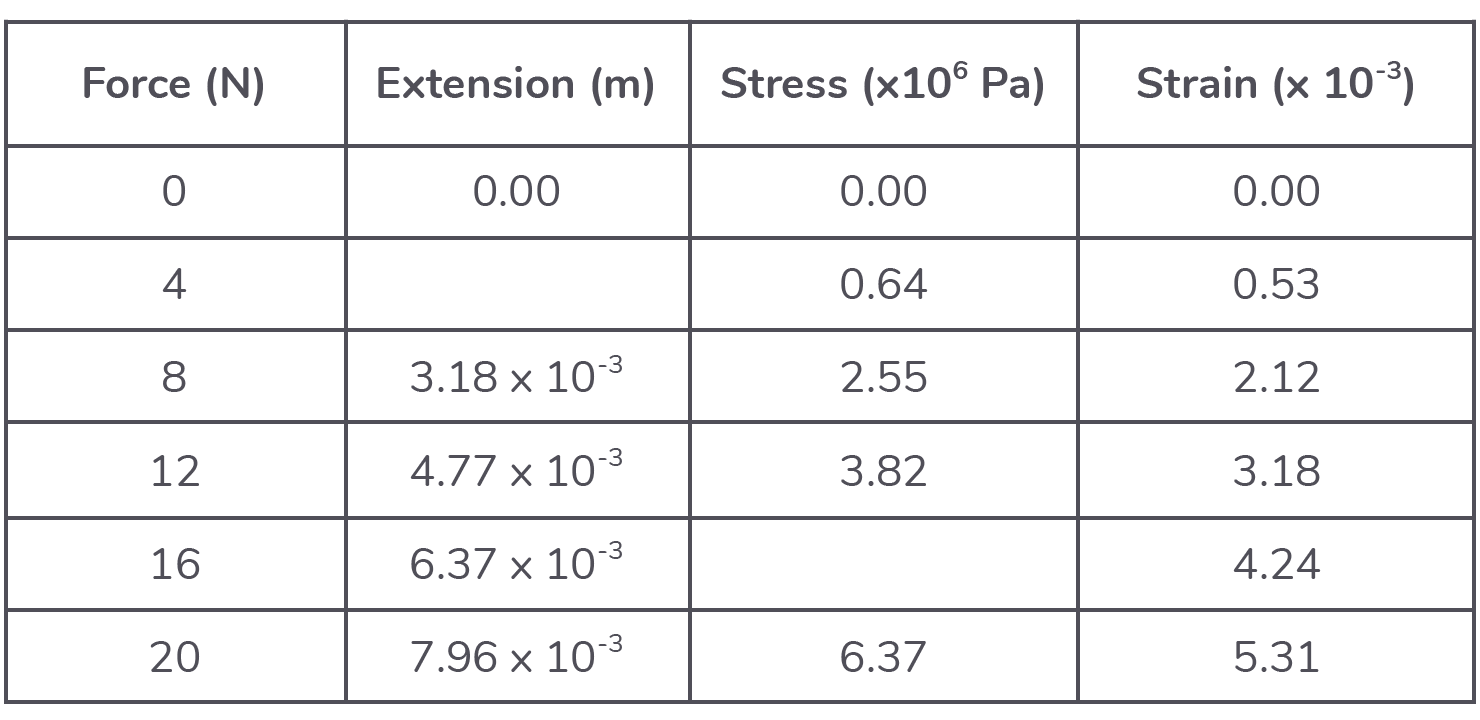
The original length of the wire is 1.5 m.
Calculate the missing extension in the student's table.
Calculate the missing stress in the table. The cross sectional area of the wire is 3.14 x 10⁻⁶ m2.
Plot a stress strain graph for the students results.
Calculate the Young modulus of the wire used in the student's experiment.
This question is about the properties of a steel cable holding up a lift in a lift shaft.
The graph below shows the stress strain relationship for 3 different materials.
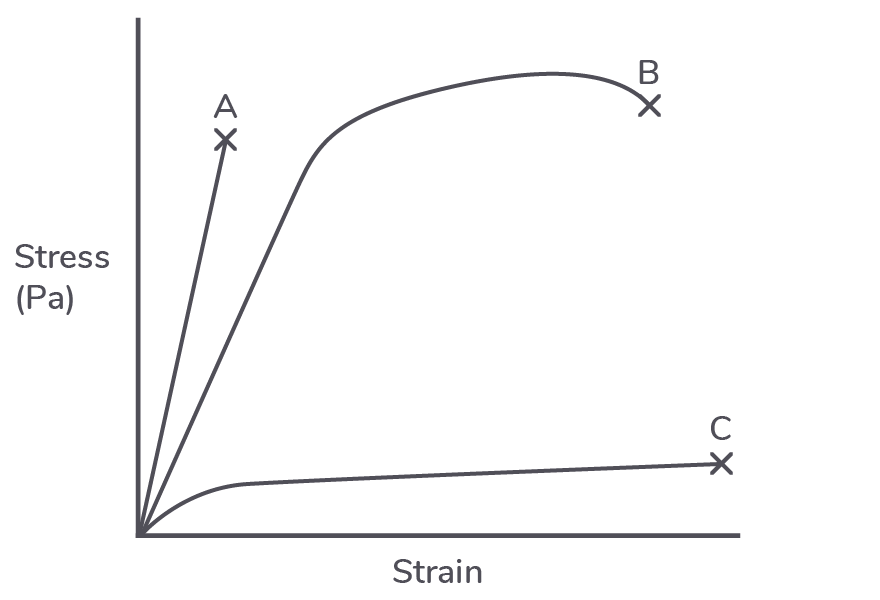
Discuss which of the three materials shown on the group would be suitable for holding up the lift in the lift shaft.
You should discuss the reason for your choice and why you rejected the other materials.
The cable has a radius of 3.0 cm and a breaking stress of 6 MPa.
Calculate the maximum mass of the passengers and lift that can be carried safely.
The empty lift has a mass of 650 kg.
The average UK adult has a mass of 80 kg.
Calculate the maximum number of adults that can safely use the lift.
The manufacturer says the maximum capacity of the lift is 8 people.
Give one reason why the manufacturer advises a lower number than that calculated in part c.