3.4 - Formation Of Stationary Waves
- 1
Formation and characteristics of stationary waves
- 2
Stationary waves in strings and their properties
- 3
Calculating the speed of sound using stationary waves
What are stationary waves?
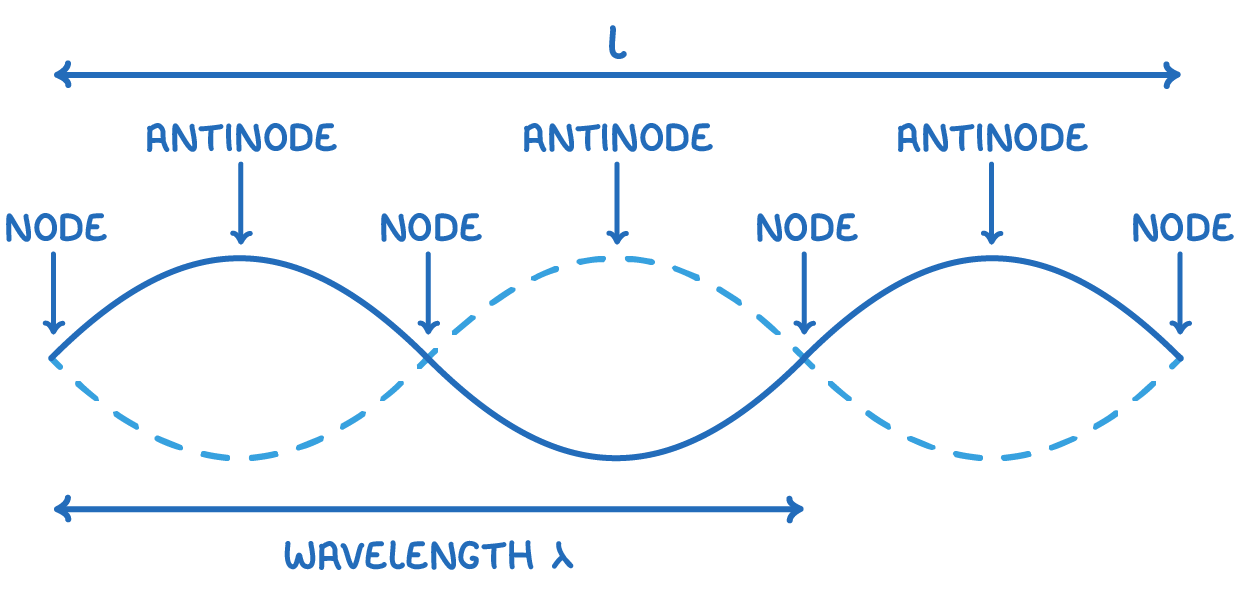
Stationary waves, or standing waves, appear motionless and are formed through the principle of superposition.
A stationary wave is formed by the superposition of two waves with the same wavelength, moving in opposite directions.
Their superposition results in points of constructive and destructive interference.
- Nodes - Points of destructive interference where the two waves cancel each other out, resulting in no movement or zero amplitude.
- Antinodes - Points of constructive interference where the waves reinforce each other, creating points of maximum movement or amplitude.
Unlike progressive waves, stationary waves don’t transfer energy; the energy vibrates within the medium, oscillating between the wave's boundaries.
Stationary waves in vibrating strings
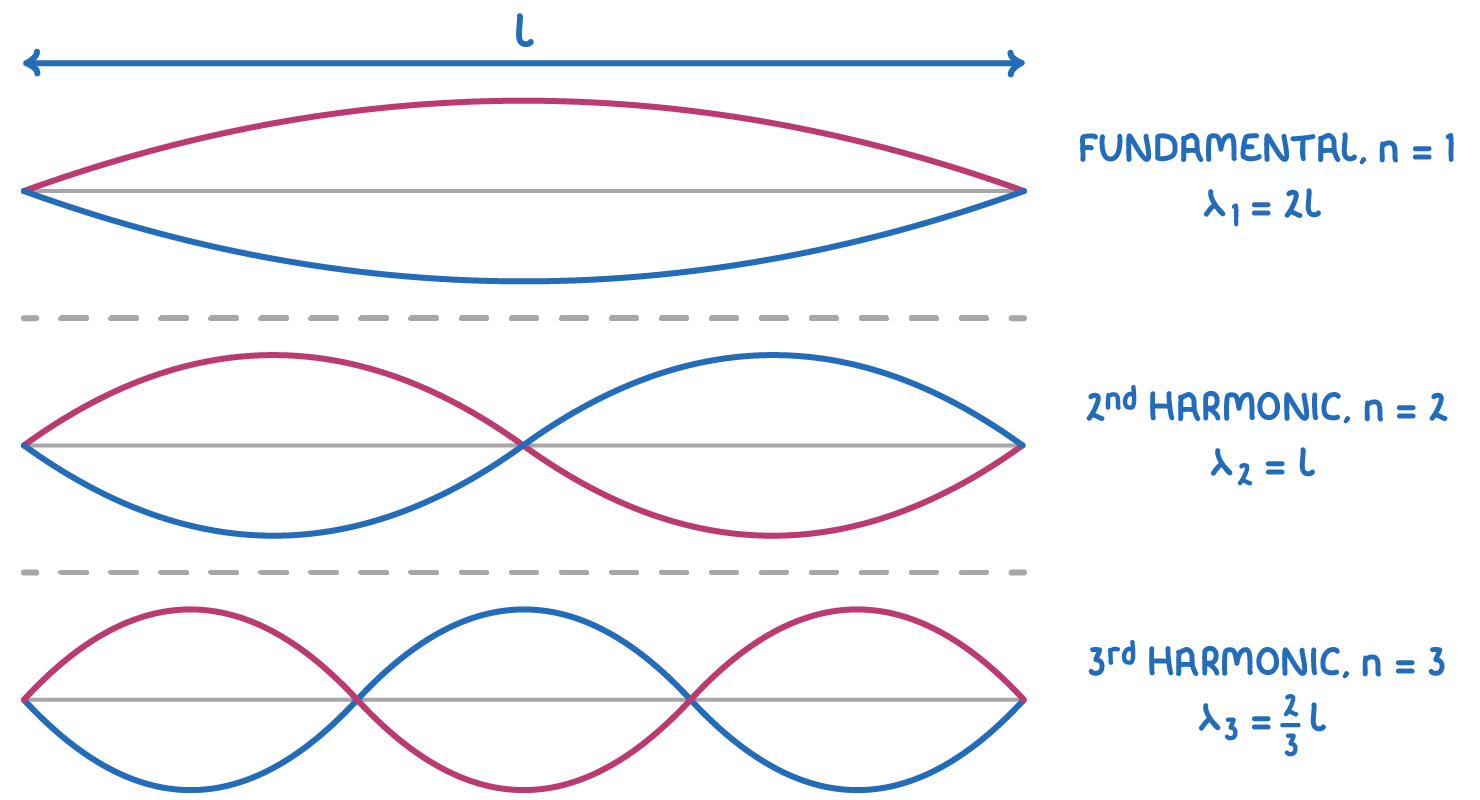
The lowest possible observable standing wave is known as the fundamental mode or first harmonic.
For the first harmonic on a string, an antinode forms at the centre of the string with a node at each end. The length of the string is equal to .
Calculating the speed of a wave
The speed v of a transverse wave on a string is determined by the tension in the string and the mass per unit length of the string.
The relationship between the speed of the wave, the tension and the mass per unit length is:
Where:
- v = speed of wave (m s^-1^)
- T = tension in string (N)
- = mass per unit length of the string (kg m^-1^)
For the fundamental mode of vibration, the length of the string is equal to , so the speed of the wave can be expressed as:
c = f = 2 f l