Gravitational Fields - exam practice
Gravitational Fields
Question 1 of 10
This question is about Newton's law of gravitation..
State Newton's law of gravitation.
Calculate the gravitational force on the Earth due to the Sun.
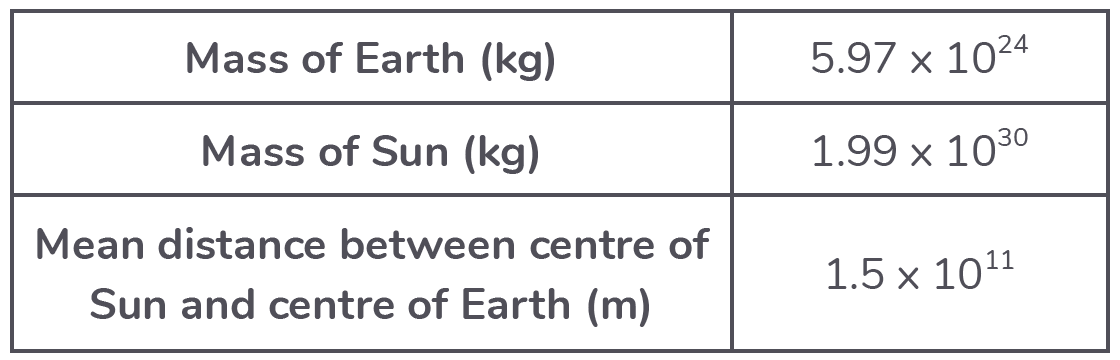
By considering the forces acting on the Earth as it orbits the Sun, show that the orbital time period T is related to the orbital radius r as shown below
State what is represented by gravitational field lines.
The diagram below shows the field lines close to the surface of a planet.
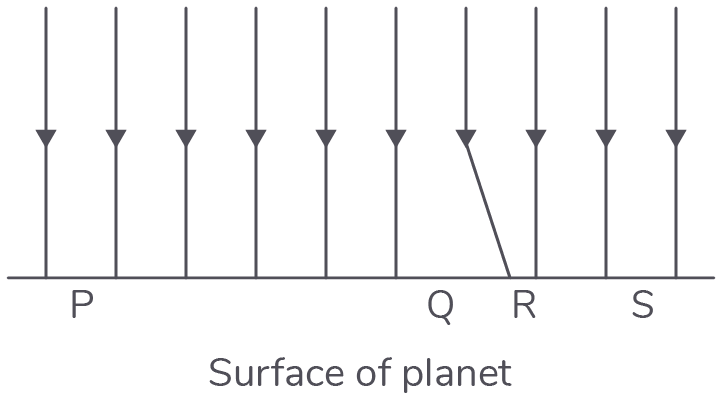
Describe where the gravitational field strength is strongest and give a possible reason for the variation in field strength.
The diagram below shows the equipotentials that surround the planet.
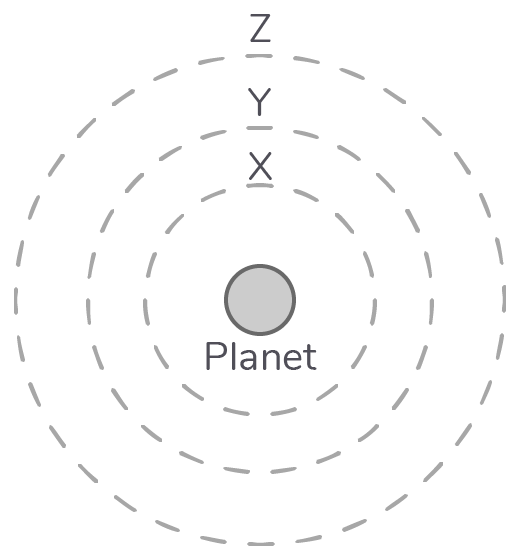
Explain what is meant by a gravitational equipotential.
The table below shows the gravitational potentials at points X, Y, and Z around the planet.
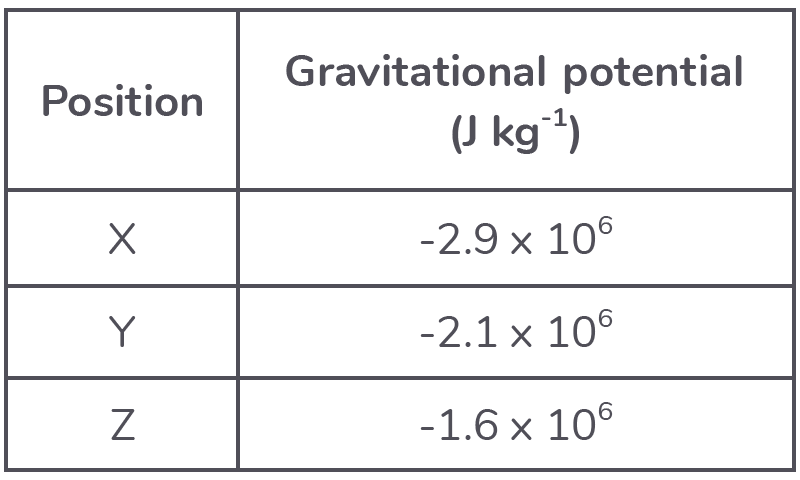
Explain why the gravitational potentials are all negative.
A satellite of mass 1,800 kg is in orbit at point Y.
Calculate the work done on the satellite in moving it from point Y to point Z.
The international space station orbits the Earth at a height h above the Earth's surface.
The Earth has a mass M and a radius R.
Derive an expression for the angular velocity of the international space station in terms of M, h and R.
The international space station orbits the Earth every 92 minutes.
The radius of the Earth is 6.37 x 10⁶ m.
The Earth's mass is 5.97 x 1024 kg.
Calculate the height above the Earth's surface that the ISS orbits.
Calculate the gravitational potential of the ISS at this altitude.
Another satellite is in a higher circular orbit.
Describe how the linear speed of this satellite compares with the linear speed of the ISS.
Earth has a mass of 5.97 x 1024 kg and a radius of 6.37 x 10⁶ m.
Calculate the gravitational potential at the Earth's surface.
Explain why the gravitational potential is negative at the Earth's surface.
Derive an expression for the escape velocity of a mass on the Earth's surface.
Calculate the minimum velocity for an object on the Earth's surface to escape the Earth's gravitational field.
A geostationary satellite is in orbit above the Earth's surface.
State the conditions for the orbit of the satellite to appear geostationary.
State the position of the satellite above the Earth's surface.
Calculate orbital radius of a geostationary satellite.
The mass of the Earth is 5.97 x 1024 kg.
The gravitational field strength at the Earth's surface is 9.81 m s-2.
Calculate the gravitational field strength experienced by the geostationary satellite.
A planet has a mass of 6 x 1024 kg and a radius of 7 x 10⁶ m.
Calculate the force of gravitational attraction between the planet and a 2,000 kg satellite that is orbiting 1,000 km above the planet's surface.
Calculate the gravitational potential at the surface of the planet.
Calculate the work done on the satellite in moving it from the surface of the planet to its orbit 1,000 km above the surface.
This question is about the gravitational field of a planet.
State what is meant by gravitational field strength.
A planet has a mass of 6.23 x 1024 kg. The gravitational potential at a distance of h above the surface is - 55.78 x 10⁶ J kg-1.
The gravitational field strength at 2h above the surface is 5.82 N kg-1.
Calculate the radius of the planet.
The diagram below shows the equipotential lines surrounding the planet.
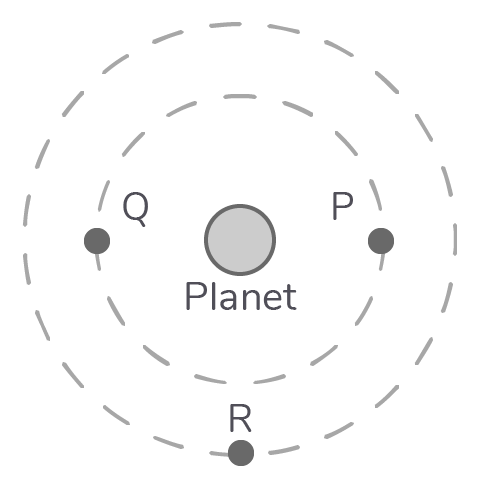
A 400 kg mass is located at P.
State how much work is done in moving the mass from P to Q.
The gravitational potential at P is -831 x 106 J kg-1.
The gravitational potential at R is -693 x 106 J kg-1.
Calculate the work done on the 400 kg mass when it is moved from position P to R.
A moon is in orbit around a planet.
The moon has a radius of 1,800 km and the planet has a diameter of 6,750 km.
The distance from the surface of the planet to the surface of the moon is 400,000 km.
The moon has a mass of 7.35 x 10²² kg and the planet has a mass of 6.03 x 1024 kg.
Calculate the force of attraction between the moon and the planet.
At point X, between the planet and the moon, the gravitational field strength is zero.
Calculate the distance from the centre of the planet to point X.
A satellite is in orbit around the Earth.
State Newton's law of gravitation.
The satellite is a geostationary satellite.
State the conditions of a satellite's orbit for it to be considered geostationary.
Calculate the height above the Earth's surface for the orbit of a geostationary satellite.
The radius of the Earth is 6.37 x 10⁶ m.
The mass of the Earth is 5.97 x 1024 kg.
The mass of the satellite is 1,500 kg.
A moon of mass m is in a circular orbit around a planet of mass M.
The mass of the moon is much less than the planet.
By considering the forces acting on the moon, show that the time period of orbit is related to the orbital radius as shown below
The table below gives data for two of the moons of Jupiter.
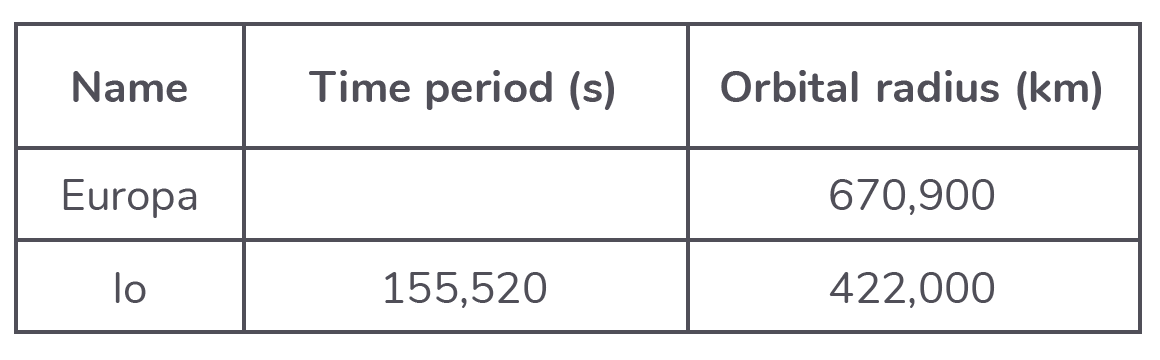
Calculate the orbital time period for Europa.
The graph below shows how the gravitational potential V varies with vertical distance from the surface of Jupiter.
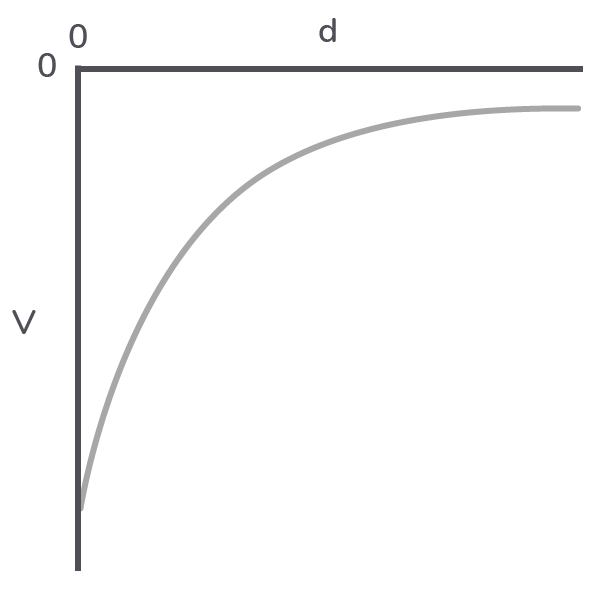
State what the gradient of the graph represents.