Nuclear Radius - exam practice
Nuclear Radius
Question 1 of 6
is formed when a nucleus of deuterium () collides with a nucleus of .
Calculate the radius of the nucleus.
The radius of the deutirium nucleus is approximately 1.5 fm.
State the distance between the centres of the nuclei for the production of to take place.
Calculate the minimum speed required by the deuterium nucleus to produce .
You may assume the nucleus is stationary.
Compare without calculation the nuclear density of the and nuclei.
A beam of electrons of energy 4.2 x 10^8^ eV is produced in an accelerator.
The de Broglie wavelength of a particle close to the speed of light can be approximated using .
Calculate the de Broglie wavelength of an electron in the beam.
Electrons can display both particle and wave-like behaviour.
Describe an experiment which provides evidence for the wave-like behaviour of an electron.
The electron beam is used to estimate the nuclear radius of carbon-12. The beam is directed at the thin sample and a detector is placed at an angle to the direction of the beam.
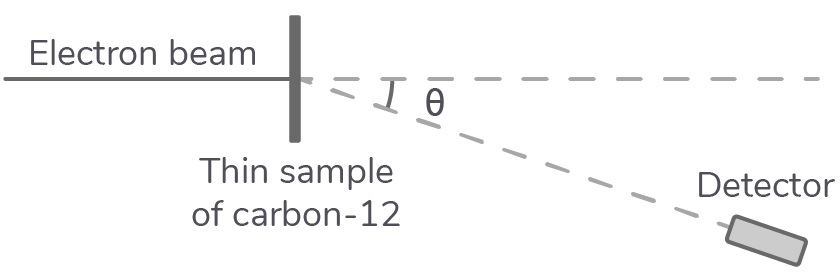
Describe what would be observed as the detector angle () increases from 0°.
A minima is detected at = 37°.
Calculate the radius of the carbon-12 nucleus.
An alpha particle travelling at 2.6 x 10^5^ m s^-1^ is directed head-on at a nucleus of gold .
Calculate the initial kinetic energy of the alpha particle.
Calculate the distance of closest approach of the alpha particle from the centre of the gold nucleus.
Increasing the kinetic energy of the alpha particle gives a smaller distance of closest approach which can be used as an estimate for the radius of the gold nucleus.
With a kinetic energy of 32 MeV, the distance of closest approach is 7 x 10^-15^ m.
Calculate an estimate for the density of the gold nucleus.
Electron diffraction is one method of approximating the radius of a nucleus.
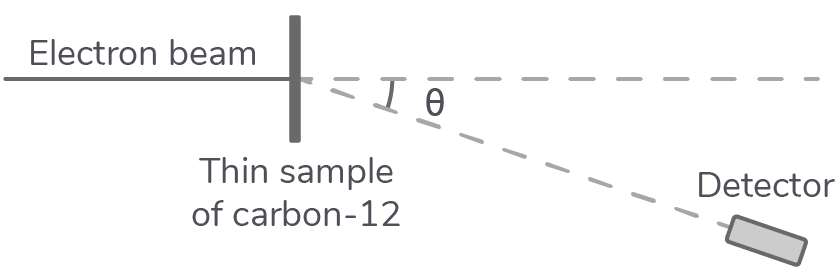
The detector records the intensity of electrons at varying angles of .
Complete the diagram below to show how the intensity of electrons varies with . You should include the location of the first minima .
A beam of electrons with a de Broglie wavelength of 2.96 x m.
Calculate the energy of the beam in MeV.
The accepted radius of carbon-12 is 2.47 x 10^-15^ m.
Explain why electrons with an energy of 2.5 x 10^7^ eV would be unsuitable for investigating the nuclear radius.
The radius of a nucleus is 2.47 x 10^-15^ m.
The radius is measured by the diffraction of electrons through a thin film of carbon-12.
Explain why the film of carbon must be thin.
The graph below shows the electron intensity vs angle for electrons in a beam of energy 400 MeV.
State the value of for the first minima.
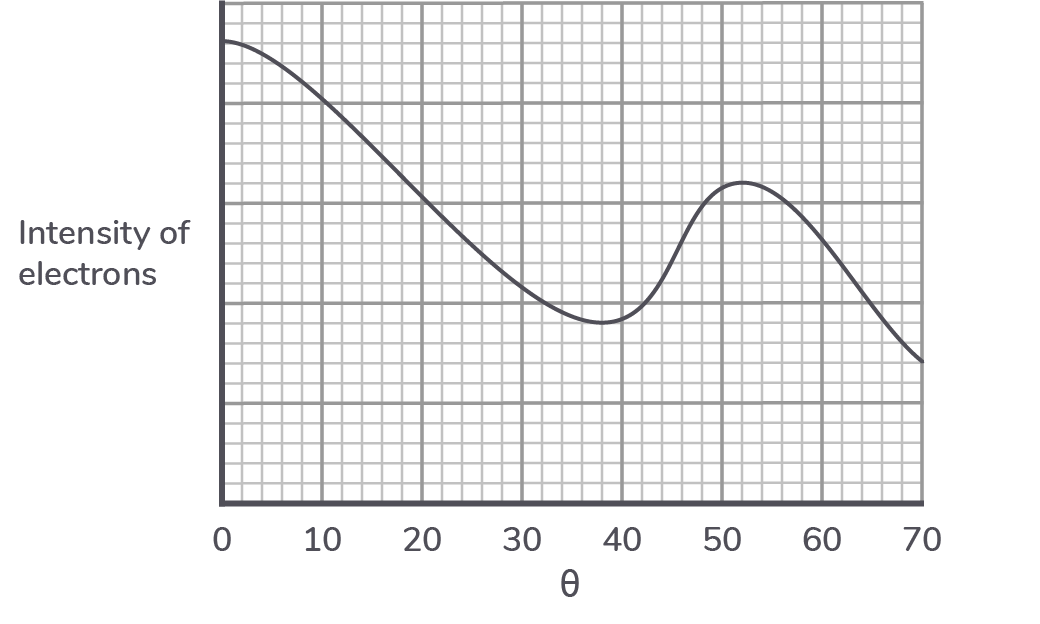
Calculate the radius of carbon-12 using your experimental reading from part b).
The accepted value of the radius of carbon-12 is 2.47 x 10^-15^ m.
Describe how the experimental setup could be changed to obtain a more accurate estimate of the radius.
Alpha particles are used to determine the distance of closest approach of a nucleus. This phenomenon can be used to estimate the size of a nucleus.
Define the distance of closest approach.
An alpha particle with a kinetic energy of 5 MeV is directed at a stationary gold nucleus.
Calculate the distance of closest approach.
Describe how the distance of closest approach can be used to approximate the radius of a nucleus.
The accepted radius of a gold nucleus is 7 x 10^-15^ m.
The mass of the gold nucleus is 3.27 x 10^-25^ kg.
Calculate the nuclear density of the gold nucleus.