Simple Harmonic Motion - exam practice
Simple Harmonic Motion
Question 1 of 7
A student is investigating the simple harmonic motion of a simple pendulum.
State what is meant by simple harmonic motion.
The pendulum bob has a mass of 50 g and the string length is 120 cm.
Calculate the time period of oscillation.
The pendulum bob is replaced with a pendulum of identical length but has the pendulum bob has a mass of 100 g.
Describe the effect on the time period of oscillation.
At time t = 0 s, the pendulum bob is released. The graph below shows how the potential energy of the pendulum varies with time.
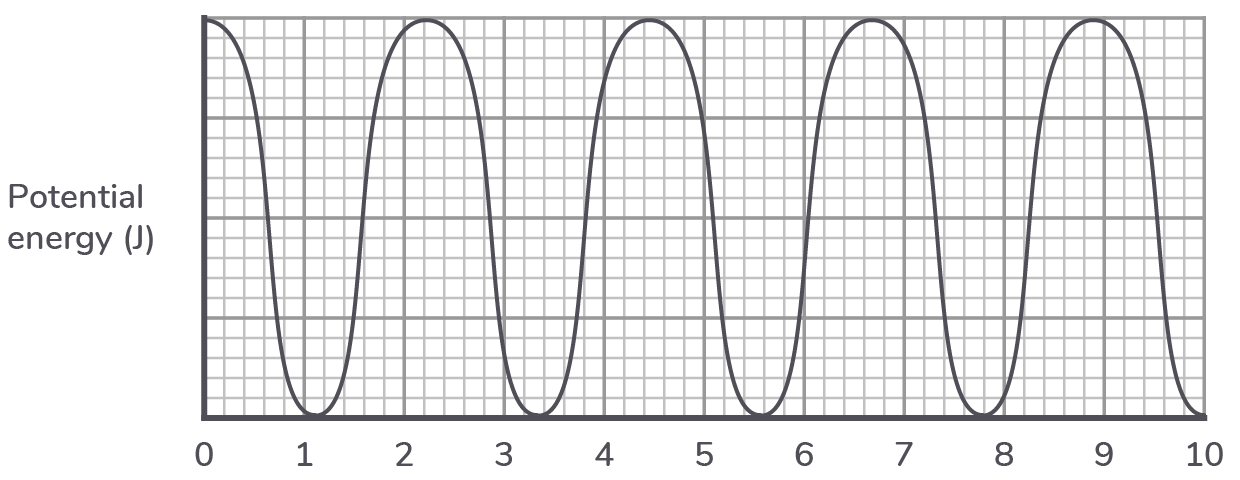
Sketch a graph to show how the kinetic energy of the pendulum varies with time.
A mass of 200 g is hung from the bottom of a spring.
The spring extends by 5cm.
Calculate the spring constant of the spring.
The spring undergoes simple harmonic motion when it is pulled down a further 4 cm and released.
Calculate the time period of oscillation.
Calculate the maximum kinetic energy of the pendulum.
Calculate the displacement of the mass 0.3 s after it is released.
You may assume the mass was released when displaced by 4 cm.
A mass is suspended from a spring with a spring constant 30 N m-1.
The mass oscillates vertically with simple harmonic motion about the equilibrium position.
At time t = 4.3 s the magnitude of acceleration of the mass is 1.87 ms-2 and its displacement is 2.50 x 10⁻³ m.
Calculate the natural frequency of the mass-spring system.
Calculate the mass attached to the bottom of the spring.
The mass-spring system above oscillated in air.
Describe the energy changes that will take place as the mass moves from the lowest point in its motion through the equilibrium position to the highest point in its motion.
A 2 kg mass is connected between two springs.
When the mass is displaced it oscillated with simple harmonic motion.

Explain what is meant by simple harmonic motion.
The graph below shows how the displacement of the mass varies with time.
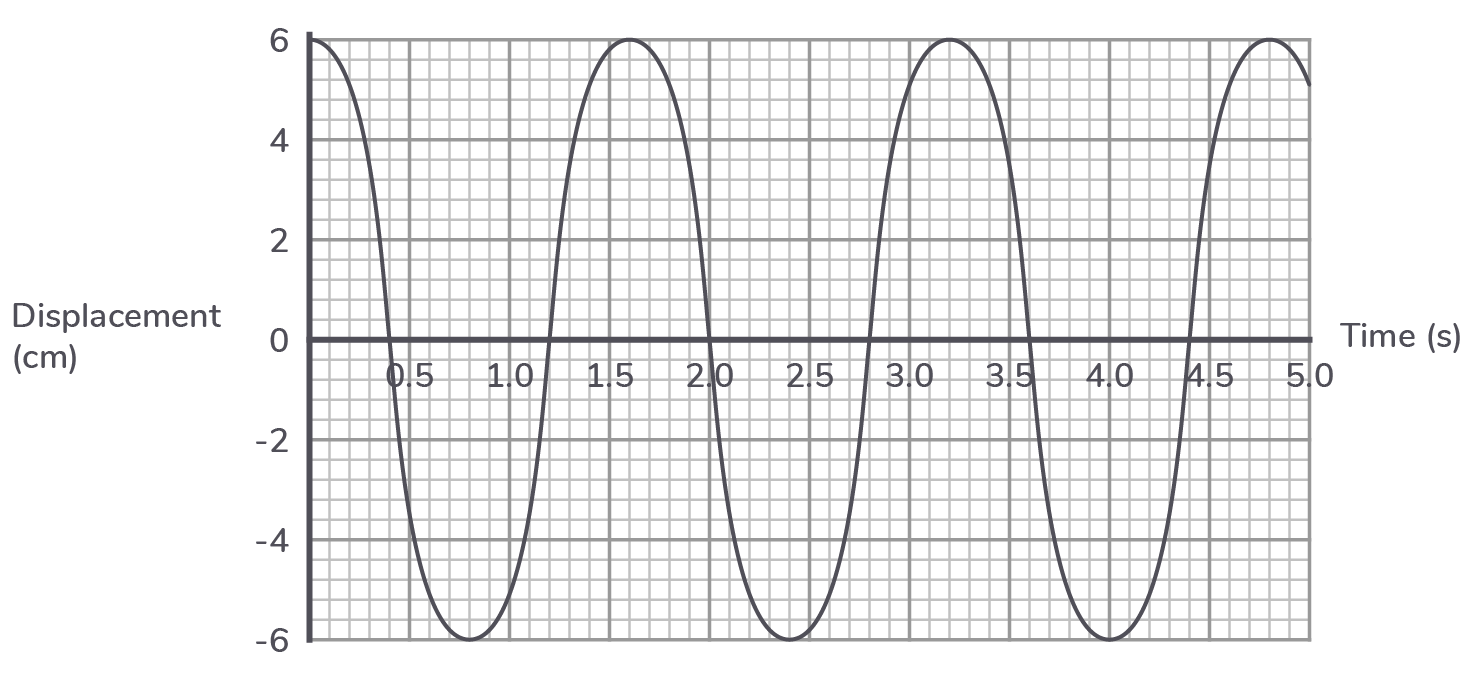
Calculate the maximum acceleration of the mass.
Calculate the maximum kinetic energy of the mass during the oscillations.
A student is investigating the simple harmonic motion of two pendulums.
The student displaces the pendulum and releases it. The graph below shows how the displacement varies with time for the simple pendulum.
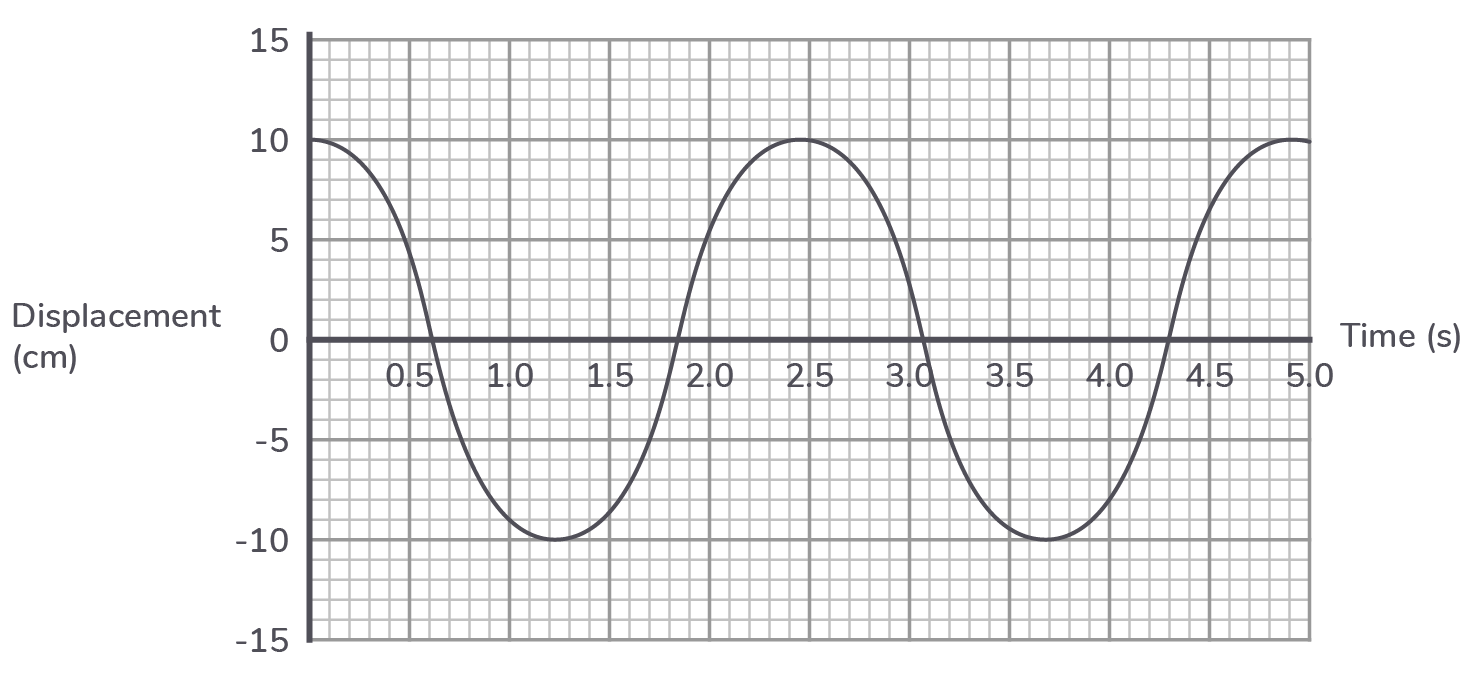
State when the pendulum bob has maximum kinetic energy.
Calculate the maximum kinetic energy of the 20 g pendulum bob.
The pendulum is replaced by a pendulum which has half the length.
The new pendulum is displaced by the same amount and released.
Sketch the displacement-time graph for the new pendulum.
This question is about a simple pendulum of length 1.5 m.
Simple pendulums undergo simple harmonic motion about an equilibrium position.
State what is meant by simple harmonic motion.
For oscillations of small amplitude, the acceleration of a pendulum bob is related to its displacement by the expression
where g is the acceleration due to gravity and L is the length of the pendulum.
Show that the period T of the oscillations is given by the expression
The student replaces the pendulum bob with another pendulum bob which has the same radius but twice the mass.
Describe the effect on the time period of the pendulum.
The student notices the amplitude of oscillations decreases with time.
Give one reason why the amplitude of the pendulum decreases with time.
A student is investigating the simple harmonic motion of a mass attached to a spring.
State what is meant by simple harmonic motion.
The student pulls the mass down and releases it.
The graph below shows how the displacement of the mass varies with time.
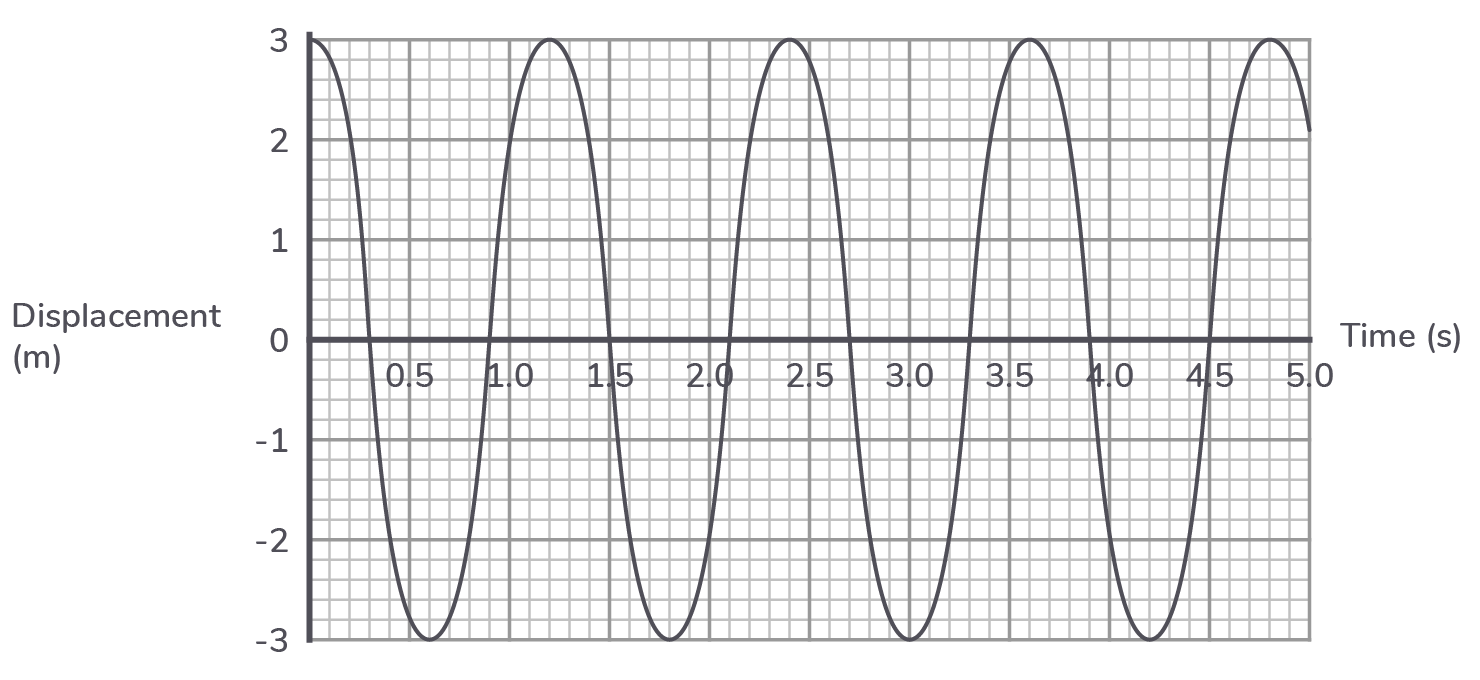
Sketch a graph to show how the acceleration of the mass varies with displacement. Label your axes with appropriate values.
Calculate the maximum kinetic energy of the 2 kg mass.