D.C. Circuits - exam practice
D.C. Circuits
Question 1 of 16
1 of 16
The National Grid uses high-voltage transmission lines to carry electrical power around the UK. A particular transmission line delivers 800 MW of power at 132 kV to the user. It loses 1% of the transmitted power as heat.
What is the resistance of the transmission line?
Question 2 of 16
2 of 16
In this resistor network, the emf of the supply is 12 V and it has negligible internal resistance.
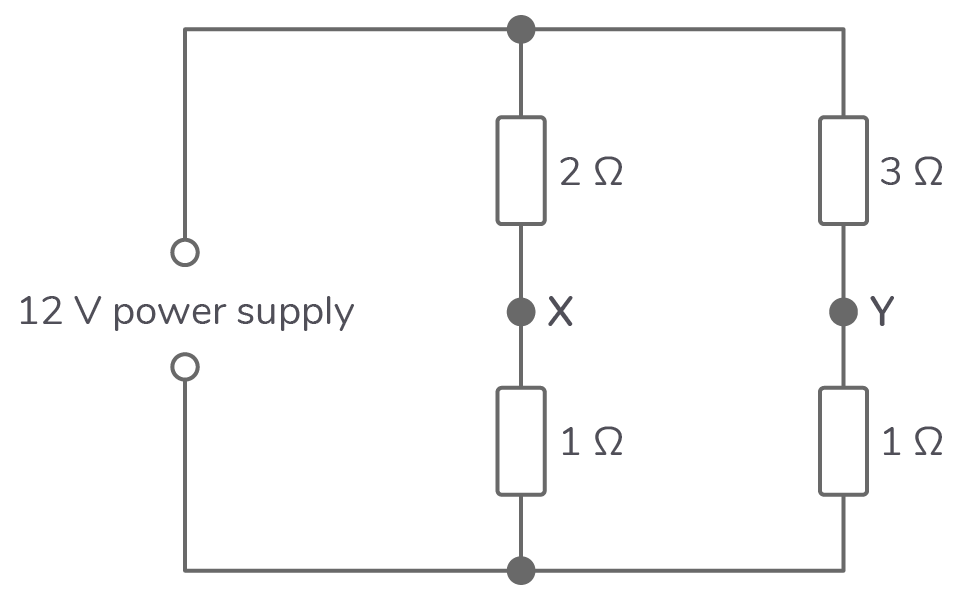
What is the reading on a voltmeter connected between points X and Y?
Question 3 of 16
3 of 16
Resistors of resistance R, R and 3R are connected as shown.
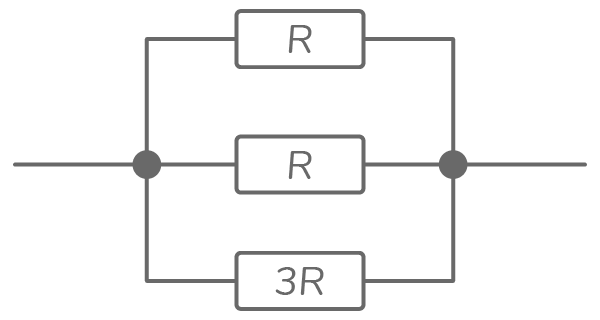
What is the resistance of the arrangement?
Question 4 of 16
4 of 16
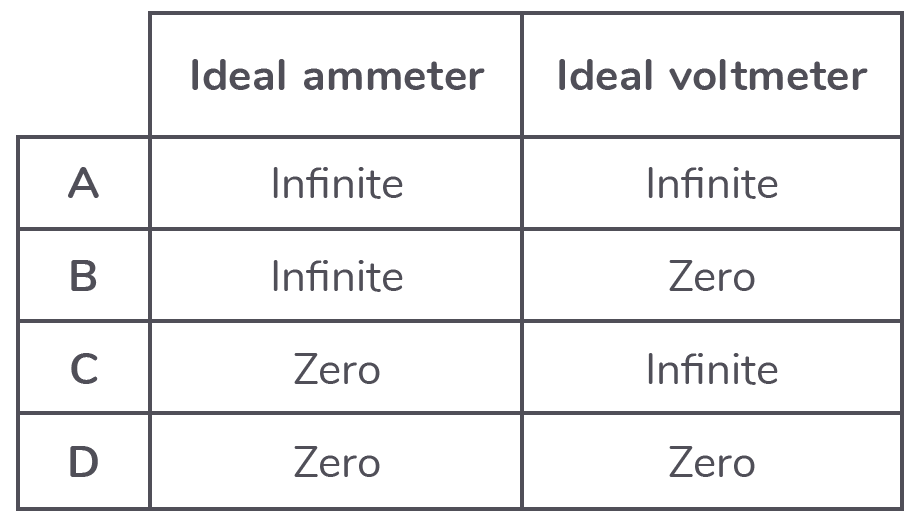
Which row shows the resistances of an ideal ammeter and an ideal voltmeter?
Question 5 of 16
5 of 16
A resistor with resistance R is made from metal wire of resistivity .
The length of the wire is L.
What is the diameter of the wire?
Question 6 of 16
6 of 16
Resistors X and Y are connected in series with a 6.0 V battery of negligible internal resistance.
X has resistance R and Y has resistance .
A voltmeter of resistance R is connected across Y.
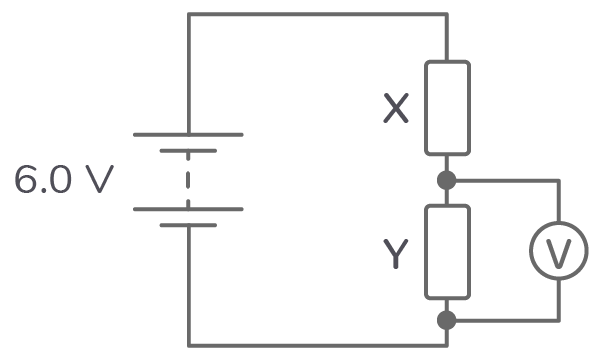
What is the reading on the voltmeter?
Question 7 of 16
7 of 16
In the circuit shown, a potential difference of 3.0 V is applied across XY.
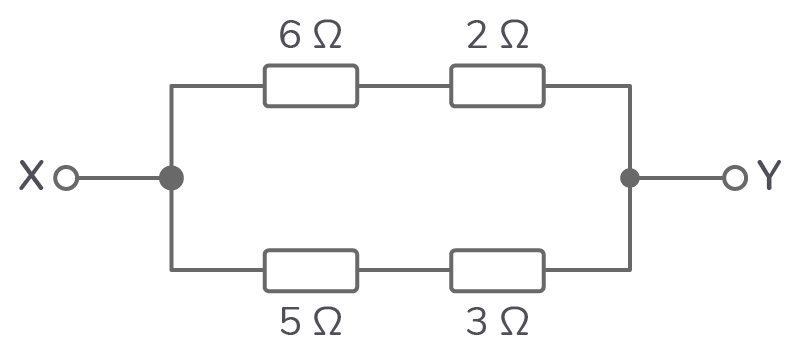
What is the current in the 5 Ω resistor?
Question 8 of 16
8 of 16
Which is equivalent to the ohm?
Question 9 of 16
9 of 16
A wire has a resistance R.
What is the resistance when both the length and radius of the wire are doubled?
Question 10 of 16
10 of 16
Three resistors are connected in a circuit.
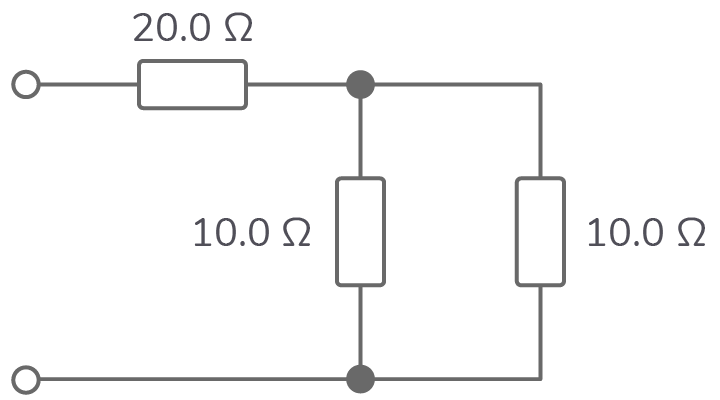
The resistance of each resistor is shown in the circuit diagram.
What is the total resistance of this circuit?
Question 11 of 16
11 of 16
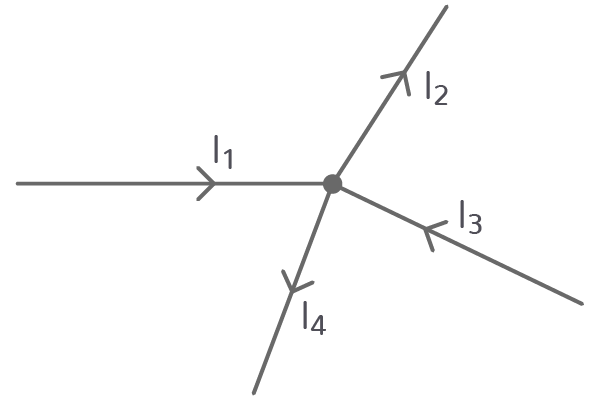
The diagram shows the conventional currents entering and leaving a junction in an electric circuit.
I1 , I2 , I3 and I4 are all positive.
Which statement is always true?
Question 12 of 16
12 of 16
The potential difference across a lamp is 2.5 V. The current in the lamp is 20 mA.
What is the energy dissipated in the lamp in 3.0 hours?
Question 13 of 16
13 of 16
The current in a wire is 20 mA.
How many electrons pass a point in the wire in 2 minutes?
Question 14 of 16
14 of 16
The diagram shows the currents in a set of wires.
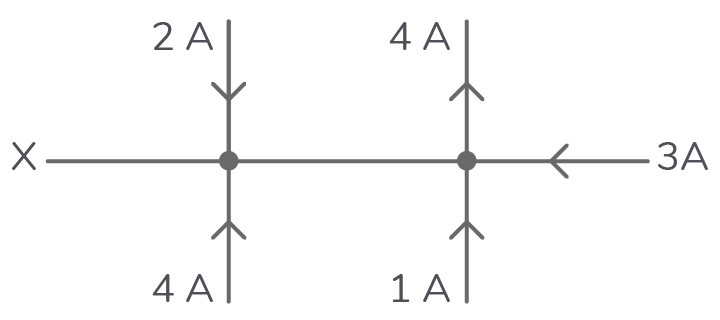
What is the magnitude of the current at X?
Question 15 of 16
15 of 16
A gas containing doubly-charged ions flows to give an electric current of 0.64 A
How many ions pass a point in 1.0 minute?
Question 16 of 16
16 of 16
A mobile phone operates at a constant power of 200 mW
It has a 3.7 V lithium-ion battery that has a charge capacity of 9,400 C
What is the time taken for the battery to discharge completely?