Radioactivity - exam practice
Radioactivity
Question 1 of 10
1 of 10
Nobelium-259 has a half-life of 3,500 s.
What is the decay constant of nobelium-259?
Question 2 of 10
2 of 10
A pure sample of nuclide X containing N nuclei has an activity A.
The half-life of X is 6,000 years.
A pure sample of nuclide Y containing 3N nuclei has an activity 6A.
What is the half-life of nuclide Y?
Question 3 of 10
3 of 10
Cobalt-60 has a half-life of 5.27 years.
What is the total activity of 1.0 g of cobalt-60?
Question 4 of 10
4 of 10
Which of the following best describes the decay constant for a radioisotope?
Question 5 of 10
5 of 10
After 64 days the activity of a radioactive nuclide has fallen to one sixteenth of its original value. The half-life of the radioactive nuclide is
Question 6 of 10
6 of 10
X and Y are two radioactive nuclides. X has a half-life of 3.0 minutes and Y has a half-life of 9.0 minutes.
Two freshly prepared samples of X and Y start decaying at the same time.
After 18 minutes the number of radioactive nuclei in both samples is the same.
The sample of Y initially contained N radioactive nuclei.
What was the initial number of radioactive nuclei in the sample of X?
Question 7 of 10
7 of 10
The number of parent nuclei in a sample of a radioactive element is N at time t.
The radioactive element has a half-life
The rate of decay is proportional to
Question 8 of 10
8 of 10
U++ is a doubly-ionised uranium atom. The uranium atom has a nucleon number of 235 and a proton number of 92.
In a simple model of the atom, how many particles are in this ionised atom?
Question 9 of 10
9 of 10
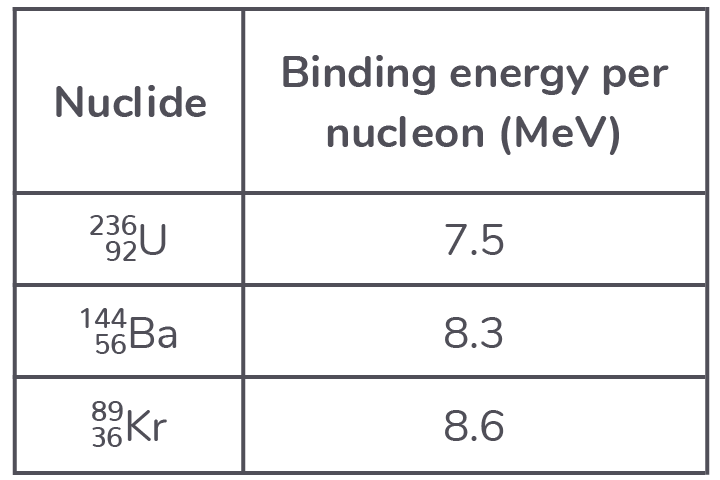
Uranium-236 undergoes nuclear fission to produce barium-144, krypton-89 and three free neutrons.
What is the energy released in this process?
Question 10 of 10
10 of 10
The table shows the masses of three particles.
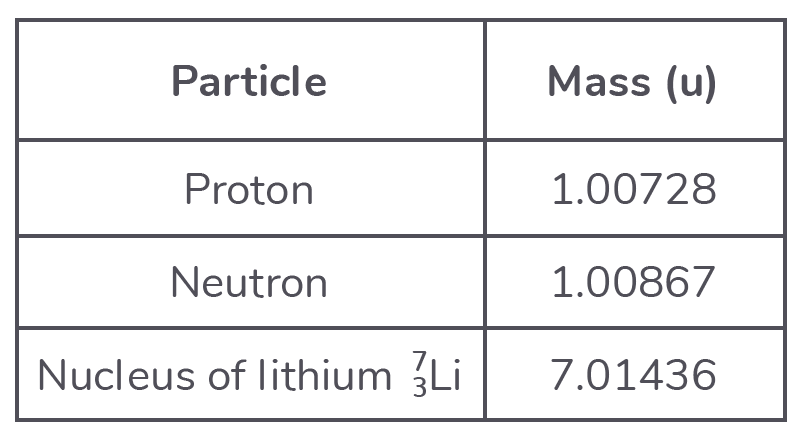
What is the mass difference of the Li-7 nucleus?