1.9 - Tectonic Disaster Trends
Trends in frequency and magnitude since 1960
Since 1960, tectonic disasters have shown relative stability compared to other natural hazards.
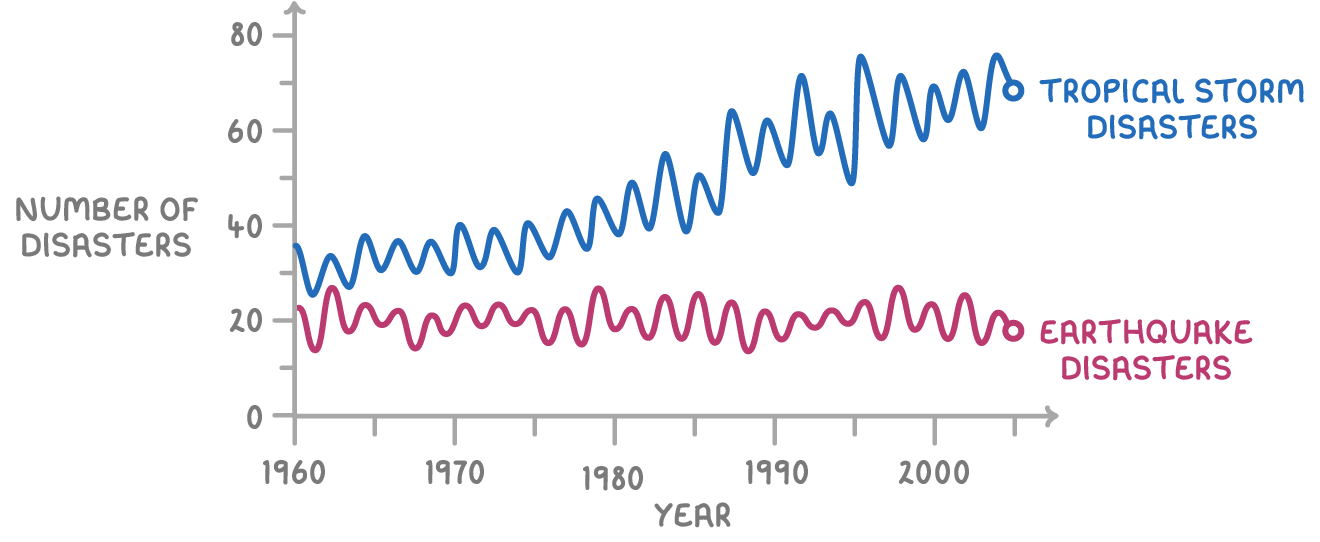
Comparison with atmospheric hazards
- Tectonic disasters, like earthquakes, have not experienced significant changes in how often they occur or how intense they are. Their numbers have fluctuated modestly, generally staying between 12 and 28 events per five-year period from 1960 to 2015.
- In contrast, atmospheric hazards, such as tropical storms and droughts, have increased in frequency. This rise is linked to human-induced factors like climate change and the enhanced greenhouse effect.
- For example, tropical storm disasters were around 25–35 in the 1960s and 1970s but climbed to 65–75 or more by the 1990s and beyond, while earthquake disasters remained low and consistent.
This difference highlights that tectonic events are primarily driven by natural geological processes, with less direct human influence on their occurrence.
Factors influencing tectonic disaster trends
- Human modifications to the environment, such as land degradation, can worsen impacts or slightly increase frequency in some cases by destabilising landscapes.
- However, overall, there has been no major upward trend in tectonic disaster frequency or magnitude, unlike the clear increases seen in atmospheric hazards.
Role of global media in perceptions of disasters
The way disasters are reported can create a false sense that they are happening more often. This is largely due to advancements in communication and monitoring technologies.
How media influences public perception
- Global media has expanded rapidly, making it easier to report on tectonic disasters quickly and widely. This gives the impression of more frequent events, even if actual numbers are stable.
- Media often prioritises disasters with a fast speed of onset, as these are seen as more dramatic and newsworthy.
- Coverage tends to focus more on disasters in developed nations, where access and interest are higher, compared to those in developing nations.
Improvements in monitoring and recording
- Better technology, such as sensitive monitoring systems and integrated networks, has improved detection and documentation of disasters. This reduces reliance on manual observations and increases the number of reported events.
- As a result, more disasters are recorded now than in the past, contributing to the perception of rising frequency.
Reliability of tectonic disaster data
Collecting accurate data on tectonic disasters can be challenging, which affects how trends are analysed.
Challenges in data collection
- Data is hard to gather in remote or inaccessible areas, leading to underreporting or inaccuracies.
- Quantifying impacts, such as the exact number of affected people or economic losses, can be difficult.
These issues mean that trends should be interpreted carefully, considering potential gaps in records.
Increasing number of people affected
Over time, more individuals are impacted by tectonic disasters, even if the events themselves are not becoming more frequent. This trend is driven by population changes and living patterns.
Reasons for the rise in affected populations
- Growing numbers of people are settling in high-risk areas prone to tectonic activity, such as earthquake zones or volcanic regions.
- Urbanisation creates denser populations, increasing vulnerability. In crowded urban settings, a single disaster can affect many more people.
- As a result, more individuals end up homeless or needing long-term support after events, amplifying the human cost.
This trend underscores the importance of planning and risk assessment in vulnerable locations.
Decreasing fatalities from tectonic disasters
Despite more people being affected, the number of deaths from tectonic disasters has generally declined. This positive shift results from better preparation and global development.
Factors contributing to fewer fatalities
- Improved preparedness - Countries invest in resilient infrastructure, such as buildings designed to withstand earthquakes. Building codes are enforced, especially for new constructions.
- Rising wealth and reduced poverty - Global wealth is increasing and absolute poverty is decreasing. Wealthier populations can afford better protections, though a development gap persists, as developed countries invest more than developing ones.
- Advances in communication - Technology like satellite communications allows for faster warnings and coordinated responses, enabling evacuations and aid to reach affected areas more quickly.
These improvements show how human ingenuity can mitigate the deadliest effects of tectonic events.
Rising economic impacts of tectonic disasters
While fatalities decrease, the financial costs of tectonic disasters are growing. This reflects changes in global wealth and infrastructure complexity.
Reasons for increasing economic losses
- Higher relative wealth means more valuable assets are at risk. Developed countries, with complex infrastructure, face higher rebuilding costs than developing countries.
- The growth of middle-class populations worldwide increases the value of property, services, and infrastructure, making replacements more expensive after a disaster.