6.14 - Mitigation Strategies
Understanding mitigation strategies
Mitigation strategies are approaches designed to lessen the effects of climate change by lowering the concentration of carbon dioxide (CO2) in the atmosphere.
Key mitigation strategies
Renewable switching
Renewable switching involves increasing the availability and decreasing the cost of cleaner energy sources, such as solar, wind, or hydroelectric power, to reduce reliance on fossil fuels. National governments invest in renewable infrastructure, such as wind farms or solar panels, and integrate them into the national grid to make them widely available.
Energy efficiency strategies
- Individual actions - People can reduce car usage by opting for fuel-efficient vehicles, or make homes more energy-efficient by installing double glazing and insulation.
- Government initiatives - Regulations may mandate minimum energy efficiency standards for new buildings, and grants or loans can encourage homeowners to install energy-efficient features.
Carbon taxation
- Business applications - Governments can charge companies for CO2 emissions or for using materials transported over long distances.
- Vehicle examples - Older, less efficient cars may face higher taxes compared to newer models with lower emissions.
Carbon capture and storage
Carbon capture and storage (CCS) involves capturing CO2 from fossil fuel burning and injecting it underground into depleted reservoirs, such as old oil or gas fields. Governments can invest in CCS technology to scale up this approach.
Afforestation
Afforestation focuses on increasing carbon uptake by the biosphere. Landowners may receive grants to reforest their land.
The need for international cooperation
Role of the Intergovernmental Panel on Climate Change
The Intergovernmental Panel on Climate Change (IPCC) is a United Nations body that assesses scientific information on climate change. It provides guidance to governments on reducing greenhouse gas emissions, emphasising the need for global emission cuts to limit warming.
Shared Socioeconomic Pathways
The IPCC's 2021 report introduced Shared Socioeconomic Pathways (SSPs), which are scenarios projecting future climate outcomes based on different levels of climate change mitigation.
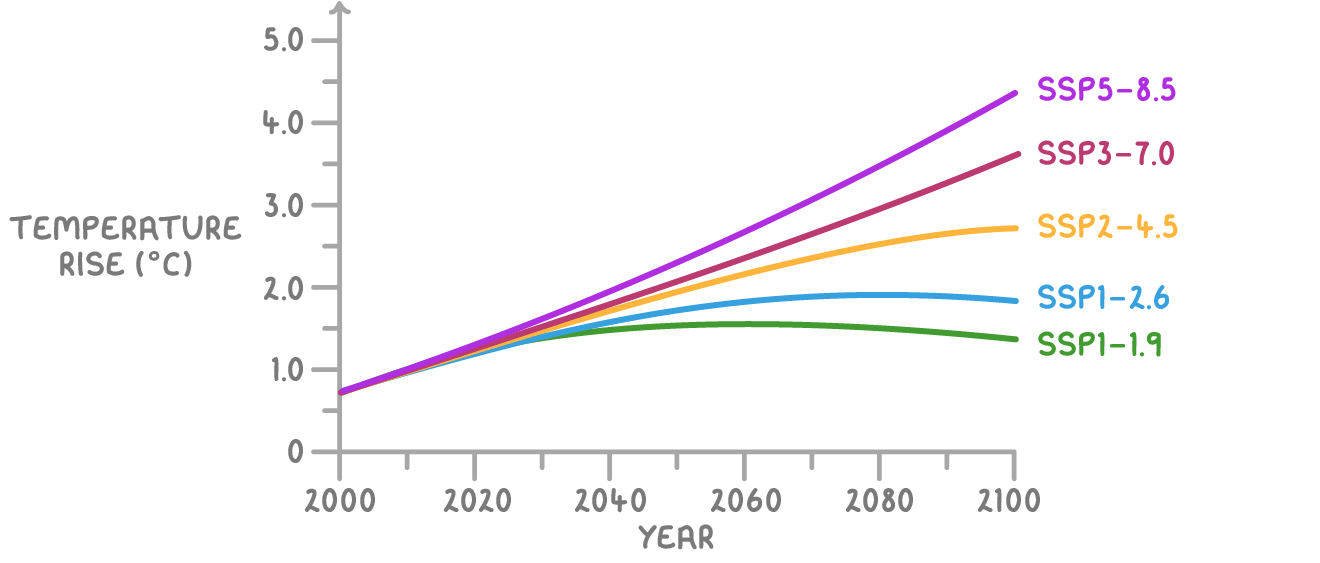
Key SSP scenarios and projections:
| Scenario | Description | Projected temperature rise by 2100 (compared to pre-industrial levels) |
|---|---|---|
| SSP1-1.9 | Strong mitigation with sustainable development | Around 1.4°C |
| SSP1-2.6 | Effective mitigation balancing economic growth and environmental protection | Around 1.8°C |
| SSP2-4.5 | Moderate mitigation with ongoing challenges | Around 2.7°C |
| SSP3-7.0 | Limited mitigation amid regional rivalries | Around 3.6°C |
| SSP5-8.5 | Minimal mitigation with fossil fuel-dependent growth | Around 4.4°C |
These projections show that stronger mitigation efforts lead to lower temperature rises, highlighting the urgency of international action.
International treaties and schemes
Major international treaties
- Kyoto Protocol (1997) - An agreement for participating countries to keep emissions within set limits.
- Paris Agreement (2015) - A treaty for participating countries to keep emissions within set limits.
These treaties foster global cooperation and ensure participating countries agree to monitor and report progress on their emission limits.
Carbon trading schemes
Carbon trading schemes put a limit on the amount of emissions countries and businesses can emit. If entities emit less than their limit, they can sell extra carbon credits. Conversely, if they emit more carbon emissions, they must buy more credits.