8.7 - Globalisation & Global Inequalities
How globalisation contributes to tax havens
Globalisation involves the increasing interconnectedness of economies, societies, and cultures worldwide, often driven by trade, technology, and the movement of capital. This process has transformed economic systems, including the emergence of tax havens, which are countries or territories that offer low or no taxes on financial activities to attract wealth.
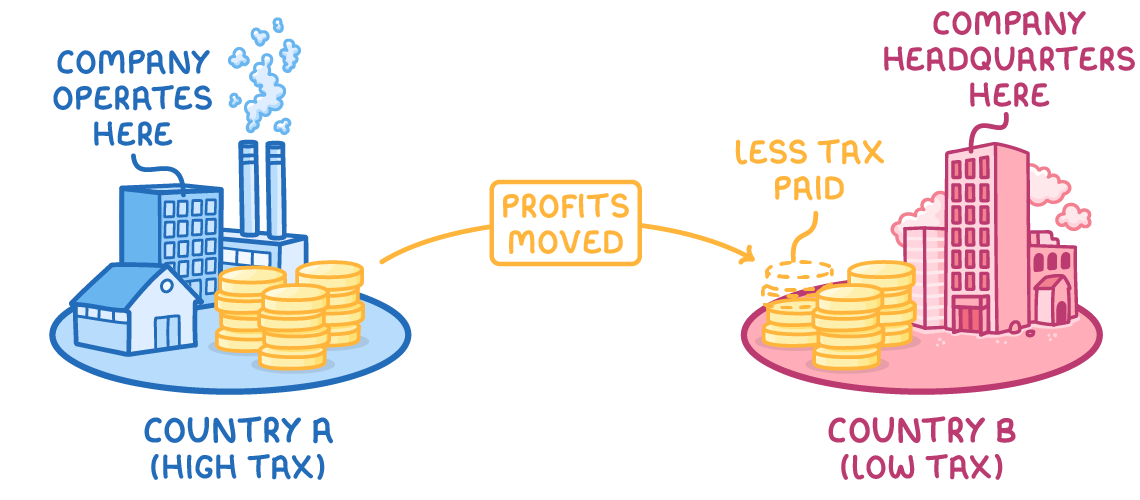
Key features of tax havens
- Tax havens typically operate under a low tax regime, where they impose minimal taxes on income, profits, or financial transactions.
- This setup appeals to wealthy individuals and transnational corporations (TNCs), which are large companies operating in multiple countries.
- Globalisation has reduced regulations on financial markets, making it easier to move money across borders without strict oversight.
- People and companies use tax havens to avoid high taxes in their home countries. For example, TNCs may locate their headquarters there, while wealthy individuals might live as expatriates (people residing abroad) or deposit funds in local banks.
Many tax havens are small island states, such as the Bahamas, or overseas territories of larger nations, like the Cayman Islands (a UK overseas territory).
Measuring secrecy in tax havens
The Financial Secrecy Index (FSI) ranks countries based on their level of financial secrecy and the scale of hidden money flows. A higher FSI score indicates greater secrecy and larger financial operations.
Top tax havens by FSI scores (2022):
| Country/Territory | FSI Score |
|---|---|
| USA | 1951 |
| Switzerland | 1167 |
| Singapore | 1023 |
| Hong Kong | 927 |
| Luxembourg | 804 |
How globalisation enables tax havens
Globalisation's removal of financial barriers allows money earned in one country to be easily stored in a tax haven. This lack of regulation means fewer laws restrict cross-border transfers, enabling TNCs and individuals to minimise tax liabilities legally.
Debates on the existence of tax havens
There is ongoing disagreement about whether tax havens should be permitted, as they offer both benefits and drawbacks. Governments, intergovernmental organisations (IGOs) like the EU and OECD (Organisation for Economic Co-operation and Development), and non-governmental organisations (NGOs) such as Oxfam hold varying views.
Advantages of tax havens
- Economic benefits for host countries - Small nations can generate revenue by charging registration fees for businesses, boosting their economies without relying on other industries.
- Support for TNCs and growth - By allowing companies to retain more profits, tax havens enable business expansion, job creation, and potentially broader economic growth.
Disadvantages of tax havens
- Loss of government revenue - Globally, up to $600 billion in corporate taxes is estimated to be lost annually, reducing funds available for essential services like health care and education.
- Facilitation of illegal activities - High secrecy levels can enable crimes such as international drug trafficking, as financial trails are harder to trace.
Perspectives on regulation
Governments and IGOs often tolerate tax havens as a byproduct of deregulated markets, though they have introduced measures to increase TNC accountability. However, stricter rules risk driving companies to relocate.
In contrast, NGOs argue for stronger regulations to end tax havens, claiming they exacerbate inequality by enriching the wealthy while forcing higher taxes or spending cuts on ordinary people, which can deepen poverty.
The growth of global inequality
Inequality refers to the uneven distribution of resources, opportunities, and wealth among individuals, groups, or countries. Globalisation has accelerated economic growth but also widened these gaps, concentrating wealth among a small elite.
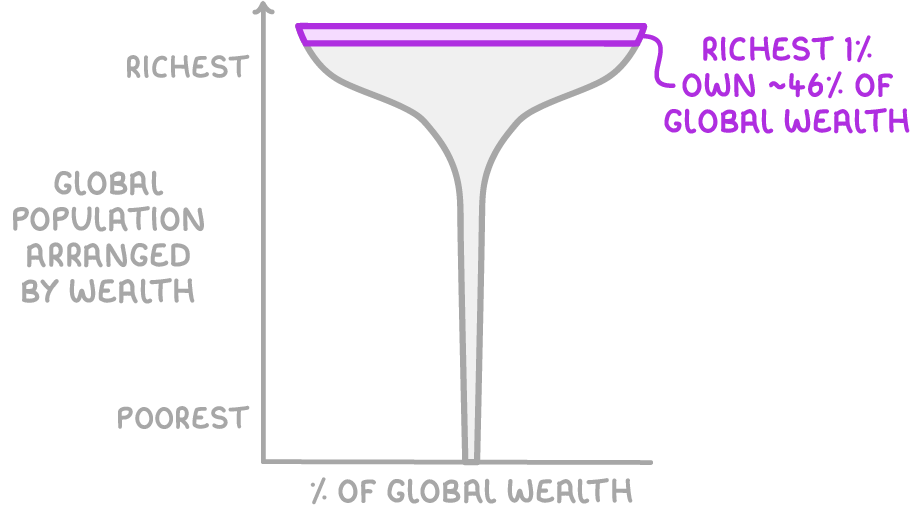
Key statistics on global inequality
In 2020, the richest 1% of the world's population owned nearly 46% of global wealth. This divide is growing both between countries (e.g., wealth concentrated in places like the USA and Japan) and within them, affecting social groups, genders, and elites versus the general population.
Causes linked to globalisation
- Wealth accumulation by TNCs - Easier global operations allow TNCs and their owners to amass vast fortunes, widening the gap between rich and poor.
- Limited access to opportunities - Unequal education restricts skills for those from poorer backgrounds, slowing economic contributions and technological progress. Health care disparities also reduce productivity.
Impacts on economies and stability
Rising inequality hampers economic growth by limiting workforce potential. It can also spark social tensions, protests, or conflicts, threatening political stability and the sustainability of the global economic system. In response, organisations like the United Nations (UN) have urged actions towards greater equality, particularly for women and minority groups.
Ecuador's alternative economic model
Some countries have rejected neoliberalism, an economic approach emphasising free markets, deregulation, and individual profit, in favour of models prioritising equality and sustainability. Ecuador provides a case study of this shift.
Historical context
Located in northwest South America, bordering Colombia to the north and Peru to the south and east, Ecuador faced instability in the 1980s and 1990s, including conflicts, recessions, and heavy international debts. Previous governments focused on oil profits and debt repayment, often at the expense of citizens.
Elected in 2006, President Rafael Correa (serving until 2017) introduced socialist policies to prioritise people over profits.
Key policies under Rafael Correa
- New constitution and buen vivir - In 2008, a constitution incorporated buen vivir, an indigenous philosophy meaning 'good living'. It emphasises community wellbeing, environmental protection, and a balanced life over individual success and endless growth, challenging neoliberal ideals.
- Public spending and taxes - Correa increased investments in services and temporarily raised taxes to fund earthquake recovery in 2016.
- Environmental actions - The government sued a US oil company for Amazon damage, highlighting a focus on ecological accountability.
Outcomes and measurements of success
Between 2006 and 2016, poverty rates nearly halved, and inequality decreased. This is evidenced by the Gini coefficient, a measure of income inequality where 0 represents perfect equality and 100 perfect inequality. Ecuador's Gini coefficient showed a general decline from around 54 in 2003 to about 44 in 2017, with some fluctuations and a slight rise by 2020.
This downward trend reflects reduced inequality, though the COVID-19 pandemic caused a recession, increasing poverty. In 2021, a government plan aimed to create opportunities to improve socio-economic conditions.
Criticisms and limitations
Correa's approach faced backlash from indigenous groups and activists for being authoritarian and for allowing oil drilling in remote Amazon areas, which contradicted environmental goals.