7.11 - Relationships with the Middle East
Alliances with global superpowers
Global superpowers have formed alliances with various countries in the Middle East, often influenced by historical events such as the aftermath of the First and Second World Wars. These alliances shape political, economic, and military relationships in the region. The alignments are complex and can shift over time, reflecting strategic interests like security, trade, and ideology.
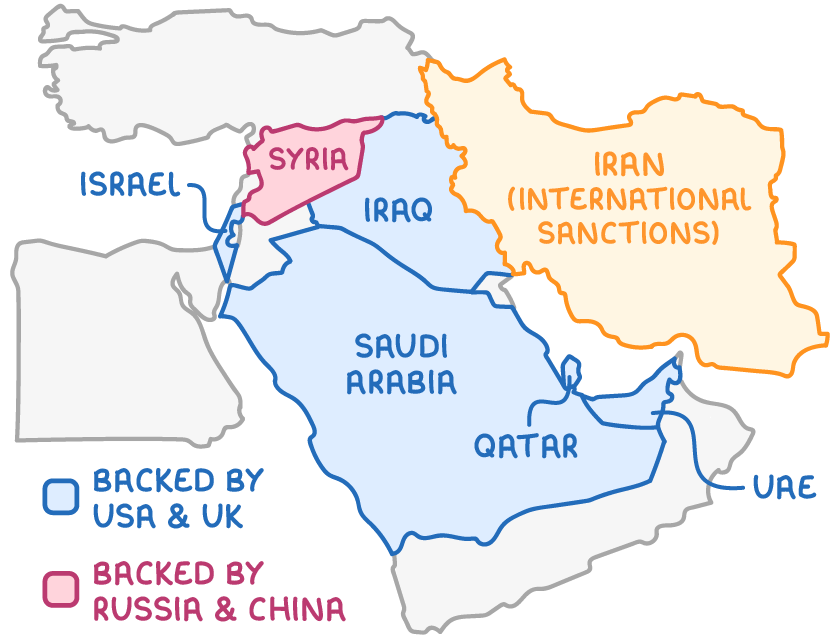
Examples of key alliances
- Israel - Established in 1948 with support from the UK and USA, Israel maintains strong ties with these countries today, based on shared political and security interests.
- Iraq - Historically linked to the Soviet Union, Iraq has generally aligned with the USA and its allies. However, conflicts such as the Gulf War (1990–1991) and the Iraq War (2003–2011) involved USA-led efforts to remove Iraqi leader Saddam Hussein, end the occupation of Kuwait, and promote regional stability.
- Syria - The Syrian government has been allied with Russia since 1980, and it also maintains close relationships with China and Iran.
- Iran - Faces international sanctions from countries including the USA, Japan, the Republic of Korea, and Switzerland due to its nuclear programme.
- Saudi Arabia, Qatar, and the UAE - These nations are allied with the USA and UK, primarily through economic connections related to oil trade.
These alliances can create a web of competing interests, where superpowers support different sides in regional disputes, leading to broader geopolitical tensions.
Reasons for tension in the Middle East
The Middle East experiences significant tension due to a combination of social, political, and cultural factors. These issues often stem from historical divisions and modern challenges, making the region a focal point for international involvement.
The Arab Spring uprisings
The Arab Spring refers to a series of protests and uprisings across the Middle East and North Africa between 2010 and 2012. These movements were driven by young people seeking change amid economic decline, government corruption, and demands for greater democratic rights. Leaders responded with force in some cases, leading to armed conflicts and a return to autocratic rule (governance under a single, dominant leader). This has left many people dissatisfied and has prolonged instability in affected countries.
Challenges with systems of governance
Newly formed governments in the region sometimes struggle to establish stable democracies. For instance, Iraq's constitution was created in 2005 after the country's first free elections, but ongoing conflicts arose as separatist groups challenged the government's authority and exposed weaknesses in its initial strategies.
Disputes over territory division
Tension often arises from how land is divided among religious and ethnic groups, especially when groups claim areas as their ancestral homelands. A prominent example is the ongoing conflict between Israelis and Palestinians since Israel's founding in 1948, where both sides dispute rights to the same territories.
Conflicts from cultural ideologies
Differing cultural and religious beliefs can fuel tension, particularly when groups perceive threats to their heritage or faith. In extreme cases, this leads to armed defence of ideologies.
Key example: The Islamic State (IS)
- IS is an extremist terrorist group driven by a radical interpretation of Sunni Islam (a major branch of Islam).
- The group has seized territory and carried out attacks to establish a caliphate – a religious state governed under Islamic rule.
- IS's rise is linked partly to power imbalances after the Iraq War, where a majority Sunni government was replaced by one dominated by Shia Muslims (another major branch of Islam), creating resentment and opportunities for extremism.
Challenges from the legacy of historical alliances
Historical alliances between superpowers and Middle Eastern countries have left lasting challenges, including unintended consequences from past actions. These legacies can complicate current international relations, as superpowers deal with the fallout from their earlier involvements.
Issues with arms sales and shifting alliances
Countries such as the UK, USA, some European nations, and Russia have sold weapons to the Middle East over decades. Due to internal arms trading and changing political alignments, allied forces sometimes face opponents using weapons supplied by their own countries.
Refugee crises and regional strain
Armed conflicts have generated large refugee populations, with over 6.6 million Syrians fleeing since 2011. Hosting refugees strains neighbouring countries' resources and can heighten tensions, especially if cultural or religious differences exist between refugees and host populations.
Conflicting alliances and territorial disputes

Some nations face divided loyalties due to overlapping alliances. For example, Turkey, as a NATO member, supports efforts to combat Islamic State in Syria. However, the Kurds – an ethnic group without a recognised state – also fight Islamic State but clash with Turkey over demands for an independent Kurdish territory.
Tolerance of terrorist groups
Certain countries may not actively oppose terrorist organisations, allowing them to expand. Funding for these groups can come from networks within Middle Eastern states, even if the groups do not control territory there.
Impact of natural resources on global relations
The Middle East's abundant resources, particularly oil, heavily influence its interactions with superpowers. These resources drive economic dependencies and can escalate tensions when access is threatened. Stability in the region is crucial for global trade, making resource management a key factor in international diplomacy.
The role of oil reserves
The Middle East holds approximately 48% of the world's oil reserves, attracting involvement from Europe and the USA to secure supplies. Early investments by the UK and later the USA helped develop the region's oil industry, fostering technological growth and economic ties.
How oil creates tension:
- Conflicts or trade sanctions, such as those imposed by the USA on Iran in 1979 and 1995, disrupt oil prices – rising during instability or falling as competitors fill supply gaps.
- Political stability benefits trading nations, but accusations like Iraq's claim that Kuwait was 'slant drilling' (extracting oil via pipelines under borders) led to the 1990 invasion of Kuwait.
Dependence on oil and economic vulnerabilities
The region's hot, dry climate limits agriculture, making oil a primary economic driver. This reliance means disruptions in oil trade affect multiple countries.
Tensions over scarce resources like water

Resources in short supply, such as water, also spark conflicts. The Euphrates and Tigris rivers serve as vital transboundary water sources (rivers crossing international borders) for Turkey, Iraq, and Syria. Actions like damming rivers to favour one country's supply or withdrawing from water-sharing agreements can intensify disputes.