7.10 - Relationships with Developing Countries
Superpowers, emerging powers and developing countries
- Developing countries often maintain strong connections with former colonial powers or current superpowers, which can influence their economic and political landscapes.
- These ties frequently involve trade and alliances, but the benefits are not always equal.
- Emerging powers, which are nations experiencing rapid economic growth and increasing global influence (such as China and India), are forming new relationships with developing countries, often on different terms than those offered by established superpowers.

How superpowers interact with developing countries
- Superpowers tend to dominate trade relationships with developing countries, often gaining more advantages from these exchanges.
- This occurs because superpowers can set the terms of trade, which may not favour the developing nations.
- Developing countries export raw materials and basic crops, such as sugar and tobacco, at low prices to superpowers.
- In return, superpowers sell back complex manufactured goods at higher prices.
- This creates an unfair dynamic where developing countries have limited bargaining power and must accept the conditions imposed.
- Superpowers are reluctant to alter these arrangements if it might diminish their global status or economic dominance.
- As a result, developing countries may remain economically dependent, with little room to negotiate better deals.
How emerging powers differ in their approach
- Emerging powers also seek low-cost raw materials from developing countries, but they can offer manufactured goods at lower prices than superpowers.
- This makes their propositions more attractive and competitive.
- Unlike superpowers, emerging powers have less established global status to protect, allowing them to build stronger, more flexible relationships with developing countries without the same concerns about maintaining dominance.
- These relationships can provide developing countries with affordable goods and investment, potentially fostering greater economic interdependence.
This shift is creating new patterns in global trade, where emerging powers are challenging the traditional dominance of superpowers.
China's relationships with African countries
China, as an emerging power, has developed significant ties with various African nations in recent decades. This relationship focuses on trade, investment, and aid, marking a shift in geopolitical dynamics on the continent. These interactions increase interdependence, meaning the economies and policies of the involved countries become more closely linked, though the benefits are not always evenly distributed.
China–Africa relations involve strategies to secure resources and expand influence
-
Trade expansion - China imports large volumes of raw materials and energy sources from Africa, such as coltan (a mineral used in mobile phones) from the Democratic Republic of Congo and oil from Nigeria.
-
Foreign direct investment (FDI) - In 2020, China invested approximately US$4.2 billion in Africa, with a substantial portion going to five key countries.
Top five African countries receiving Chinese FDI (2020) Amount Kenya US$630 million Democratic Republic of Congo US$612 million South Africa US$400 million Ethiopia US$311 million Nigeria US$309 million -
Foreign aid provision - China offers grants and low-interest loans to countries with strong trade ties, such as Angola, to support development.
-
Infrastructure and energy projects - Investments fund large-scale developments, including roads, rail lines, ports, communication networks, hydroelectric dams (like the Djibloho Dam in Equatorial Guinea), and water treatment plants.
These elements demonstrate how China is building long-term economic connections, often tied to resource access.
Opportunities of China-Africa relations
The growing ties between China and African countries present several positive outcomes. These opportunities can stimulate economic growth and development in African nations.
Economic and social benefits
- Attracting further investment - Chinese-funded infrastructure, such as transport networks, makes African countries more appealing to other foreign investors and private companies, facilitating new trade links.
- Supporting local businesses - Improved roads, rails, and ports benefit domestic companies, encouraging intra-African trade and economic integration.
- Employment generation - Construction and operational phases of projects create jobs for local people, leading to long-term economic boosts in communities.
- Community aid initiatives - Investment deals often include aid projects that directly help local populations.
- Access to affordable goods - African markets are expanding for Chinese products, which are often cheaper, allowing more people on lower incomes to purchase consumer items.
Environmental and energy advantages
Investments in hydroelectric power plants encourage renewable energy use. Between 2000 and 2013, China funded 17 such plants across 14 African nations, reducing reliance on fossil fuels.
These opportunities highlight how interdependence can drive progress.
Challenges of China-Africa relations
While there are benefits, the China-Africa dynamic also introduces significant difficulties. These challenges can create economic, political, and environmental problems for African countries.
Economic and political concerns
- Resource depletion risks - Many trade deals rely on finite resources like minerals and oil. If these run out, China might reduce investments, leaving African economies exposed.
- Neocolonial parallels - The relationships resemble historical colonial exploitation, where politically weaker African nations are vulnerable to unfair terms set by a more powerful partner.
- Competition with local industries - The influx of cheap Chinese goods increases competition for African manufacturers, potentially harming local economies.
- Low-quality employment - Jobs from Chinese projects are often short-term and low-paid.
Environmental and health impacts
- Degradation from resource extraction:
- The demand for materials has led to severe environmental harm, such as open-cast mining in Zambia destroying woodland savanna at sites like the Nchanga mine, where deep pits prevent landscape recovery.
- Oil spills in countries like Angola and Chad have contaminated water sources and farmland.
- Pollution and waste issues - New industries generate toxic waste that pollutes water when regulations are weak.
- Worker health risks - In metal extraction sectors, poor conditions pose dangers to the health and well-being of African workers.
These challenges underscore the need for balanced policies to mitigate negative effects while maximising gains.
Rising economic importance of Asian countries
Asia is becoming a central hub in the global economy, with emerging powers like China and India leading the charge. This shift is reshaping international trade, population dynamics, and geopolitical influence, moving the focus away from traditional centres like Europe.

Key drivers of Asia's economic rise
- Expanding trade networks - Countries like China and India are forging strong global trade links, enhancing Asia's geopolitical role.
- Shifting economic centre - The world's economic centre of gravity is moving towards Asia as the region produces a larger share of worldwide output.
- Population and market growth - By 2030, 27 of the world's 33 megacities will be in Asia, creating vast markets driven by middle-income consumers.
- Rapid GDP increases - Beyond China and India, nations like Indonesia and Malaysia have seen consistent GDP growth from 2000 to 2019, contrasting with declines in Europe.
- Formation of trade blocs - In 2020, 15 Asia-Pacific countries, including ASEAN members, China, Japan, South Korea, Australia, and New Zealand, established the Regional Comprehensive Economic Partnership (RCEP). This is the largest trade bloc ever, covering almost a third of all global economic activity.
These developments are boosting Asia's influence, but they also introduce complexities in international relations.
Geopolitical tensions from Asia's rise
The economic ascent of Asian countries has generated strains, particularly in regions with historical conflicts. These tensions can affect political and economic prospects.
Major sources of regional stress
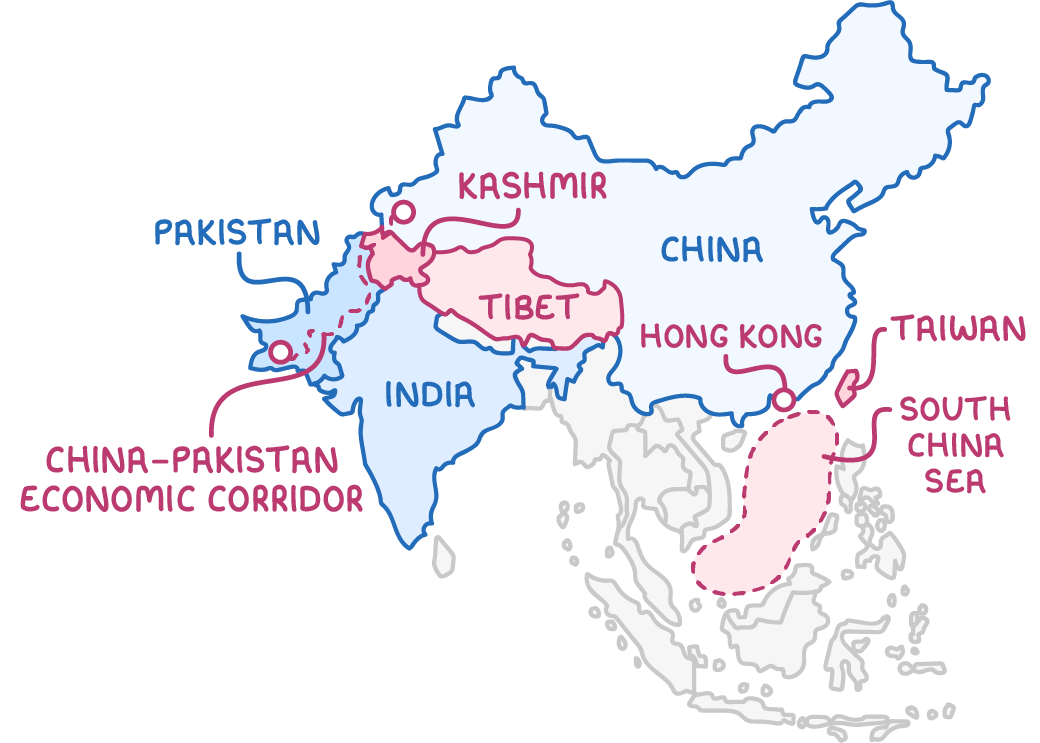
- China's territorial disputes - China faces international criticism over its control of Hong Kong, tensions with Taiwan, and governance of Tibet. Its efforts to dominate the South China Sea have heightened conflicts with neighbouring countries and global powers.
- India-Pakistan rivalry - Disputes over the Kashmir region create ongoing political and economic risks for both nations, potentially hindering development.
- Infrastructure and alliances - The China-Pakistan Economic Corridor has escalated tensions between India, China, and Pakistan.