7.1 - Classifying Powerful Countries
Classifications of powerful countries
Countries can gain geopolitical influence based on their human and physical characteristics, which determine their level of power on a global scale.

Three main types of powerful countries
- Superpowers - These nations, such as the USA, exert dominance worldwide through superior economic, military, and political strength. This allows them to shape global events and policies.
- Emerging powers - Countries like China show rapid growth in influence, particularly through economic expansion, positioning them as potential future superpowers.
- Regional powers - Nations such as Mexico hold sway primarily within their own continent, influencing neighbouring countries but lacking global reach.
Key characteristics of superpowers
Currently, the USA is the only true superpower, dominating all these areas, while historical examples include Britain as a hyperpower (a completely unchallenged dominant force) from around 1850 to 1910, and the USA in that role from 1990 to 2010.
Six essential characteristics
-
Economic - A robust economy forms the base of power, enabling investment in other areas. Superpowers have high gross domestic product (GDP), which is the total value of goods and services produced in a country. They generate global revenue through transnational corporations (TNCs), which are companies operating in multiple countries, and maintain stable currencies to facilitate international trade.
-
Political - This involves shaping global decisions through membership in intergovernmental organisations like the United Nations (UN). Superpowers influence policies, alliances, and behaviours of other nations.
-
Military - Superpowers allocate a large portion of GDP to defence, exporting technology to allies and using force to protect interests. This includes threats, invasions, or aid.
Country Annual military spending (US$ billion) (2020) USA 778 China 252 India 72 Russia 62 Saudi Arabia 57 -
Cultural - Influence spreads through ideology, which is a dominant set of beliefs or behaviours that others aspire to follow. This includes arts, food, fashion, and media that promote a country's values globally.
-
Demographic - A large, educated, and healthy population supports a strong workforce and military. Superpowers often attract more migrants than they lose, boosting innovation and labour supply.
-
Access to natural resources - Abundant supplies of energy (like coal or oil) or metals (such as iron) reduce dependence on imports and enable profitable trade, enhancing control over other nations.
The role of physical geography
Physical geography also plays a role. Larger land areas generally provide more resources and strategic advantages, though exceptions exist, like Britain's historical influence despite its size. Features such as extensive coastlines facilitate trade, while mountains or other topography can aid defence or limit expansion.
Hard and soft power approaches
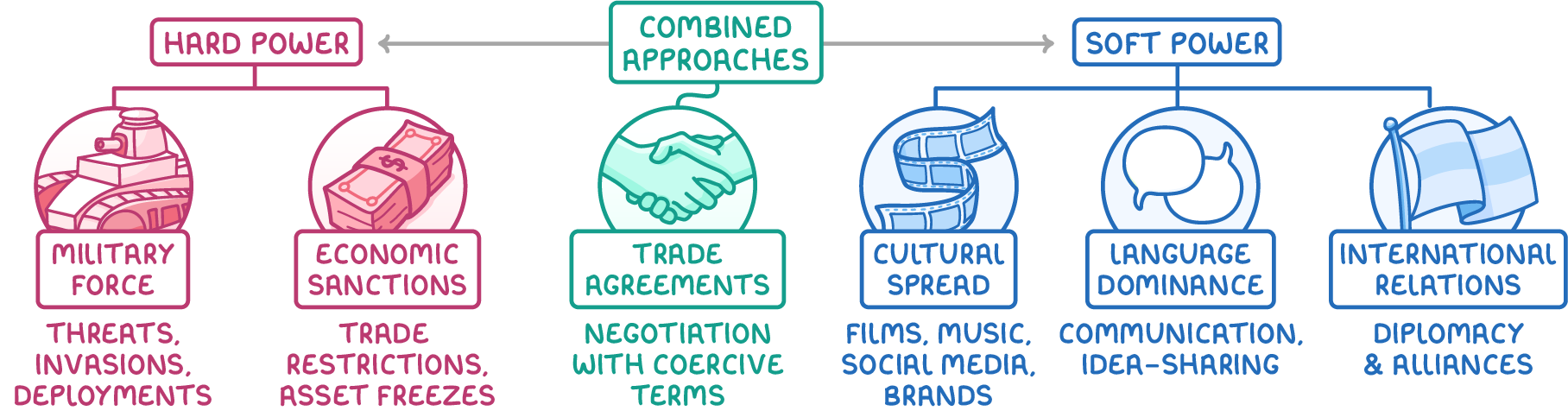
Hard power
Hard power involves using military or economic force to compel others, often creating immediate results but at high costs and risks. Its importance has declined as global interconnectedness grows, though it remains relevant.
Key elements of hard power:
- Military force - This includes threats, invasions, or deployments from well-equipped armies, foreign bases, and nuclear capabilities. For example, the USA and its allies applied this during the Iraq War (2003–2011).
- Economic sanctions - Measures like trade restrictions, asset freezes, arms embargoes, or travel bans limit a target's actions. Russia's 2022 invasion of Ukraine prompted widespread sanctions against it.
Hard power can achieve short-term goals but may foster long-term instability and is expensive to maintain.
Soft power
Soft power, a term coined by Professor Joseph Nye in 1990, attracts others through appealing culture, policies, or negotiations rather than force. globalisation has amplified its role, as shared cultural elements make influence easier.
Key elements of soft power:
- Cultural spread - Films, music, television, social media, and brands export a country's lifestyle and values, encouraging emulation.
- Language dominance - A widely used language, like English, facilitates communication and idea-sharing globally.
- International relations - Strong diplomatic ties and attractive policies build alliances and persuasion without threats.
Soft power works best among culturally similar nations and promotes voluntary cooperation.
Combined approaches
Some strategies mix hard and soft elements. For instance, trade agreements involve negotiation (soft) but may impose terms that control pricing or access, adding a coercive aspect (hard).
China's Belt and Road Initiative
China's Belt and Road Initiative (BRI), launched in 2013, aims to enhance trade links and position China as a future superpower.
Overview of the BRI
The initiative connects China with Asia, Africa, and Europe through massive investments, totalling around US$1 trillion by 2023, focused on infrastructure like railways, ports, and airports. This fosters connectivity and economic ties.
Key projects
| Project | Description |
|---|---|
| New International Land-Sea Trade Corridor | Combines roads, railways, and sea routes for efficient links between China, Asia, and Europe. |
| China-Pakistan Economic Corridor | Builds oil pipelines, power plants, and transport networks to boost energy and trade. |
| China-Laos Railway | Links southwest China to Laos. |
| New Eurasia Land Bridge | Enhances rail connections from China to Europe. |
These projects span economic corridors (land routes), sea routes (maritime paths), and dedicated railways.

Results of the BRI
China reports creating about 400,000 jobs in participating countries, lifting around 40 million people out of poverty, and promoting economic growth. This is said to encourage international cooperation and peace.
Criticisms and limitations of the BRI
- Critics argue it creates a 'debt trap', where loans to developing nations give China leverage for political support.
- There are concerns that new ports and airports could serve future military purposes, expanding hard power subtly.