4.1 - Variation in Economic Activity
Industrial sectors and place classification
Places can be categorised based on their main economic activities, which often reflect the types of industries that dominate there. These industries are divided into four key sectors, each focusing on different stages of production and service delivery. Understanding these sectors helps explain why some areas thrive while others face challenges.
The four main industrial sectors
- Primary sector - Involves extracting and producing raw materials directly from the natural environment, such as farming, mining, and fishing.
- Secondary sector - Focuses on manufacturing and processing raw materials into finished goods, turning basic resources into more complex products like cars or machinery.
- Tertiary sector - Provides services that help people access and use goods, including retail, customer support, and administrative tasks.
- Quaternary sector - Centres on research, development, and innovation, often in high-tech fields like scientific research or digital technologies.
This classification shows how a place's economy can be shaped by its resources, history, and location. For example, areas rich in natural resources might rely more on primary activities, while urban centres often emphasise services.
Changes in industrial sectors over time
As places develop economically, their dominant sectors tend to shift from basic resource extraction to advanced services and innovation. This evolution reflects broader changes in technology, global trade, and workforce skills, leading to more diverse and connected economies.
The Clark-Fisher model
The Clark-Fisher model illustrates how employment in different sectors changes as an economy progresses through stages of development. It uses a timeline to show the relative importance of each sector, helping to predict patterns in economic growth.
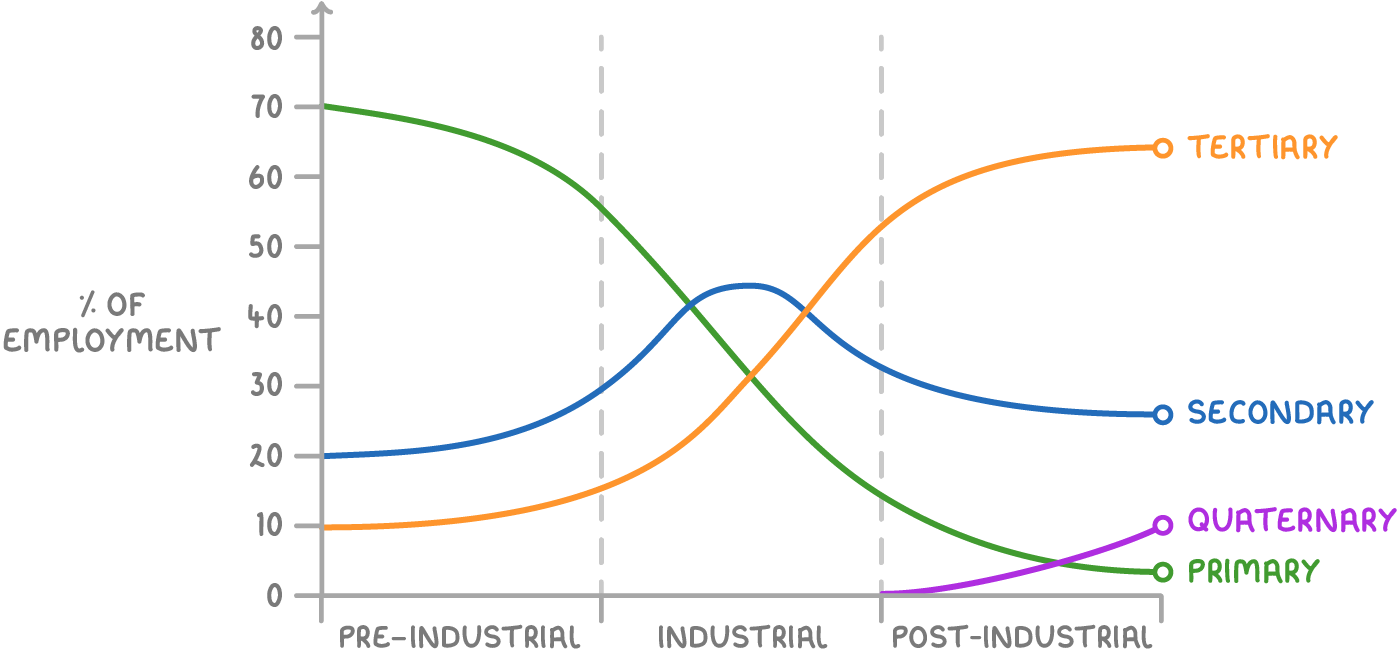
Stages of the Clark-Fisher model:
- During pre-industrial stages, primary industries dominate because societies rely heavily on agriculture and raw material extraction.
- As industrialisation occurs, secondary manufacturing rises sharply, creating jobs in factories and production.
- In post-industrial phases, tertiary services become the largest sector, with quaternary activities emerging as innovation drives growth.
This progression often results in deindustrialisation, where traditional manufacturing declines in favour of service-based and knowledge-driven economies. Places that adapt to these changes typically become more prosperous and globally linked.
Factors influencing sector shifts
- Deindustrialisation - The decline of secondary industries in developed areas, often due to competition from lower-cost regions abroad.
- Shift to the new economy - Movement towards cutting-edge technologies and quaternary activities, replacing outdated methods (the 'old economy') and fostering faster growth.
- Geographical patterns - Rural areas often retain a primary focus, northern UK cities like Leeds and Manchester have transitioned from secondary to diverse industries, while London and the south-east lead in quaternary sectors around universities.
Places successfully shifting to tertiary and quaternary sectors usually see higher wages and better connectivity, compared to those reliant on primary or secondary industries.
Economic profiles of Liverpool and Lerwick
Different places exhibit unique economic characteristics shaped by their history, location, and recent developments. Comparing urban and rural examples highlights how industrial sectors and employment types influence local prosperity.
Central Liverpool's economy
Central Liverpool, situated on the River Mersey estuary, evolved from a major 18th- to mid-20th-century port and manufacturing hub. It attracted global immigrants and grew rapidly, but dock and factory decline in the 1960s caused widespread deprivation. Recent regeneration, including its 2008 European Capital of Culture status, has boosted investment in services.
Key features:
- High employment in managerial and professional roles, reflecting a strong tertiary sector with office-based redevelopment.
- Low levels of skilled trades and basic labour jobs, due to the shift away from manufacturing.
- Compared to England's average, it has more professionals but fewer in elementary occupations.
This profile shows a post-industrial economy focused on services, contributing to urban revival.
Lerwick's economy
Lerwick, the main town on the Shetland Islands, has a history tied to fishing since Viking times, with Scottish integration from the 15th century. The 1970s North Sea oil discovery, combined with tourism growth, has driven economic expansion.
Key features:
- High employment in skilled trades and elementary roles, linked to the ongoing seafood industry (catching, processing, and sales).
- Lower levels of managerial and professional jobs compared to Scotland's average.
- Emphasis on primary activities like fishing, with some tertiary growth from oil and tourism.
Lerwick represents a more traditional, resource-based economy, contrasting with Liverpool's service-oriented transformation.
Classification by types of employment
Beyond industrial sectors, places can be defined by the nature of jobs available, which affects financial security, community growth, and perceptions of success. Employment types range from stable full-time roles to more precarious options, influencing overall economic health.
Main types of employment
- Economically inactive individuals - People not working due to retirement, unemployment, long-term illness, or disability; high numbers can signal lower success and increase dependence on active workers.
- Temporary, part-time, or zero-hours contracts - These offer less income and security than full-time permanent jobs, making people vulnerable to economic downturns and hindering place growth.
- Seasonal employment - Common in rural farming areas or tourist spots, providing income during peak times but instability otherwise.
- Self-employment - Involves running one's own business, often filling market gaps and fostering community ties; success can create jobs for others.
Comparing Liverpool and Lerwick
- Lerwick has higher full-time employment and lower unemployment than Liverpool.
- Liverpool features more students, supported by its universities, while both have low part-time rates.
Places with stable, full-time jobs are generally seen as more prosperous.
Connections between economic and social variables
Economic factors like income and job types are closely linked to social aspects such as health, education, and mobility. These connections can create cycles of advantage or disadvantage, affecting a place's overall development.
How social factors influence employment
- Health and disabilities - Poor health limits job options, increasing reliance on support and reducing earning potential.
- Education engagement - Low job prospects can discourage young people from further education; children of professionals are more likely to pursue higher qualifications and similar careers.
- Education levels - Higher qualifications, like degrees, lead to better-paid jobs; places with many graduates have higher average earnings.
- Personal mobility - Advanced education enables relocation for better opportunities, enhancing career prospects.
- Location-specific barriers - In areas like Lerwick, despite high numbers of degree holders, fewer professional roles are available due to the local economy's focus.
For example, 2011 Census data shows Liverpool with more people having no qualifications compared to Lerwick, where foundation degrees are more common.
How income affects social factors
- Health and life expectancy - Higher earners often enjoy better health through access to nutritious food, check-ups, and quality housing.
- Other influences on health - Urban pollution in places like Liverpool can harm health despite income, while Lerwick reports higher self-rated good health despite lower wages.
These links show that economic improvements can enhance social well-being, but location and environment also play important roles.
Quality of life and economic inequalities
Quality of life assesses overall well-being, including health, living standards, and participation in society. It often correlates with economic factors but is not solely determined by income, revealing inequalities across places.
Key aspects of quality of life
Quality of life varies regionally; low-earning areas typically score poorly on indicators like life expectancy, health conditions, and education. For instance, in the UK Prosperity Index (ranking 1 best to 389 worst), Liverpool ranks among the lowest at 381st, while Shetland (including Lerwick) ranks significantly higher at 84th.
Influences beyond income
- Cost of living - High-earning places may have expensive housing and essentials, reducing actual quality of life.
- Life satisfaction - Some low-income areas report high satisfaction; for example, Nigeria's low GDP per capita contrasts with life satisfaction levels similar to high-income Hong Kong.
This demonstrates that while economic success boosts quality of life, factors like community and affordability also contribute, highlighting the need for balanced development.