6.11 - Implications of Changes to the Carbon Cycle
Human reliance on carbon and water cycles
Human wellbeing describes the overall quality of life, including social, economic, and health aspects, where people feel safe, healthy, and able to improve their circumstances. This wellbeing depends heavily on natural systems like the carbon and water cycles.
These cycles provide essential resources for food production, settlement building, and economic growth. Their health is strongly linked to human wellbeing.
People approach these cycles in different ways. Some treat them as resources to exploit for short-term gains. Others adopt a custodial approach, focusing on conservation to maintain long-term benefits.
Role of forests in human wellbeing
Forests are vital ecosystems that offer multiple benefits, directly linking to human wellbeing through economic, health, and environmental services.
Key ecosystem services provided by forests
- Economic resources - Forests supply timber, paper, and food products, supporting livelihoods for over 1.6 billion people worldwide.
- Medicinal research - Tropical rainforests are hotspots for discovering new compounds used in pharmaceuticals.
- Climate regulation - Forests moderate local temperatures and act as barriers against noise and air pollution.
- Emotional and spiritual value - Woodlands offer spaces for recreation, reducing stress and enhancing mental health. Many value forests for their beauty.
Deforestation disrupts these services.
Environmental Kuznets curve and deforestation
The environmental Kuznets curve illustrates how environmental degradation relates to a country's economic development, forming an inverted U-shape. Environmental degradation refers to damage like pollution or habitat loss caused by human activities.
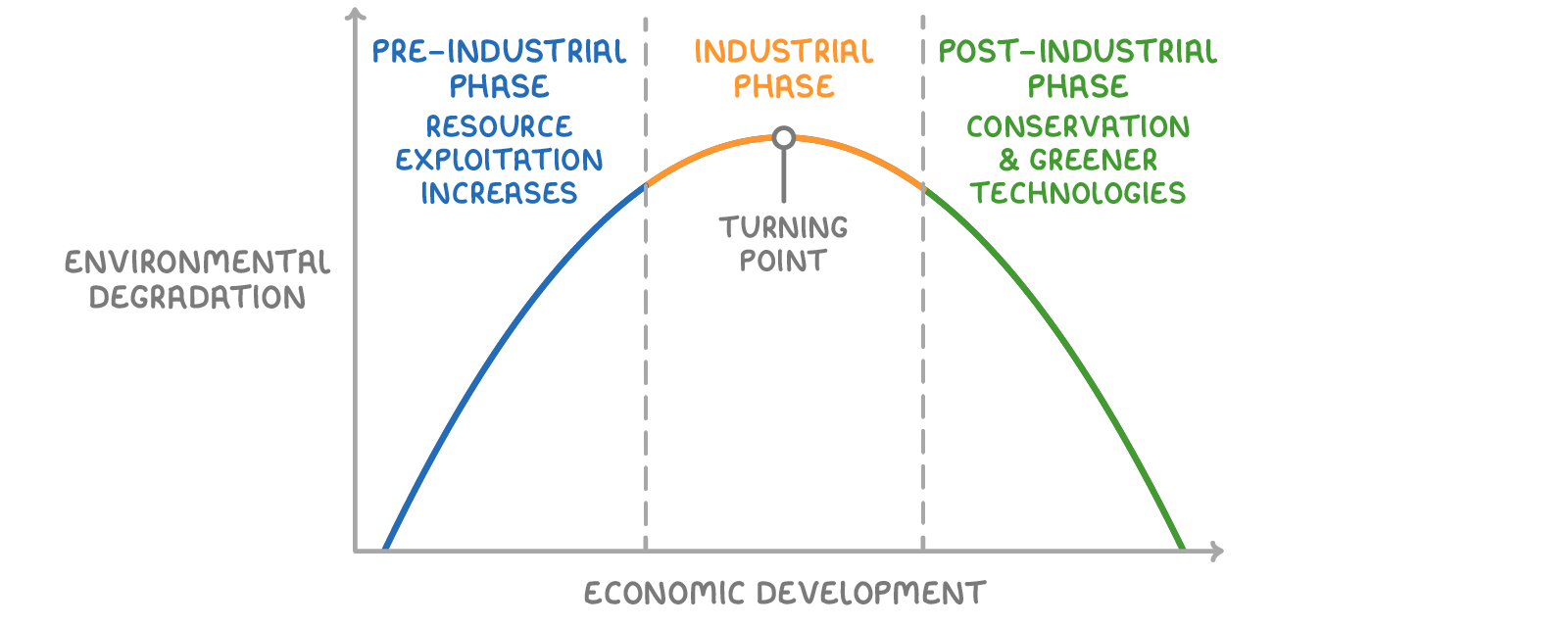
Stages of the environmental Kuznets curve
- Pre-industrial phase - Low development means minimal resource use, so degradation is low.
- Industrial phase - As economies grow, resource exploitation increases, causing rising degradation, such as through rapid deforestation for industry.
- Turning point - At peak industrialisation, a shift towards sustainability begins.
- Post-industrial phase - Degradation decreases as countries implement conservation, import resources, or adopt greener technologies.
The curve's shape varies by country; some nations industrialise quickly and stay in high-degradation phases longer.
Deforestation trends in different income groups
Deforestation rates differ based on economic priorities. In low-income countries, immediate needs like poverty alleviation often lead to forest exploitation.
| Income group | Trend in forest area (1990–2016) | Reasons |
|---|---|---|
| High-income countries | Slight increase (from around 25% to just under 28% of land area) | Focus on conservation, afforestation, and restoration programmes, often supported by charities raising awareness. |
| Low-income countries | Steady decrease (from just over a quarter to around 22% of land area) | Prioritisation of economic gains over long-term environmental health. |
| World average | Very slight decrease (around 30% of land area) |
Effects of rising temperatures on water stores
Rising global temperatures alter water stores and flows. This leads to social and economic challenges, such as higher flood and drought risks, making crop production more difficult and costly due to the need for interventions like irrigation.
Main changes to water stores
- Precipitation patterns - Higher temperatures boost evaporation, adding more water vapour to the atmosphere. This results in intense rainfall events causing flash floods, alongside extended dry periods increasing drought risks.
- River regimes - In glacial regions, prolonged melting seasons raise meltwater volumes entering rivers, heightening flood potential.
- Freshwater stores - Reduced snowfall and faster melting shrink cryosphere storage. Arid areas may see smaller lakes and depleted groundwater.
Impacts of rising temperatures in the Arctic
The Arctic region is warming rapidly, affecting its role in the carbon and water cycles. This creates both challenges and opportunities for human wellbeing, particularly for indigenous communities and global sea levels.
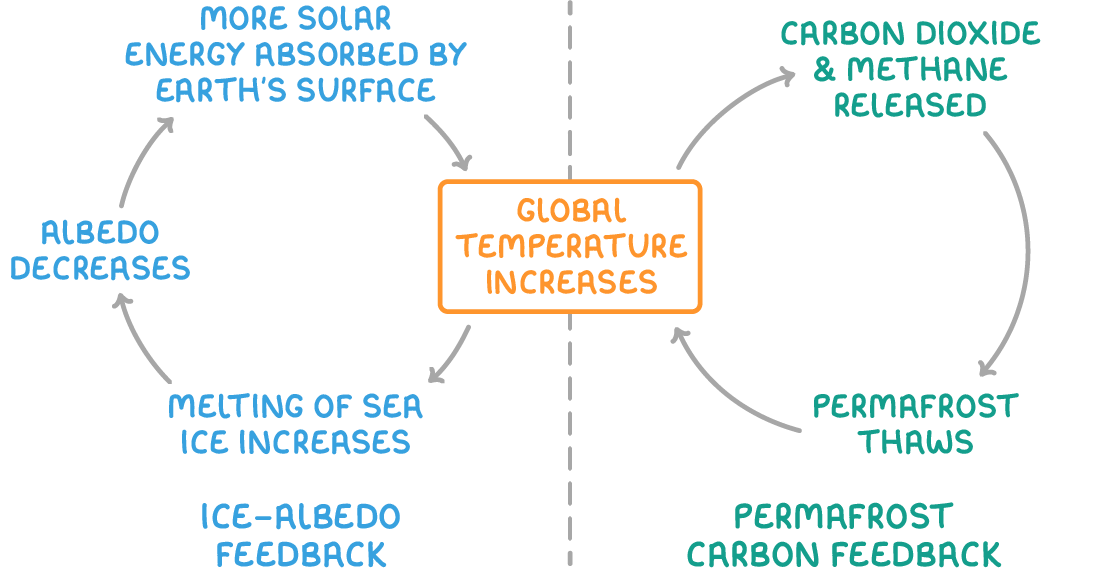
Challenges of warming in the Arctic
- Sea-level rise - Reduced snowfall and extended melting periods contribute to global sea-level increases, threatening coastal livelihoods through flooding.
- Albedo effect - Ice reflects solar radiation, but melting exposes darker water that absorbs more heat, creating a positive feedback loop accelerating further melting.
- Permafrost thaw - The Arctic acts as a net carbon sink, but thawing permafrost releases stored carbon as carbon dioxide and methane. In places like northern Canada, this destabilises ground, causing infrastructure subsidence.
- Shipping and pollution risks - Melting opens routes like the North-West Passage, increasing vessel traffic but raising chances of oil spills harming marine life.
Opportunities from warming in the Arctic
- Changes in wildlife and hunting - Animals like caribou extend their grazing ranges northward, lengthening hunting seasons for indigenous groups dependent on them for food.
- Agricultural benefits - Warmer conditions extend growing seasons, potentially boosting crop yields in some areas.
- Marine ecosystems - Ice-free seas expand habitats for phytoplankton, enhancing carbon sequestration.
Arctic sea ice extent has shrunk dramatically; for instance, from extensive coverage in the mid-1980s to much reduced levels around the early 2010s, amplifying these impacts.
Importance of managing oceans for human wellbeing
Oceans are integral to human wellbeing, but rising temperatures and acidity threaten their ability to support marine life. Effective management is crucial for economies dependent on seas.
Challenges from ocean changes
- Marine species migration - Tropical fish move poleward to avoid warming waters, disrupting food webs and increasing competition. This affects communities relying on local fisheries.
- Fishing industry impacts - Developing countries, without advanced vessels, struggle to follow migrating fish, reducing food security and income.
- Tourism declines - Coral bleaching and disintegration harm attractions like reefs, affecting businesses such as dive schools.
- Sea-level threats - Rising waters endanger low-lying coasts, requiring decisions on defences, which must balance costs against global climate issues.