2.1 - Economic Growth
The main macroeconomic objectives of governments
Governments pursue several key goals to manage the economy effectively, aiming to improve overall living standards and stability.
Primary macroeconomic objectives
- Economic growth - This involves boosting the economy's ability to produce more goods and services. Governments seek steady increases to raise living standards.
- Low inflation - Keeping price increases under control is essential. For instance, a target like 2% helps maintain purchasing power, with bodies such as a monetary policy committee adjusting interest rates to meet this goal.
- Reducing unemployment - Governments work towards full employment, where most people who want jobs can find them. Higher employment levels make the economy more efficient and boost total spending through increased earnings.
- Balance of payments equilibrium - This means matching earnings from exports and incoming funds with spending on imports and outgoing flows. It prevents issues from ongoing surpluses or deficits that could harm the economy.
Additional macroeconomic objectives
- Budget balance - Ensuring government income from taxes matches or exceeds spending to avoid excessive debt.
- Environmental protection - Promoting sustainable practices to safeguard natural resources.
- Income equality - Reducing gaps between rich and poor through policies like progressive taxation.
Different types of economic growth
Economic growth reflects an expansion in what an economy can produce, measured in various ways depending on the timeframe.
Short-run economic growth
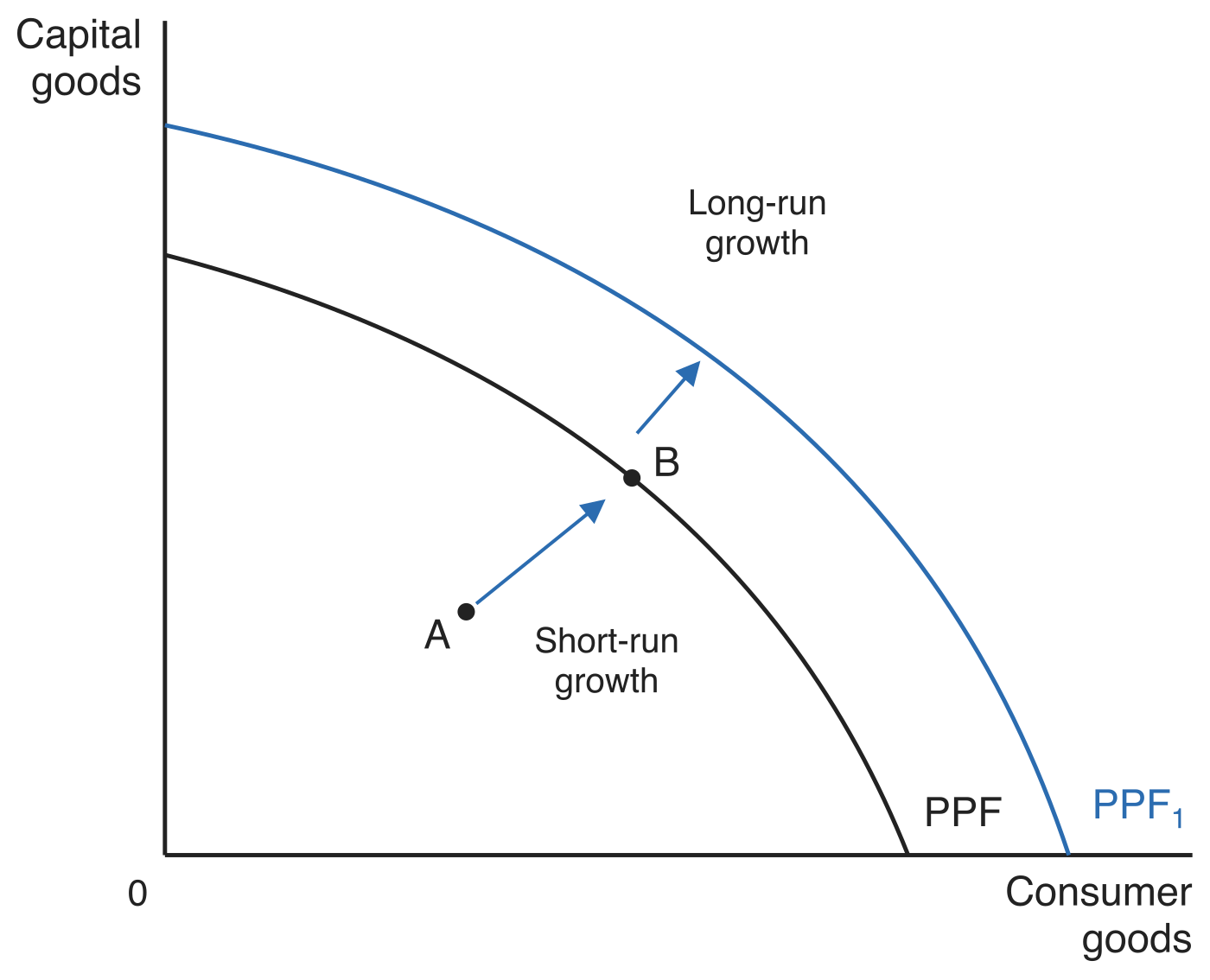
Short-run growth, also called actual growth, measures changes in real gross domestic product (GDP) after removing inflation effects. It often fluctuates due to shifts in total demand or supply. On a PPF diagram showing capital goods against consumer goods, this appears as a movement from point A inside the curve to point B on the curve, without shifting the PPF itself.
Long-run economic growth
Long-run growth, or potential growth, comes from enhancing the economy's overall capacity through better resources or efficiency. This might involve advanced equipment or a more skilled workforce. It is shown by a smooth upward trend in growth rates over cycles of booms and slumps. On a PPF, the entire curve shifts outwards to PPF1, indicating higher productive potential. The diagram below shows both: the movement from point A to point B (short-run growth) and the outward shift to PPF1 (long-run growth).
The economic cycle and output gaps
Economies experience ups and downs in activity, known as the economic cycle (or trade/business cycle). These phases affect employment, prices, and demand, with gaps highlighting differences between current and potential output.
Phases of the economic cycle
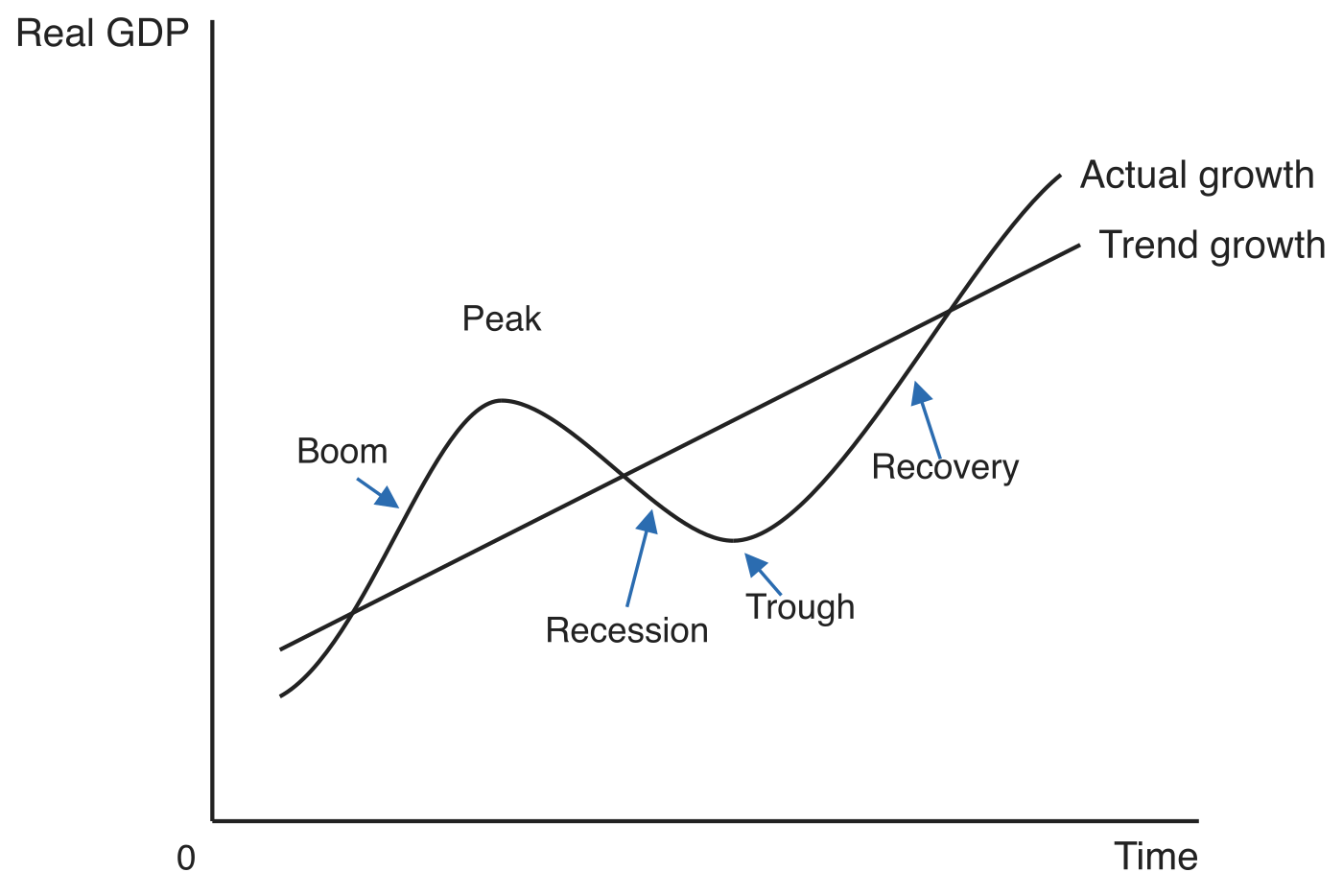
- Boom - Rapid expansion where total demand surges, jobs increase, but prices often rise due to high activity.
- Recession - At least two quarters of falling output, leading to lower demand, higher joblessness, and declining prices.
- Recovery - A shift back to positive growth, with rising demand, fewer job losses, and increasing prices.
The diagram below plots real GDP against time. Actual growth fluctuates around the smoother trend growth line: it climbs through a boom to a peak, falls through a recession to a trough, then rises again during the recovery.
Types of output gaps
Output gaps measure how actual output compares to the economy's trend or potential level.
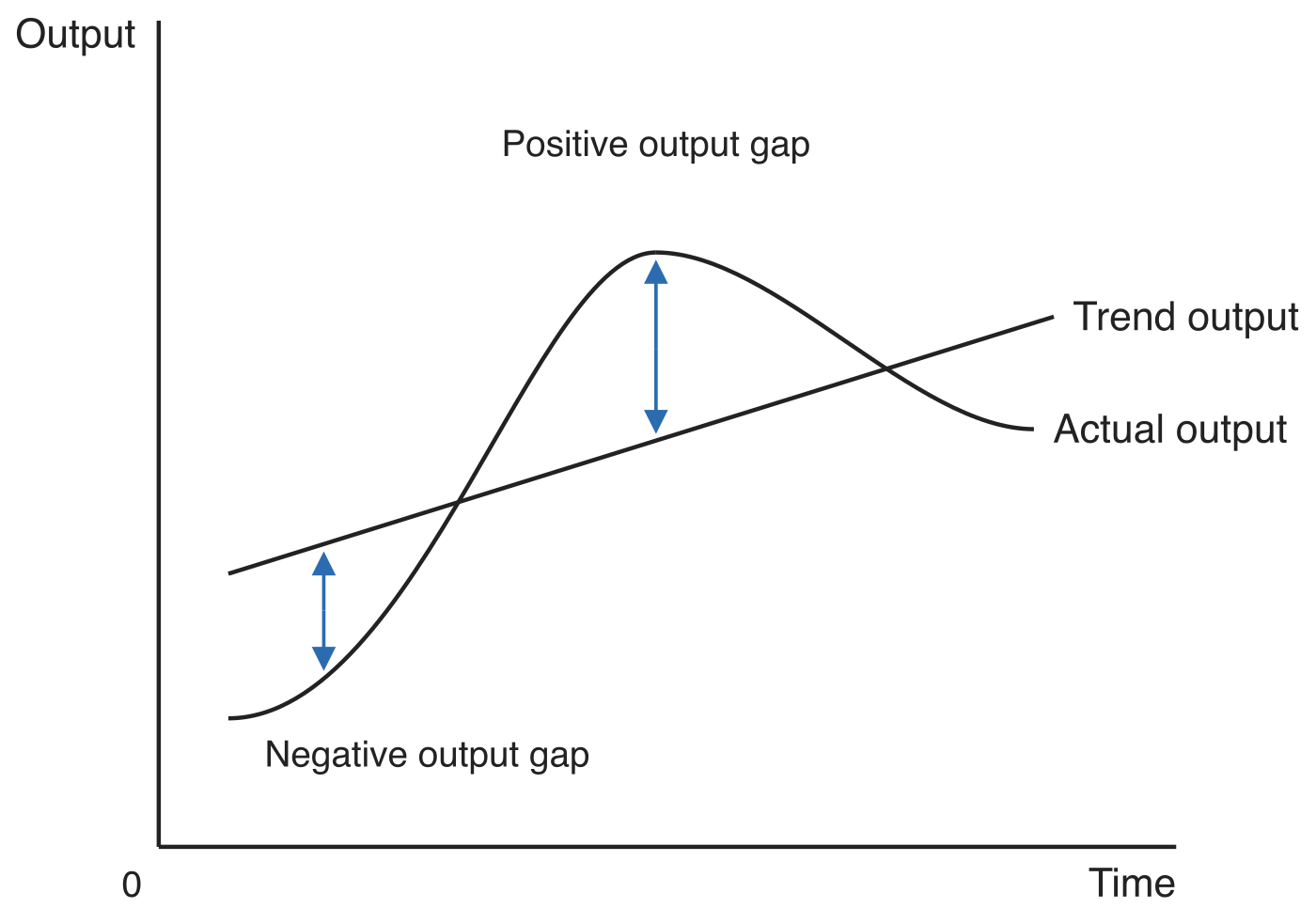
- Negative output gap (recessionary gap) - Actual output falls below potential, often in slumps, leaving resources like workers underused and putting downward pressure on prices.
- Positive output gap (inflationary gap) - Actual output exceeds potential during peaks, overusing resources, lowering unemployment but pushing prices up.
The diagram below plots output against time: actual output fluctuates around trend output, opening a negative output gap where it dips below the trend and a positive output gap where it rises above it.
These gaps can be shown on diagrams:
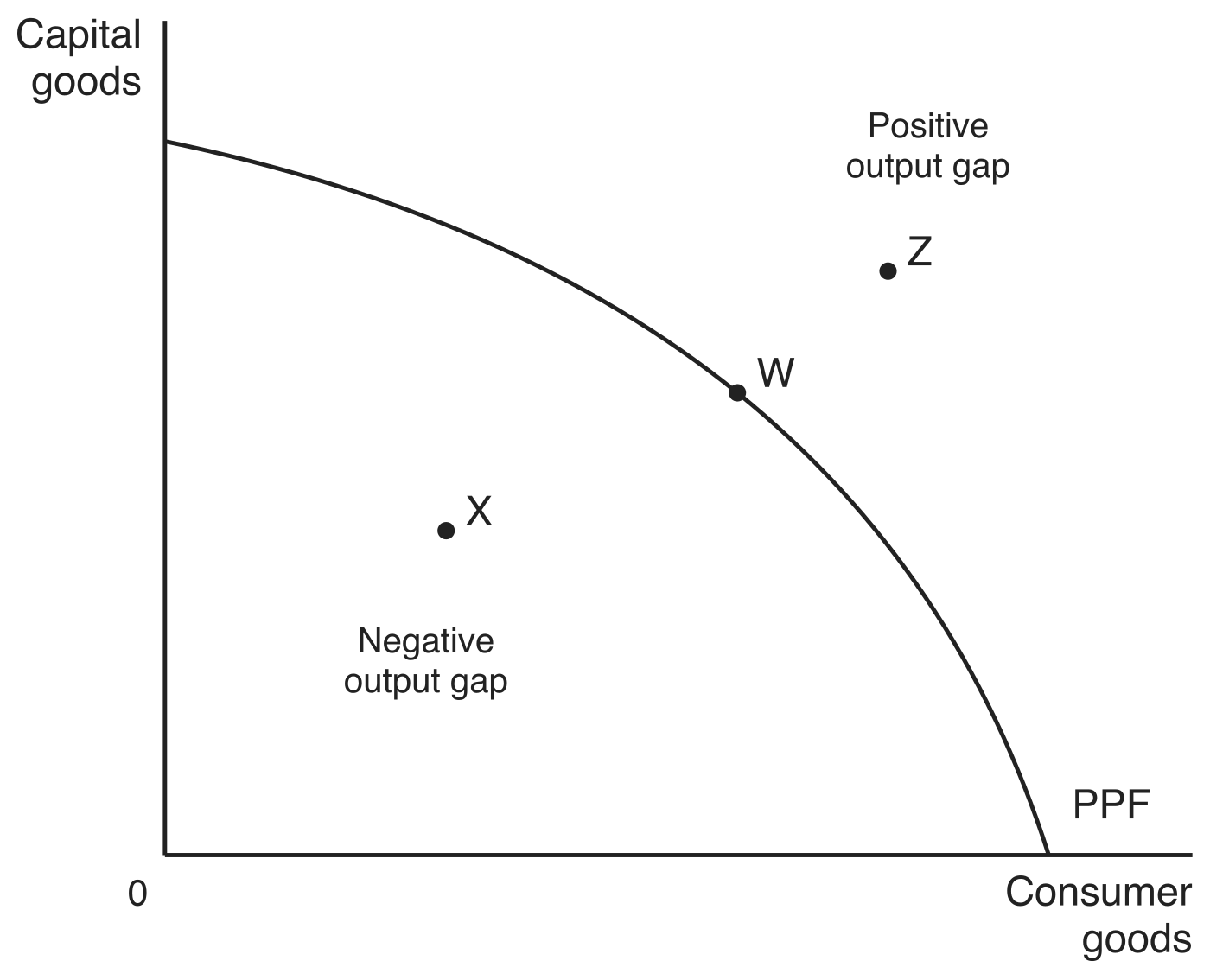
- On a PPF for capital goods and consumer goods, point X inside the curve indicates a negative output gap (unused capacity), point W on the curve shows the economy at full capacity, and point Z beyond the curve indicates a positive output gap (overcapacity).
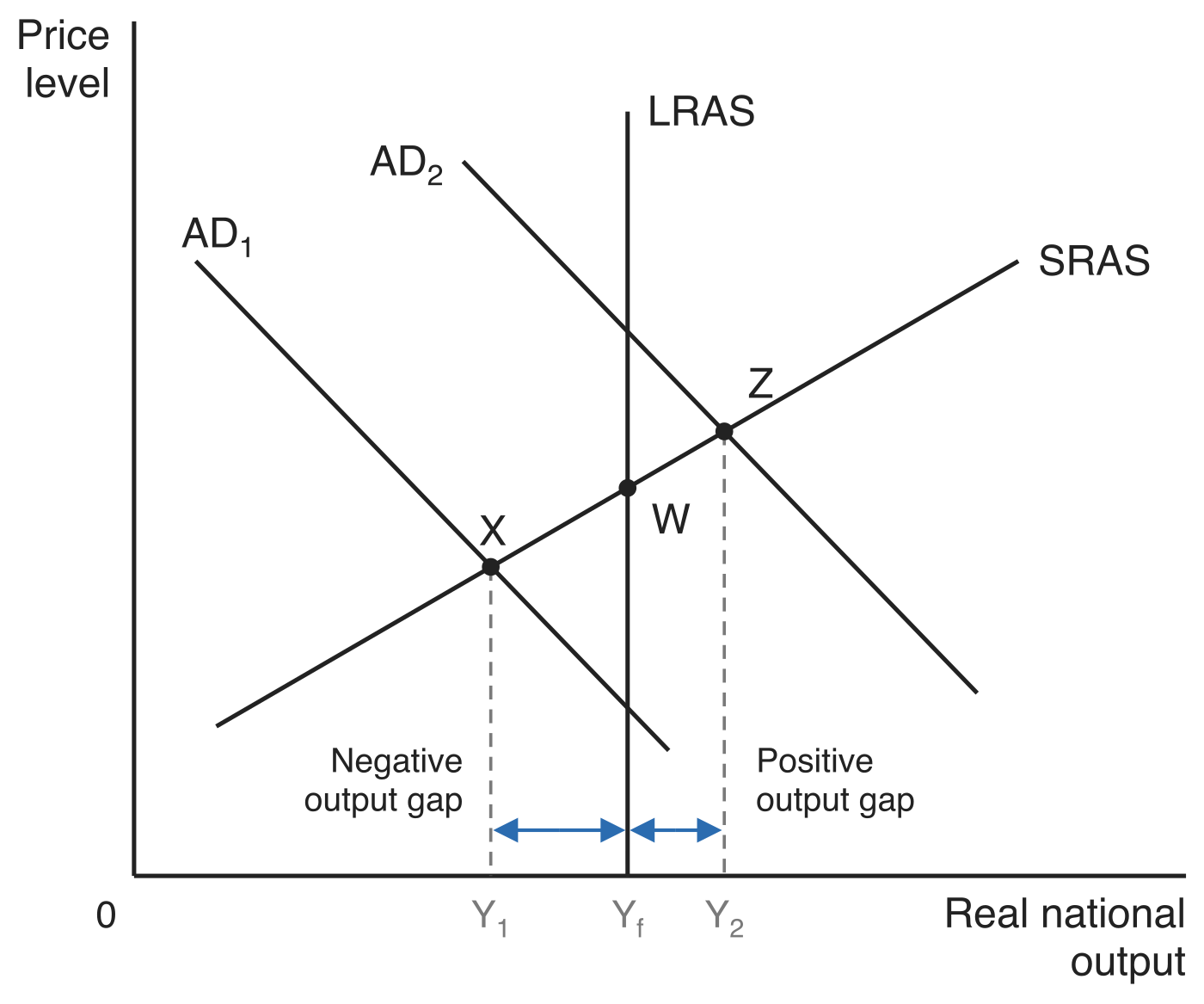
- In an aggregate supply-aggregate demand (AS-AD) model, the long-run aggregate supply (LRAS) curve is vertical at the economy's full potential output, Yf, where the short-run aggregate supply (SRAS) curve crosses it at point W. When demand is AD1, the SRAS-AD1 equilibrium at point X lies left of LRAS, so output Y1 is below potential and the distance from Y1 to Yf is a negative output gap. When demand rises to AD2, the equilibrium at point Z lies right of LRAS, so output Y2 is above potential and the distance from Yf to Y2 is a positive output gap.
Consequences of economic growth and recessions
Economic growth brings advantages but also drawbacks, while recessions create challenges that can reshape businesses and government finances.
Benefits of economic growth
- Boosts job opportunities, cutting unemployment and lifting incomes for better living standards.
- Enables firms to pay higher wages and invest in new technology or staff.
- Improves trade balances through higher exports and raises government funds from taxes, reducing the need for borrowing.
- Supports environmental efforts, like funding cleaner manufacturing methods.
Costs of economic growth
- May widen income gaps, as unskilled workers miss out on wage rises.
- Can lead to stress from heavier workloads and inflate prices if demand outpaces supply.
- Risks trade deficits from increased import buying and harms the environment through pollution or resource depletion.
Impacts of recession
- Businesses shut down, raising unemployment, especially among young people, and cutting investment for future growth.
- Governments face higher welfare costs and lower tax income, increasing borrowing and deficits.
- Some sectors, like budget stores, may thrive, while inefficient firms are forced to adapt or close.
Creating short-run and long-run economic growth
Growth can be stimulated in the short term by boosting demand or supply, while long-term gains focus on building capacity. Governments play a key role in both.
Creating short-run economic growth
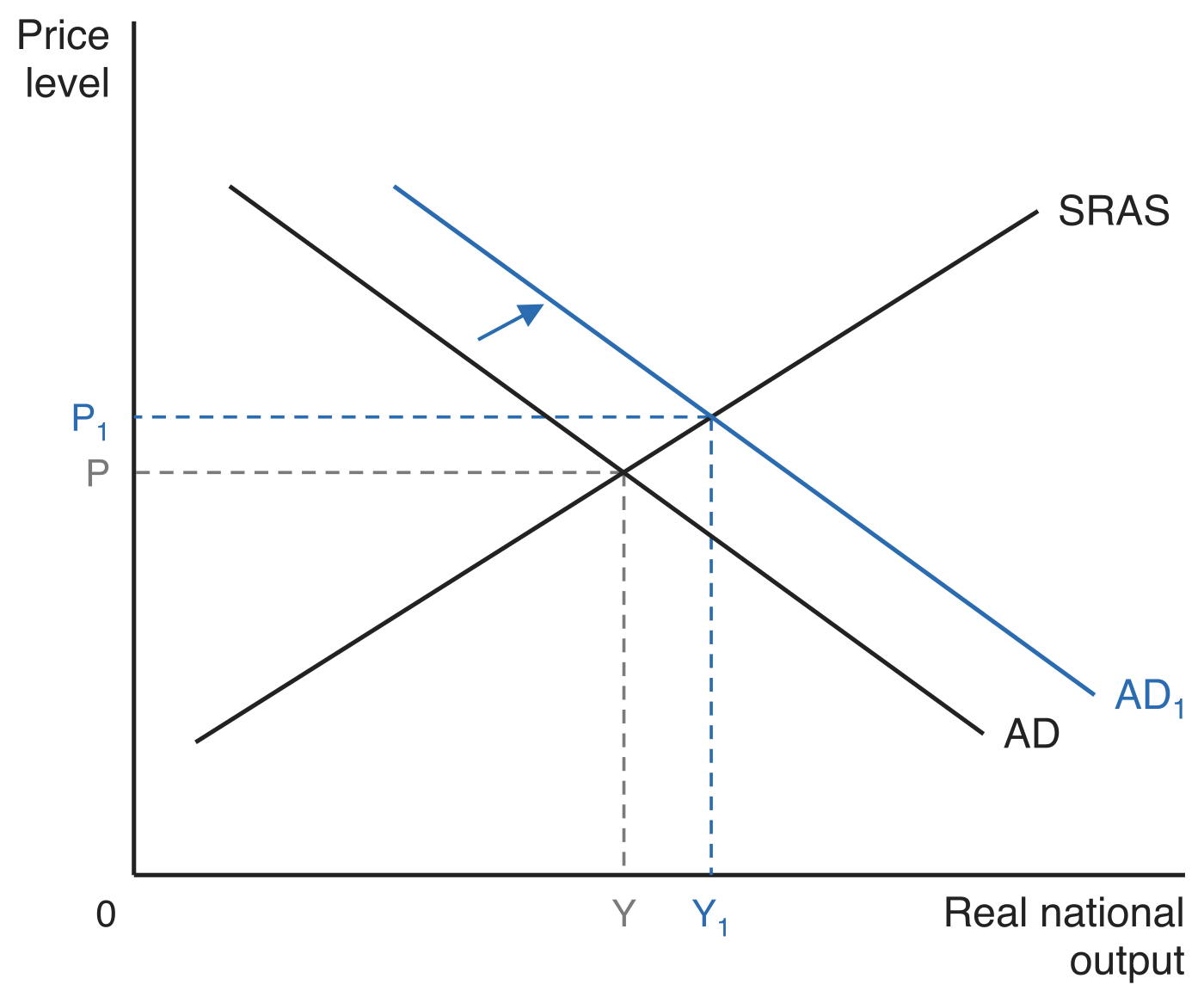
- Increasing aggregate demand (AD) - Shifts the AD curve right through factors like reduced borrowing costs or higher benefits, amplified by spending propensities and multiplier effects. The diagram below shows this: as demand rises from AD to AD1 along the short-run aggregate supply (SRAS) curve, the price level rises from P to P1 and real national output rises from Y to Y1.
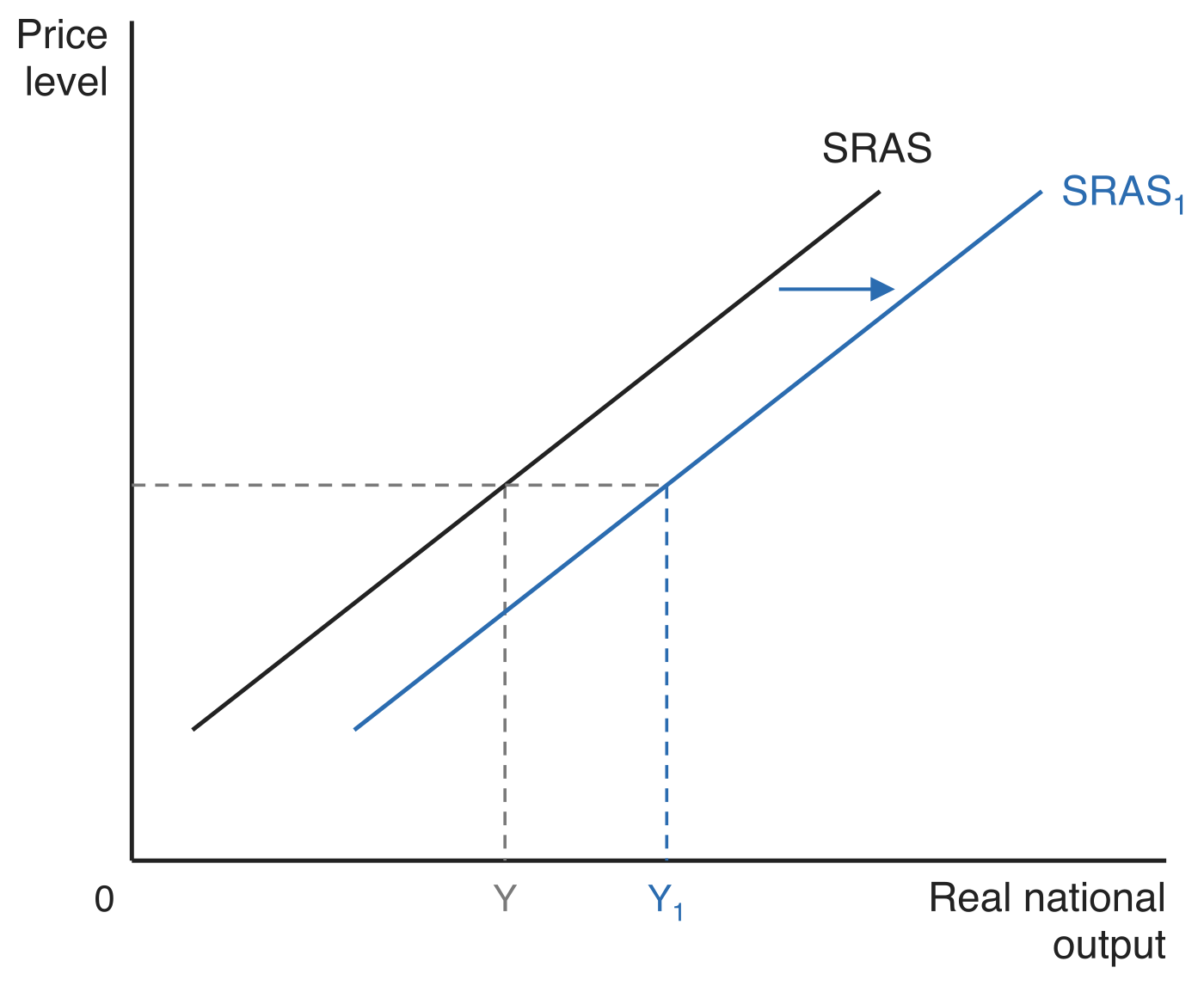
- Increasing short-run aggregate supply (SRAS) - Shifts the SRAS curve right by lowering production expenses, such as through cheaper energy or reduced pay rates. In the diagram below, the curve shifts from SRAS to SRAS1, raising real national output from Y to Y1.
Creating long-run economic growth
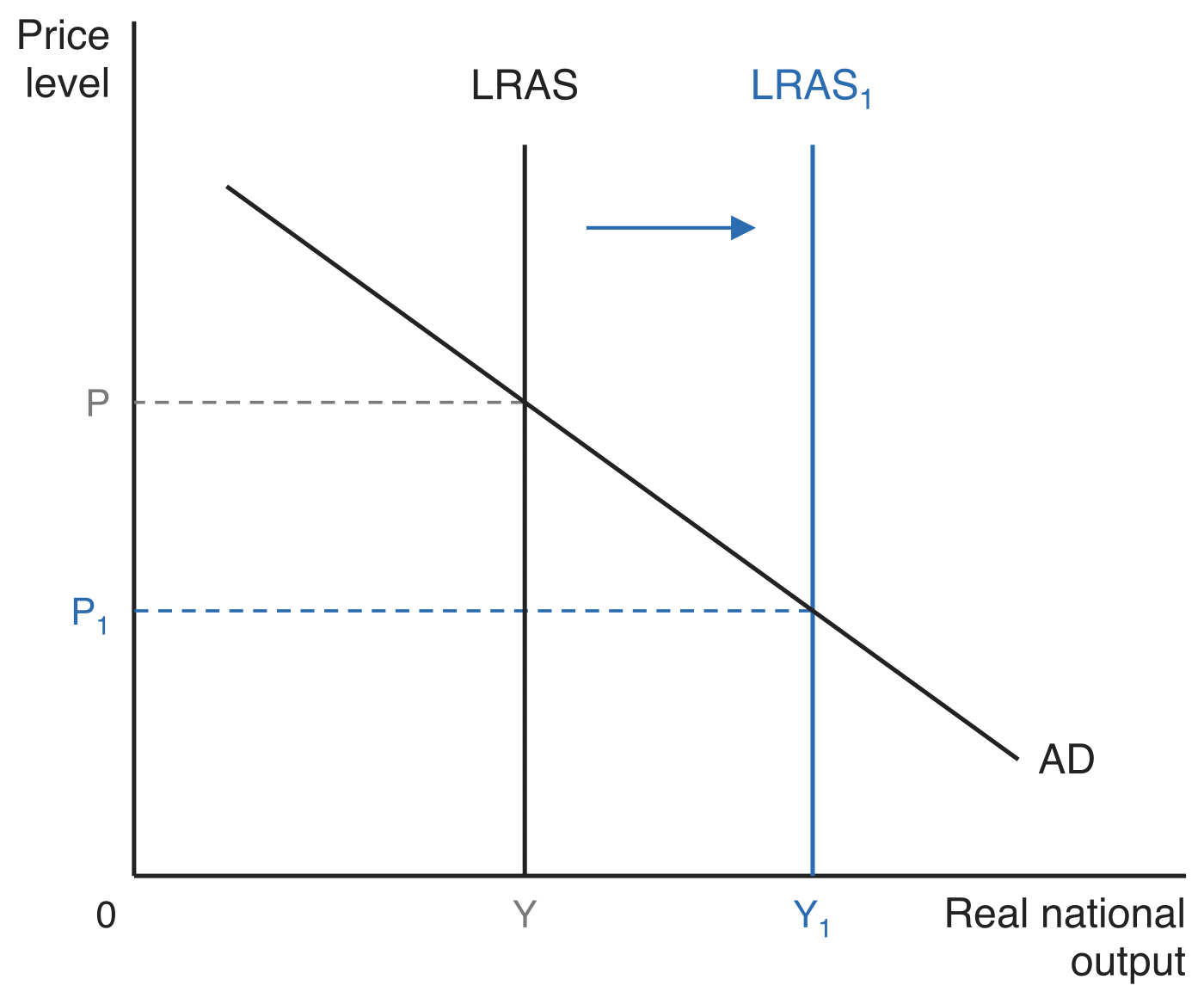
This stems from supply-side improvements that enhance resource quality or quantity, shifting the LRAS curve right.
Key factors for long-run growth:
- Introducing new technologies or innovations.
- Investing in updated equipment to strengthen capital resources.
- Enhancing farming methods, such as using improved crop varieties.
- Boosting education and skills training for a more capable workforce.
- Expanding the labour pool via policies encouraging immigration.
Governments foster this by maintaining stable conditions that encourage investment and confidence. The diagram below shows the effect: with aggregate demand (AD) unchanged, the long-run aggregate supply curve shifts from LRAS to LRAS1, raising real national output from Y to Y1 and lowering the price level from P to P1.