5.5 - Trade Unions
The definition and purposes of trade unions
Trade unions are organisations that workers join to strengthen their position when dealing with employers. By uniting, employees gain more influence over decisions that affect their jobs.
Key features of trade unions
- Formation and representation - Workers form trade unions to collectively represent their interests, such as through groups like teachers' associations or professional sports players' unions.
- Increasing bargaining power - Individual workers often have limited influence, but as a group, union members can push for better outcomes from employers.
Main purposes of trade unions
- Negotiating higher pay to improve members' earnings.
- Securing better working conditions, including safer environments and appropriate rest periods.
- Ensuring job security to protect against unfair dismissal or redundancy.
- Protecting against discrimination by enforcing fair treatment in the workplace.
- Monitoring compliance with health and safety laws to maintain a secure working environment.
How trade unions negotiate and operate
Trade unions engage in various strategies to achieve their goals, focusing on discussions with employers to reach agreements that benefit workers.
Methods of negotiation used by trade unions
- Collective bargaining - This involves unions negotiating on behalf of all members with employers, either at a national level (e.g., for industry-wide pay increases) or at a local workplace level (e.g., for specific improvements like better shift patterns).
- Productivity bargaining - Unions may agree to changes that boost efficiency, such as new working methods, in exchange for higher wages or other advantages like enhanced benefits.
- Performance-related pay - Agreements can link salary rises to workers' output quality and overall productivity, encouraging better performance.
Special arrangements in trade unions
In a closed shop system, all workers must join the union, restricting the labour pool available to employers and ensuring wages match union-agreed rates.
Trends in trade union membership and power
The influence of trade unions has changed over time, affected by economic shifts, government policies, and workforce patterns.
Historical and current membership patterns
- Peak influence - Trade unions reached their highest power in the UK around 1979, with about 13 million members, giving them strong leverage in negotiations.
- Decline in the 1980s and 1990s - Government actions under the Conservative administration weakened unions as part of supply-side policies to enhance business flexibility and competitiveness. Large manufacturing sectors, which had high union membership, also shrank due to de-industrialisation.
- Shift to service industries - Employment moved towards services, where unions are less common, further reducing membership.
- Impact of modern work practices - Flexible and part-time contracts make workers less inclined to join unions, contributing to stable but lower membership of around 6-7 million since the mid-1990s.
Government influence on union power
Recent laws have limited union strength, making them less able to disrupt markets while encouraging more adaptable workforces that benefit employers through higher productivity.
The effects of trade unions on labour markets
Trade unions can influence wage levels and employment, sometimes leading to inefficiencies but also potential benefits when productivity rises.
Negative impacts on labour markets
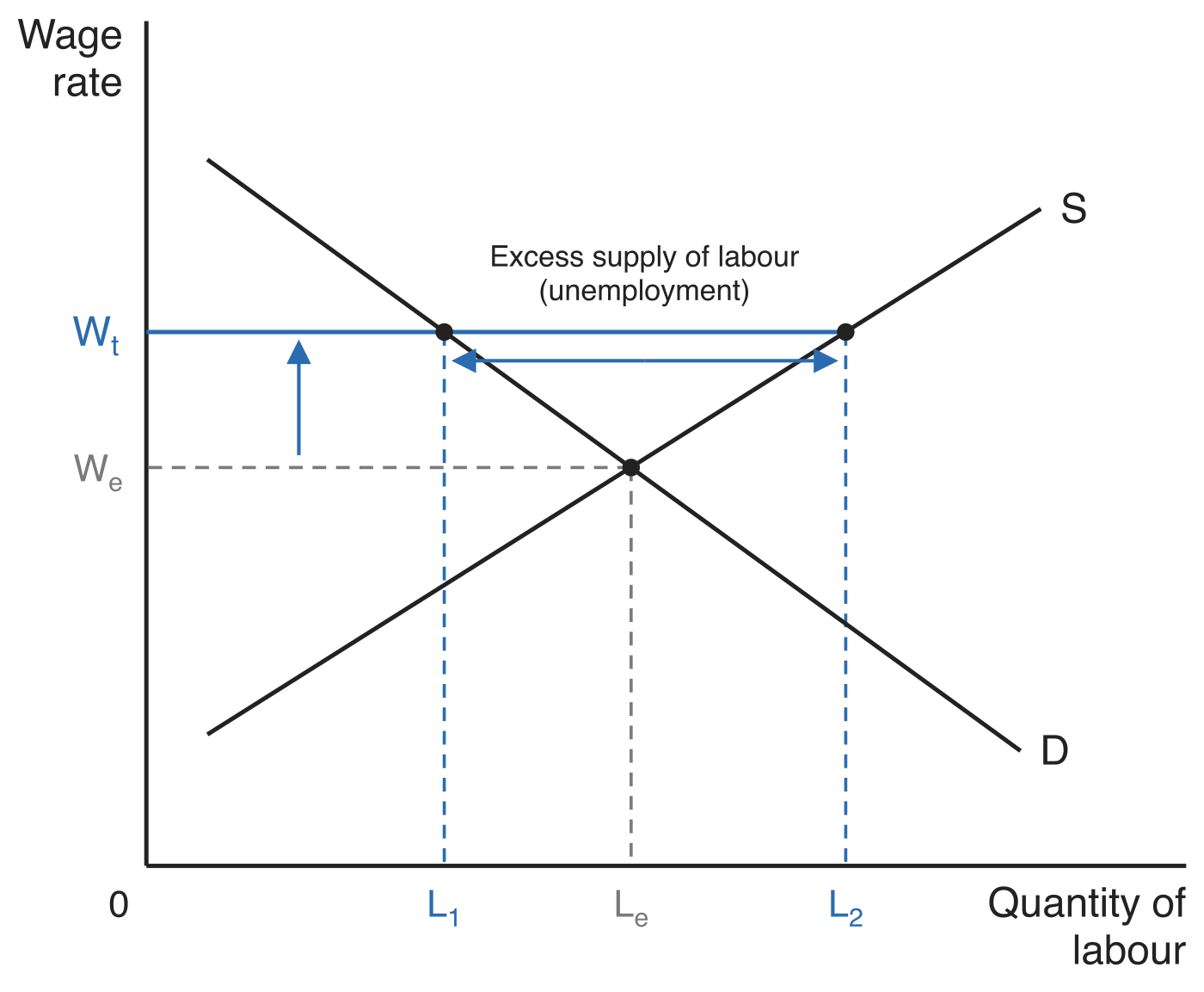
Trade unions may contribute to labour market failure by pushing wages above the market equilibrium, resulting in higher costs and job losses. The diagram below shows a trade union operating in a competitive labour market.
- Wage increases above equilibrium - Without a union, the labour market clears at the equilibrium wage We, where labour supply S meets labour demand D, giving employment Le. A trade union can force the wage up to Wt, above We. At this higher wage firms cut the number of workers they hire to L1, so production costs rise for firms.
- Kinked supply curve effect - Because no one will now work below Wt, the supply curve becomes horizontal at Wt until it rejoins S, giving a kinked supply curve. At Wt the quantity of labour demanded (L1) is below the quantity supplied (L2), so there is an excess supply of labour of L1 to L2. This surplus of workers is unemployment, and it is this that makes the higher wage a source of labour market failure.
- Factors affecting unemployment levels - The extent of job losses depends on the elasticity of labour demand; if demand is inelastic, fewer jobs are lost compared to elastic demand scenarios.
Positive impacts on labour markets
Unions can avoid job losses by linking wage rises to efficiency gains, benefiting both workers and employers.
- Boosting productivity - Unions encourage members to adopt better practices, shifting the demand curve for labour to the right as firms value more efficient workers.
- Justifying higher wages - Improved output increases workers' marginal revenue product (MRP), allowing firms to pay more without reducing employment, potentially raising profits.
Trade unions in monopsonistic markets
In markets where a single employer dominates, unions can play a corrective role, improving outcomes for workers without harming efficiency.
Characteristics of monopsonistic labour markets
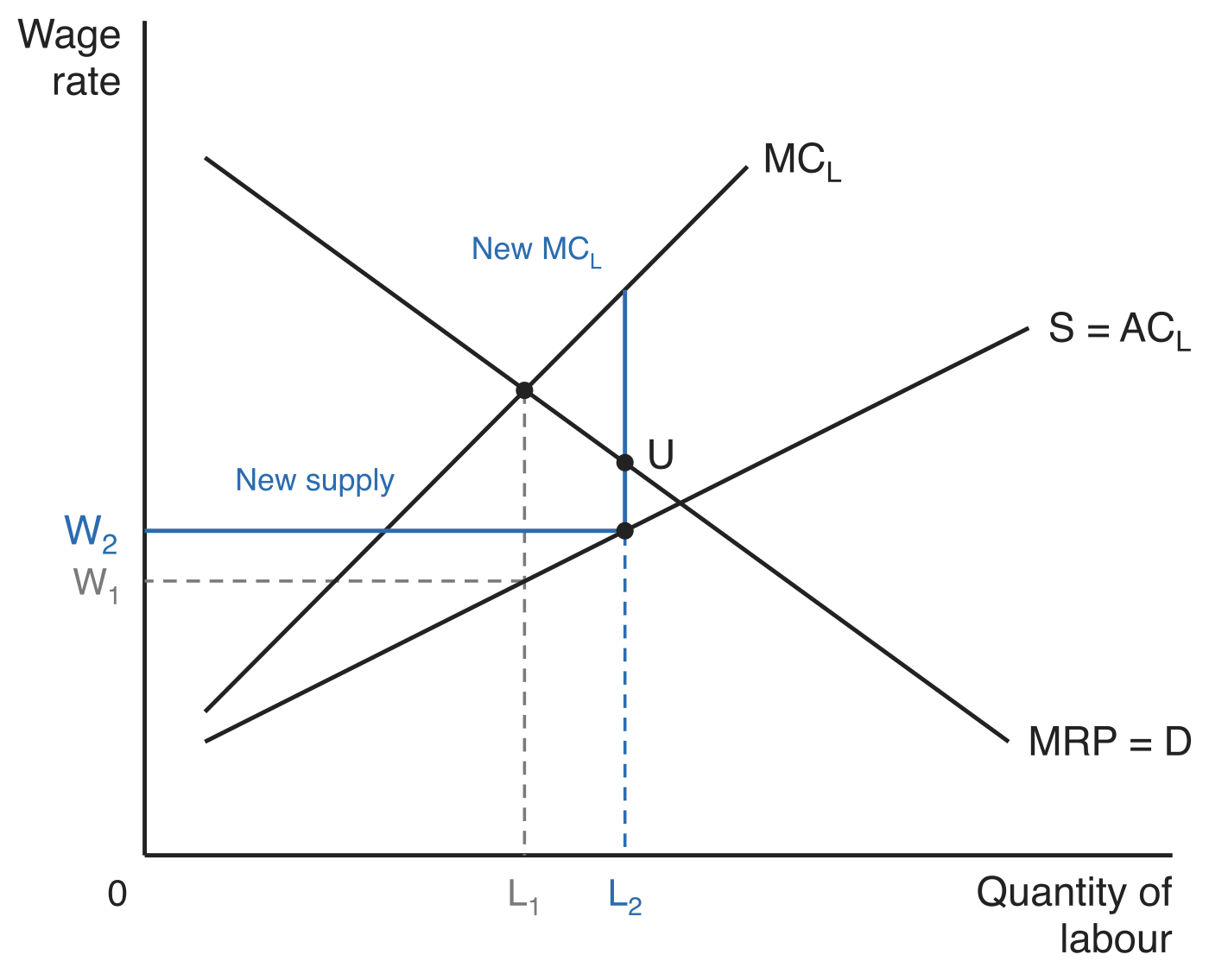
- Monopsony power - A single employer (buyer of labour) often pays below the workers' MRP, leading to lower wages and employment than in competitive markets.
- Bilateral monopoly - This occurs when a monopsonistic employer faces a single union (seller of labour), creating a balanced negotiation dynamic.
Benefits of unions in monopsonistic settings
- Raising wages and employment - Without a union, a monopsonist maximises profit where the marginal cost of labour (MCL) equals the marginal revenue product (MRP = D), hiring L1 workers and paying only W1, the wage read off the supply curve (S = ACL). When a union sets a wage floor of W2, the supply of labour becomes flat at W2 (the new supply curve), so up to that point the marginal cost of an extra worker is just W2 (the new MCL). The firm now maximises profit at point U, where the new MCL meets MRP = D, hiring L2 workers. Because W2 sits between W1 and the competitive wage, the union raises the wage from W1 to W2 and employment from L1 to L2 at the same time. The diagram below shows this.
- Reducing market failure - By countering the employer's dominance, unions move the market towards free-market equilibrium, enhancing overall efficiency.
- Overall positive effects - In these scenarios, unions help create a more productive workforce, which can reduce unemployment and support business growth through better flexibility and output.