8.7 - Unemployment & Inflation
The natural rate of unemployment and labour market equilibrium
The natural rate of unemployment (NRU) represents the level of unemployment that exists even when the labour market is balanced, with the number of job vacancies matching the number of available workers. This balance does not eliminate all unemployment, as some types persist regardless of economic conditions.
Key features of the natural rate of unemployment
- Labour market equilibrium - This occurs when the demand for labour equals the supply of labour, meaning there are sufficient jobs for the workforce, but not every individual is employed due to ongoing job transitions or skill mismatches.
- Persistence of unemployment - Even at equilibrium, frictional unemployment (short-term job changes) and structural unemployment (mismatches in skills or locations) continue, contributing to the NRU.
- Link to full employment - The NRU aligns with the concept of full employment, as it is unrealistic to achieve zero unemployment. Increasing aggregate demand cannot eliminate frictional or structural issues entirely.
The short-run Phillips curve and the inflation-unemployment trade-off
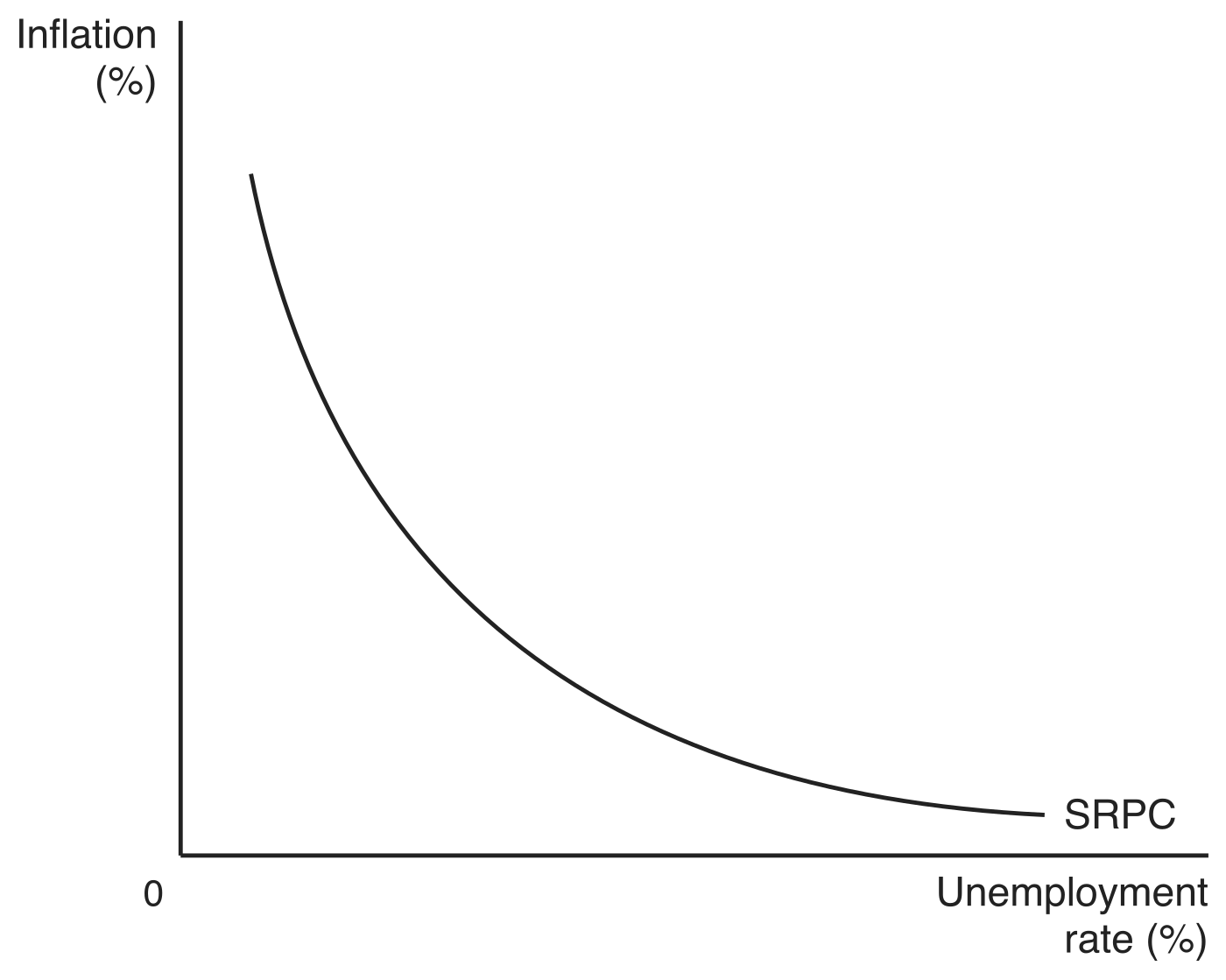
The short-run Phillips curve (SRPC) illustrates a potential inverse relationship between inflation and unemployment, based on historical data analysis. It suggests that efforts to lower unemployment might lead to higher inflation, and vice versa. The diagram below shows the SRPC: moving along the curve, lower unemployment comes with higher inflation, and higher unemployment with lower inflation.
Characteristics of the short-run Phillips curve
- Inverse relationship - As unemployment decreases, inflation tends to increase; conversely, rising unemployment is associated with falling inflation.
- Policy implications - Governments might boost aggregate demand to reduce unemployment, accepting the risk of higher inflation as a consequence.
- Role of adaptive expectations - People's expectations of future inflation are shaped by past experiences. If inflation rises, individuals anticipate it to continue, adjusting behaviours like wage demands, which can make high inflation persistent or 'embedded' in the economy.
Keynesian and Monetarist views on the Phillips curve
Economists from different schools interpret the relationship between inflation and unemployment differently, influencing how they view the Phillips curve in both short-run and long-run contexts.
Keynesian perspective on the Phillips curve
Keynesian economists generally support the idea of a trade-off between inflation and unemployment, linking it to the shape of the long-run aggregate supply (LRAS) curve.
Connection to LRAS:
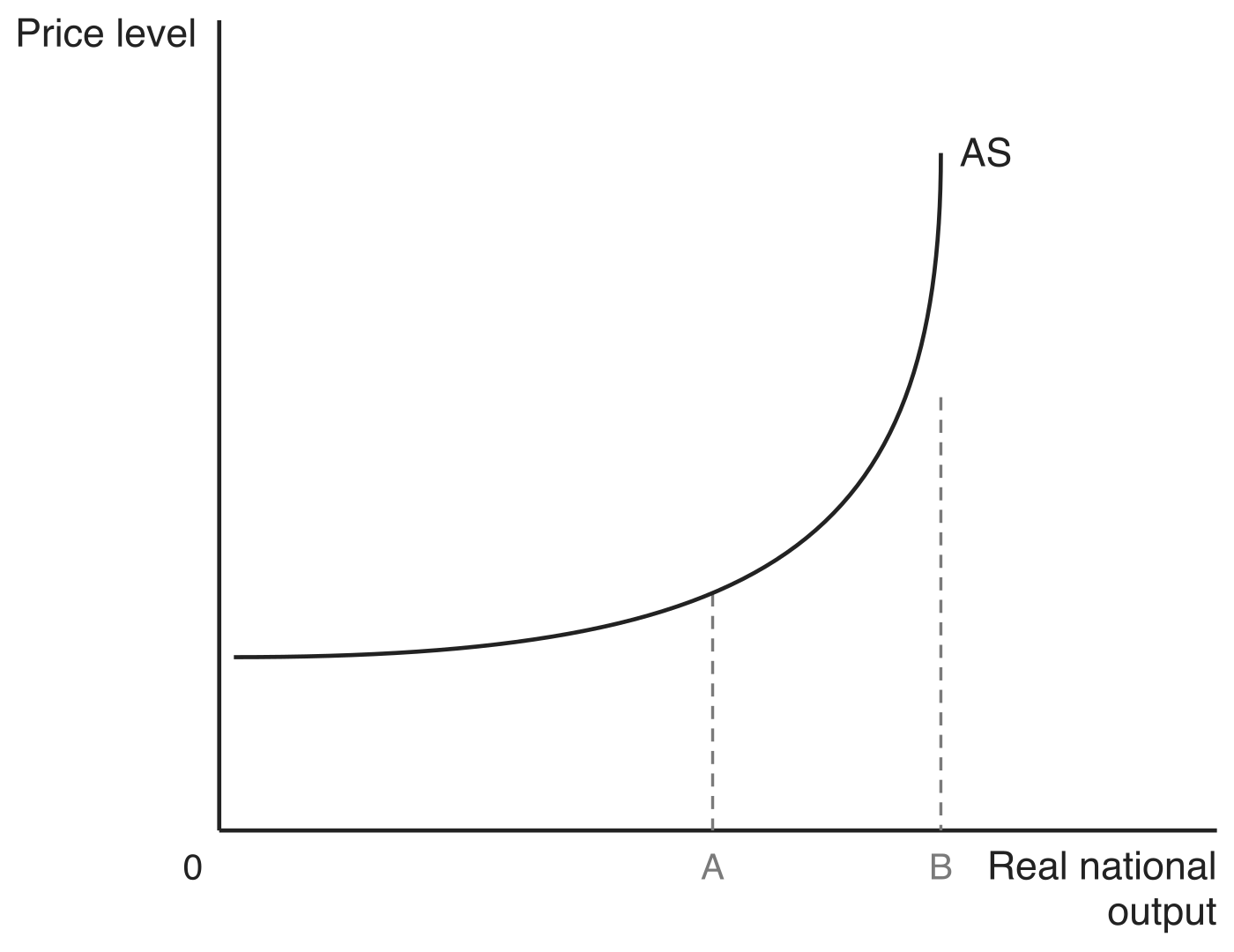
- The upward-sloping section of the Keynesian LRAS curve shows that as output rises and unemployment falls, prices increase, mirroring the inflation-unemployment trade-off in the short-run Phillips curve. The diagram below shows this AS curve.
Behaviour at different output levels:
- Below point A, where output is low and unemployment is high, increases in production have minimal impact on inflation, as workers accept lower wages.
- Between points A and B, as output approaches capacity, inflation accelerates due to rising costs and demand pressures. Beyond B the curve is vertical: output cannot rise any further.
How inflation expectations become embedded
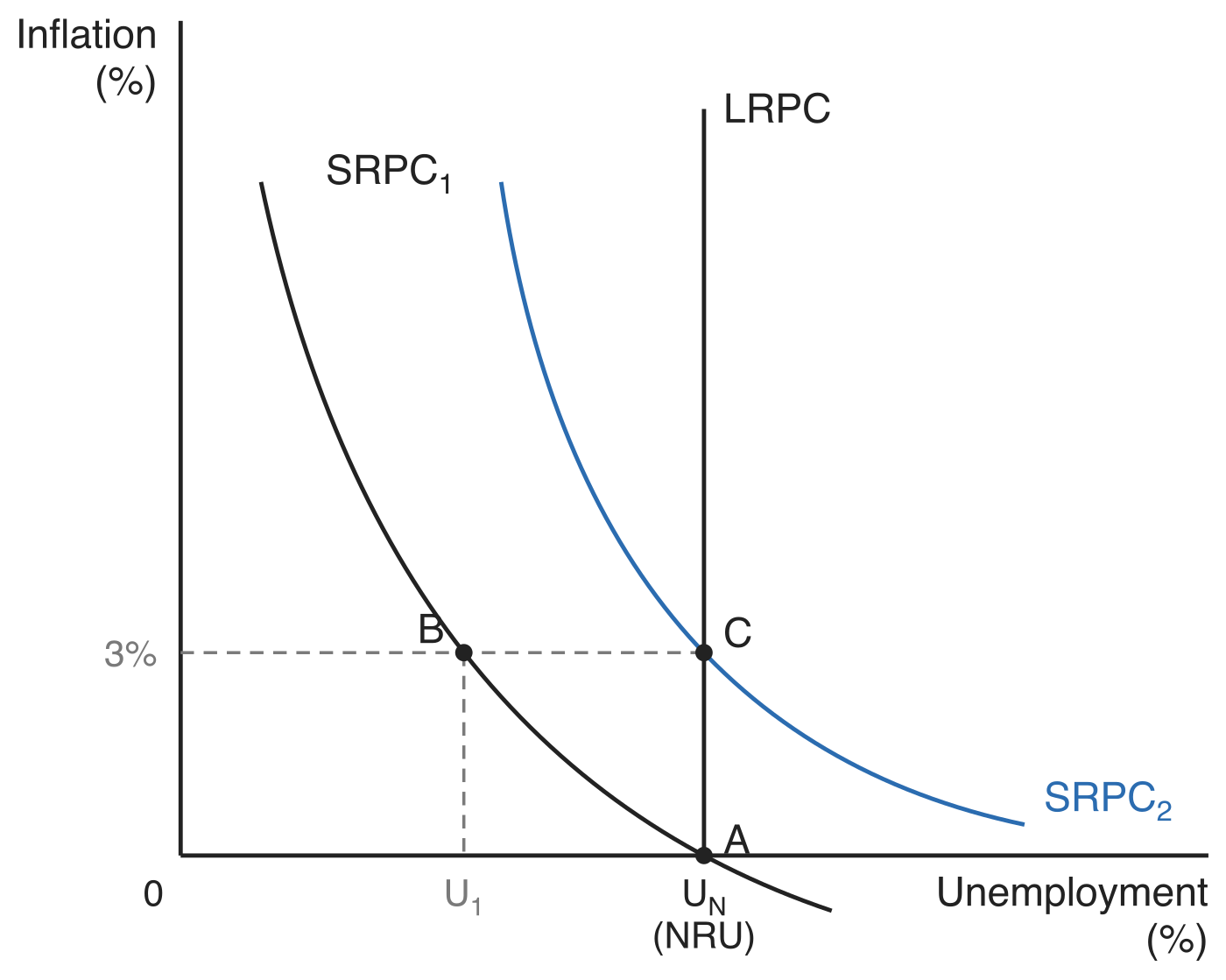
When unemployment falls below the NRU due to increased aggregate demand, inflation can rise and become self-sustaining. The diagram below shows each stage:
- Initial equilibrium - The economy starts at point A on SRPC1, with unemployment at the natural rate UN and zero inflation. Economic agents (such as workers and firms) expect inflation to remain stable, influencing wage negotiations.
- Demand increase - Higher aggregate demand reduces unemployment below the NRU, from UN to U1, pushing up wages and inflation (e.g., to 3%). The economy moves along SRPC1 from A to point B.
- Expectation adjustment - Agents then base future decisions on this new inflation rate, leading to sustained higher wage demands.
- Curve shift - The short-run Phillips curve shifts rightward from SRPC1 to SRPC2, embedding the higher inflation even as unemployment returns to the NRU: at point C, unemployment is back at UN but inflation stays at 3%.
- Policy importance - Governments aim to manage inflation expectations, such as through central bank targets (e.g., the Bank of England's 2% inflation goal), to prevent continuous rises.
Monetarist perspective on the Phillips curve
- No long-run trade-off - Increases in aggregate demand may temporarily lower unemployment but eventually lead to inflation without permanent employment gains, as the economy adjusts back to the NRU.
- Vertical long-run Phillips curve - The long-run Phillips curve (LRPC in the diagram above) is a vertical line at the natural rate UN, indicating that inflation can vary without affecting long-term unemployment levels.
- Short-run doubts - Some monetarists question even the short-run trade-off.
- Practical use - While the Phillips curve's overall significance is unclear, it remains relevant for short-term policy decisions.
Demand-side and supply-side policies to reduce unemployment
Governments use different policies depending on the type of unemployment, aiming to stimulate demand or enhance labour market efficiency.
Demand-side policies for cyclical unemployment
Cyclical unemployment arises during economic downturns, so policies focus on increasing aggregate demand to create jobs.
Policy options:
- Reflationary fiscal measures - Reducing taxes or raising welfare payments to boost spending.
- Expansionary monetary measures - Lowering interest rates to encourage borrowing and investment.
Challenges with demand-side policies:
- Information gaps - Uncertainty about the output gap or multiplier effect can lead to overspending (causing inflation) or underspending (prolonging recessions).
- Implementation issues - Policies can be imprecise, with time lags delaying effects and potentially creating further economic imbalances.
Supply-side policies to reduce the natural rate of unemployment
To lower the NRU, policies target labour market flexibility, reducing frictional and structural unemployment.
Factors determining labour market flexibility
- Labour mobility - Ease of switching jobs, influenced by workers' skills and willingness to relocate.
- Wage flexibility - Ability of wages to adjust to market changes, helping firms retain staff during downturns.
- Working arrangements - Options like part-time or short-term contracts that allow firms to adapt quickly to market shifts.
Policies to improve labour market flexibility
- Enhancing mobility - Investing in training to build transferable skills and providing relocation subsidies.
- Promoting wage flexibility - Removing minimum wage restrictions or limiting trade union influence.
- Flexible hiring - Legislation supporting short-term or zero-hour contracts for easier workforce adjustments.
Policies to reduce frictional unemployment
These focus on speeding up job searches and increasing incentives to work:
- Tax incentives - Cutting income taxes to encourage job-seeking or longer working hours.
- Information provision - Improving access to job listings to match workers with opportunities faster.
- Benefit reforms - Reducing welfare payments to motivate job searches and avoid the unemployment trap (where benefits exceed low-wage earnings).
Policies to reduce structural unemployment
These address skill and location mismatches:
- Occupational mobility - Funding training programmes or encouraging firm-led skill development.
- Geographical mobility - Subsidies for housing or relocation, though personal factors like family ties can limit effectiveness.
- Regional incentives - Offering benefits to firms locating in high-unemployment areas, combined with local training to equip workers.
Policies to tackle demand-pull and cost-push inflation
Governments apply targeted policies to control inflation based on its causes, balancing economic growth with price stability.
Tackling demand-pull inflation
Demand-pull inflation occurs when aggregate demand exceeds supply, often addressed through monetary policy:
- Interest rate adjustments - Raising rates to reduce borrowing and spending, curbing demand pressures.
- Money supply controls - Limiting the growth of money in circulation to prevent excessive demand.
Tackling cost-push inflation
Cost-push inflation stems from rising production costs, typically managed with supply-side approaches:
- Labour market reforms - Policies that enhance flexibility (as described above) to lower wage pressures and improve efficiency.
- Productivity enhancements - Investments in training and technology to reduce costs without cutting output.