Equilibrium - exam practice
Equilibrium
Question 1 of 7
Hydrogen has many industrial uses and can be produced from the reaction between methane and steam.
CH4(g) + H2O(g) ⇌ CO(g) + 3H2(g) ΔH = +210 kJ mol-1
Explain what would happen to the equilibrium yield of hydrogen if the pressure is increased.
Explain what would happen to the equilibrium yield of hydrogen if the temperature is increased.
A low pressure favours the production of hydrogen. In industry this reaction is carried out at a intermediate pressure of 30 atmospheres.
Suggest why this value is used.
The reaction is carried out in the presence of a nickel catalyst.
What effect does this have on the equilibrium yield of hydrogen?
A dynamic equilibrium between the gases NO2 and N2O4 is set up at room temperature. NO2 is a brown gas whereas N2O4 is a colourless gas.
2NO2(g) ⇌ N2O4(g) ΔH = -58 kJ mol-1
State two characteristics of a dynamic equilibrium.
Explain, using Le Chatelier's principle, what would be observed if the pressure was increased.
Explain, using Le Chatelier's principle, what would be observed if the reaction was carried out in a warm water bath.
Hydrogen can be prepared from the reversible reaction between methane and steam.
CH4(g) + H2O(g) ⇌ CO(g) + 3H2(g) ΔH = +210 kJ mol-1
Explain what is meant by a reversible reaction.
In industry, this reaction is carried out at a temperature of 800°C and a low pressure of 300 kPa with a nickel catalyst.
Explain, in terms of equilibrium yield and cost, why these conditions are used.
0.250 moles of CH4 and 0.250 moles of H2O are mixed together and left to reach equilibrium. The equilibrium mixture is found to contain 0.015 moles of CO.
Calculate the moles at equilibrium of CH4, H2O and H2.
Sulfuric acid is manufactured by the Contact process. In the first stage of this process sulfur dioxide is converted into sulfur trioxide in the presence of a vanadium(V) oxide catalyst, V2O5. The reaction is reversible as shown below.
2SO2(g) + O2(g) ⇌ 2SO3(g) ΔH = -196 kJ mol-1
State and explain the effect on the yield of sulfur trioxide if the temperature is increased.
Explain what effect the vanadium(V) oxide catalyst has on the equilibrium yield of sulfur trioxide.
The conditions used in an industrial process for this reaction are a temperature of 420 °C and a pressure of 1.7 atmospheres. It is proposed to change the temperature to 600 °C and the pressure to 10 atmospheres.
Evaluate the effectiveness of these changes on the rate and equilibrium yield of SO3.
Write an expression for the equilibrium constant, Kc, for this reaction. Include the units in your answer.
Hydrogen gas can be produced from the reaction between ethanol and steam in the presence of a catalyst. The reaction is reversible as shown by the equation below.
C2H5OH(g) + H2O(g) ⇌ 2CO(g) + 4H2(g)
Define Le Chatelier's principle.
State and explain what would happen to the equilibrium yield of hydrogen if the pressure was increased.
Write an expression for the equilibrium constant, Kc, for this reaction.
Predict the effect of increasing the pressure on the value of Kc.
Nitrogen monoxide (NO) is reacted with chlorine to form nitrosyl chloride (NOCl) as shown in the equilibrium below.
2NO(g) + Cl2(g) ⇌ 2NOCl(g) ΔH = -76 kJ mol-1
Write an expression for the equilibrium constant, Kc, for this reaction.
1.875 moles of NO is mixed with 1.25 moles of Cl2 and the mixture is left to reach equilibrium at a specific temperature.
The concentrations of NO, Cl2 and NOCl were:
- [NO] = 1.440 mol dm-3
- [Cl2] = 1.03 mol dm-3
- [NOCl] = 0.440 mol dm-3 Calculate a value for Kc, giving your answer to 3 significant figures.
The reaction is repeated at a higher temperature. Explain what effect this would have on the yield of NOCl.
Explain what would happen to the yield of NOCl if more chlorine was added to the reaction.
Ammonia is formed in the Haber process from nitrogen and hydrogen.
N2(g) + 3H2(g) ⇌ 2NH3(g) ΔH = -92 kJ mol-1
Predict the conditions, in terms of temperature and pressure, that would provide the maximum equilibrium yield of ammonia.
Explain your answer using Le Chatelier's principle.
Under a specific set of conditions, the equilibrium concentrations of the reactants are shown in the table below.
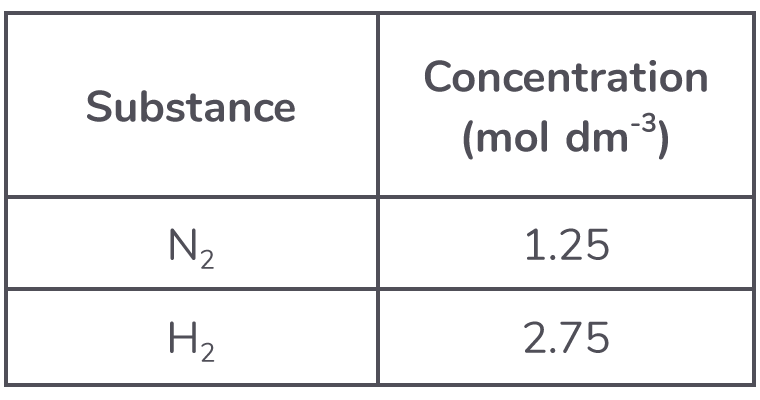
The value of Kc under these same conditions is 2.86 x 10⁻² mol-2 dm6.
Use these values to calculate the equilibrium concentration of NH3.