Alkanes - exam practice
Alkanes
Question 1 of 9
Alkanes can react with halogens to form halogenoalkanes.
State the name of the mechanism for this reaction and the condition needed for this reaction to occur.
Methane and bromine can react to form bromomethane.
Write an equation for the initiation step in this reaction and explain why this is an example of homolytic fission.
The first equation in the propagation step can be written as shown below.
CH4 + Br• ➔ •CH3 + HBr
Write an equation for the second propagation step.
Write an equation for the termination step that results in the formation of ethane, C2H6.
The alkanes hexane and 2,2-dimethylbutane are structural isomers with the molecular formula C6H14.
Draw the skeletal formula of both alkanes.
Explain why 2,2-dimethylbutane has a lower boiling point than hexane.
Write an equation for the complete combustion of hexane.
State under what conditions incomplete combustion of hexane would occur and write an equation for the reaction.
The table below shows the boiling points of some saturated hydrocarbons.
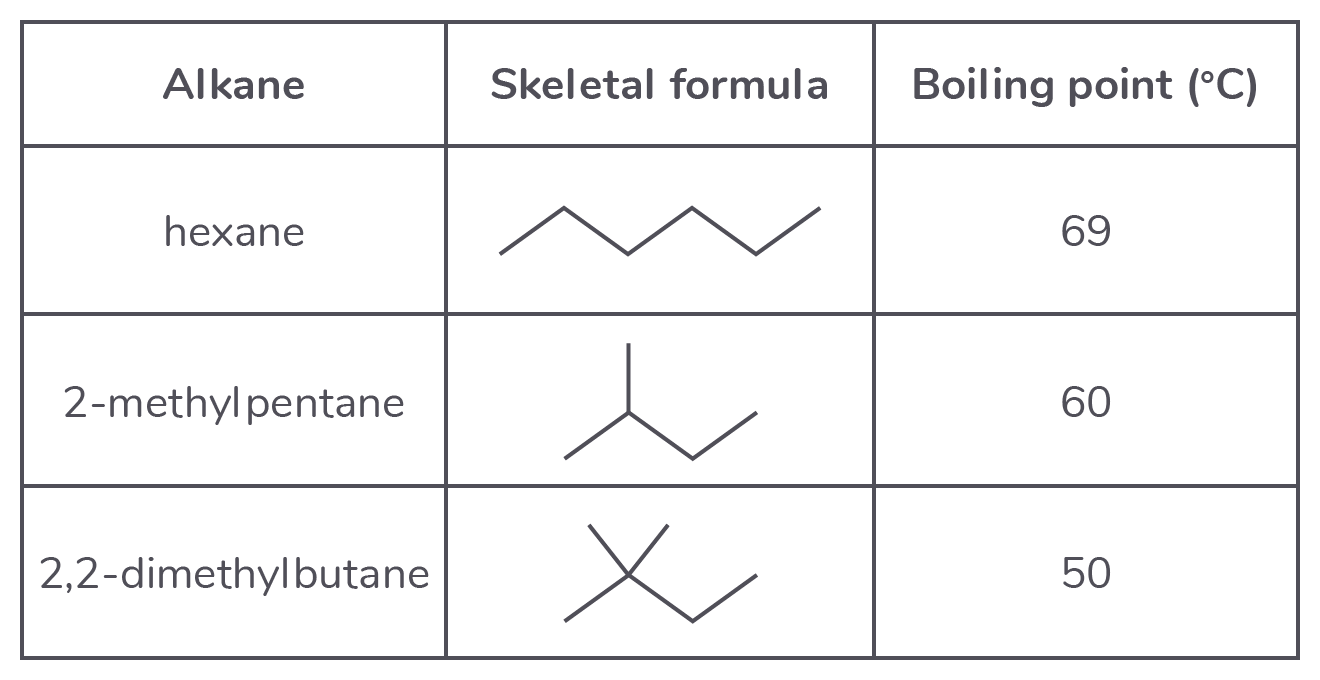
Explain the meaning of the term hydrocarbon.
State and explain the trend in boiling points shown in the table.
All of the alkanes in the table react with halogens in the presence of ultraviolet light to form halogenoalkanes.
Name the mechanism for this reaction.
Write two equations for the propagation step of this reaction between hexane, C6H14, and chlorine.
Halogenoalkanes have many uses, including as solvents and refrigerants. Bromoethane is formed from the reaction between ethane and bromine in the presence of ultraviolet light.
Write an overall equation for the reaction between ethane and bromine to form bromoethane and one other product.
Write an equation for the initiation step of this reaction.
The first equation in the propagation step is shown below.
C2H6 + Br• ➔ •C2H5 + HBr
Write an equation for the second propagation step.
Write a termination step for this reaction, resulting in the formation of butane.
Calculate the percentage by mass of bromine in the heaviest molecule containing two carbon atoms that could form when ethane reacts with a large excess of bromine. Give your answer to 3 significant figures.
This question is about the reactions of alkanes.
Alkanes can be used as fuels.
Write a balanced equation for the combustion of octane (C8H18) in excess oxygen.
Combustion of 45.6 g of octane produced 3.00 moles of CO2.
Show that this combustion was incomplete.
Alkanes react in free radical substitution reactions to form halogenoalkanes.
Write two propagation steps for the reaction between propane and chlorine to form 2-chloropropane.
Free radical substitution reactions can occur between alkanes and halogens in the presence of UV light.
Classify each of the following equations as initiation, propagation or termination by ticking the appropriate box in the table below.
Which of the following equations represents a propagation step in free radical substitution?
Which of the following species would not be formed in the free radical substitution of methane and bromine?
Nonane is an alkane with the molecular formula C9H20. It can be used as a fuel in jet engines or cracked to form other products.
State the general formula of the alkanes.
Write an equation to show the complete combustion of nonane.
A structural isomer of nonane is shown below.
Give the name of this isomer.
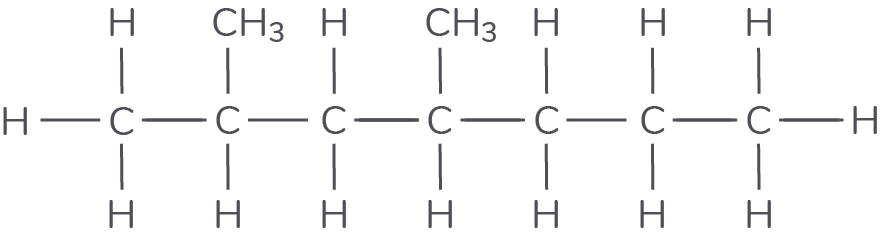
Explain why nonane has a higher boiling point than the structural isomer shown in part c).
Alkanes are saturated hydrocarbons which can be used as fuels.
Name and draw the skeletal formula of the alkane with the structural formula (CH3)2CHC(CH3)2CH2CH3.
Write an equation for the complete combustion of dodecane (C12H26).
Write an equation for the incomplete combustion of C11H24 to produce only H2O and a toxic gas.
The alkane with a molecular formula of C8H18 has several structural isomers. The structure of one of these isomers is shown below.
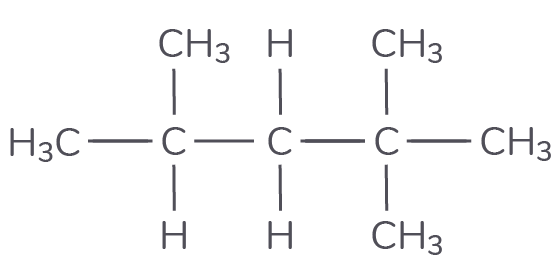
Draw the skeletal formula of the isomer shown in the diagram above.
Under certain conditions, C8H18 reacts with chlorine to form C8H17Cl.
Write an equation for the initiation step of this reaction, and state the conditions necessary for the reaction to occur.
Write an equation for the incomplete combustion of C8H18 to produce CO as the only carbon-containing product.