Extending Carbon Chains - exam practice
Extending Carbon Chains
Question 1 of 5
The carbon chain of a compound can be extended by reaction with the cyanide ion, CN-.
Write an equation for the reaction of bromoethane with potassium cyanide.
Outline a mechanism for the reaction of bromoethane with potassium cyanide.
Write an equation for the reaction between propanal and hydrogen cyanide.
Outline a mechanism for the reaction between propanal and hydrogen cyanide.
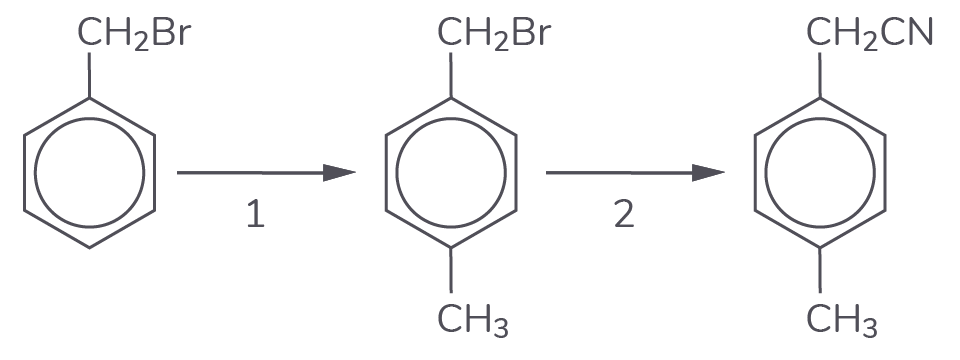
Give the reagent(s) required for the reaction shown in the diagram below.

Name the type of reaction occurring in part a).
Give the reagent(s) required for the reaction shown in the diagram below.
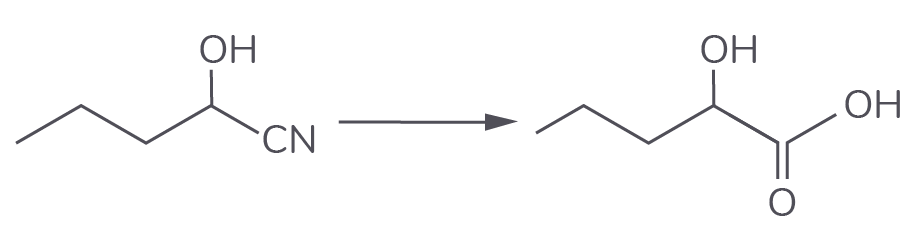
Name the type of reaction occurring in part c).
This question is about the substitution of aromatic compounds with carbon chains.
Give the reagent(s) required for the reaction shown in the diagram below.
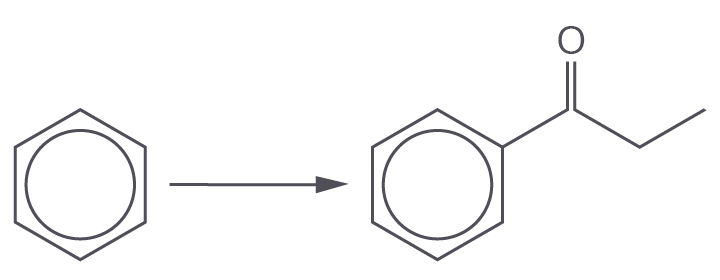
Write an equation for the formation of the reactive intermediate required for the reaction in part a).
Outline a mechanism for the reaction in part a).
The diagram below shows the structure of lactic acid, a naturally occurring chemical that can be synthesised from ethanal.
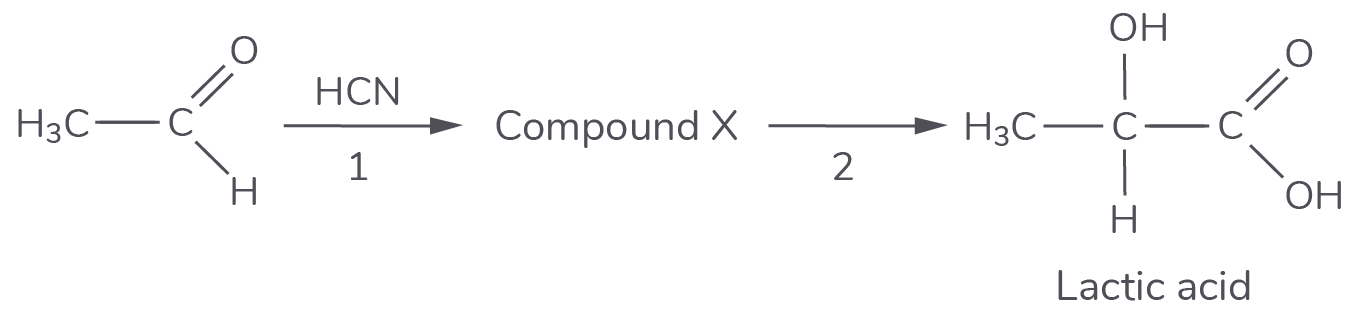
Draw the structure of compound X.
Suggest a reagent for step 2.
Compound X is reduced using H2 and a nickel catalyst.
Draw the skeletal formula of the product.
Benzene reacts with 2-chloropropane in the presence of AlCl3.
Write an equation for the formation of the electrophile for this reaction.
Outline a mechanism for the reaction.
Outline a mechanism for the reaction.
Suggest reagent(s) for step 1 and step 2 in the synthesis shown in the diagram below.