Transition Elements - exam practice
Transition Elements
Question 1 of 12
Describe the reactions of [Cu(H2O)6]2+ complex ions with:
- aqueous sodium hydroxide
- excess concentrated aqueous ammonia
- excess concentrated hydrochloric acid In your answer you should link observations with ionic equations.
Describe the reactions of [Cr(H2O)6]3+ complex ions with:
- aqueous sodium hydroxide
- excess aqueous ammonia
- hydrochloric acid In your answer you should link observations with ionic equations.
When NH3(aq) is added to Cu2+(aq), dropwise at first and then in excess, two chemical reactions occur as shown.

For each reaction:
- describe what you would see
- write an equation.
When complex ion B, [Cu(NH3)4(H2O)2]2+, reacts with 1,2-diaminoethane (en), the ammonia molecules but not the water molecules are replaced.
Write an equation for this reaction.
en = 1,2-diaminoethane.
Suggest why the enthalpy change for the reaction in part b) is approximately zero.
Explain why the reaction in part b) is spontaneous despite having an enthalpy change that is approximately zero.
This question looks at the biological applications of transition metal complexes.
Red blood cells contain haemoglobin.
Explain using ligand substitutions:
- how haemoglobin transports oxygen around the body
- why carbon monoxide is toxic.
Cis-platin, Pt(NH3)2Cl2, is an effective anti-cancer drug.
Describe the action of cis-platin in this role.
The use of cis-platin can cause side effects so nedaplatin has been developed.
Nedaplatin can be synthesised from cis-platin, as shown below.
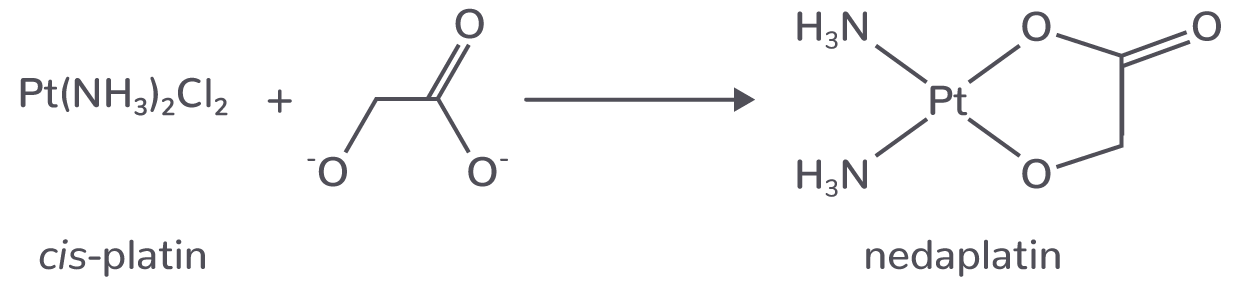
Name the type of reaction that is occuring.
This question look at the ions and complexes of cobalt.
An octahedral complex ion Y, C9H30N6Co3+, exists as two optical isomers.
In complex ion Y, Co3+ is bonded to three molecules of a bidentate ligand L.
Write the molecular formula of the bidentate ligand L.
The diagram below shows the skeletal formula of L.
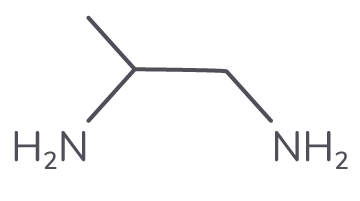
Explain how L is able to act as a bidentate ligand.
Draw a diagram that shows the shape of the complex ion Y and shows the type of bond between the ligand L and the cobalt.
The compounds [Co(NH3)5Br]SO4 and [Co(NH3)5SO4]Br are structural isomers.
Define the term structural isomer.
What is the oxidation number of cobalt in [Co(NH3)5Br]2+?
Ammonium hexachloroplatinate, (NH4)2PtCl6, is a complex of platinum used in platinum plating. Ammonium hexachloroplatinate contains the hexachloroplatinate ion.
Draw a 3D diagram to show the shape of a hexachloroplatinate ion.
On your diagram, show:
- the name of the shape
- the charge on the ion
- the value of the bond angle.
Platin, Pt(NH3)2Cl2, is a neutral complex of platinum(II).
Explain why Pt(NH3)2Cl2 has no overall charge.
Pt(NH3)2Cl2, displays cis-trans isomerism.
Draw the structure of cis-platin. State its shape and give a value of the Cl-Pt-Cl bond angle.
The use of cis-platin can cause side effects so oxaliplatin has been developed.
The structure of oxaliplatin is shown below.
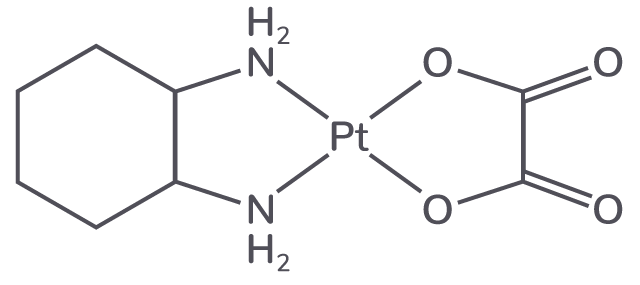
Draw the structures of the two bidentate ligands in oxaliplatin.
Steel pipelines carrying natural gas can corrode to form ‘green rust’, Fe(OH)2.
After some time, green rust can change into ‘black rust’ via the equation shown below.
3Fe(OH)2 ➔ Fe2+Fe3+2O4 + H2 + 2H2O
Use oxidation states to show that this is a redox reaction.
If seawater is present, the green rust is often oxidised to [FeCl4]- ions.
Draw diagrams to show two possible shapes for [FeCl4]-.
Name the shapes.
State the type of bonding between the chloride ligands and the iron ion in [FeCl4]-.
Cu+ also forms complexes with chloride ligands.
One example is the colourless complex [CuCl2]-.
Explain why [CuCl2]- ions are colourless.
The complex [Co(NH3)4Cl2]+ shows isomerism.
Suggest the type of isomerism shown in [Co(NH3)4Cl2]+ and draw 3D structures of the two isomers.
The diagram below shows the structure of ethane-1,2-diamine, en.
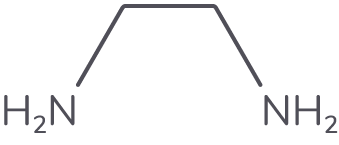
en is an example of a bidentate ligand.
Explain what is meant by the term bidentate ligand.
[Cr(en)2Cl2]+ shows geometrical and optical isomerism.
Complete the 3D diagrams to show the 3 stereoisomers of [Cr(en)2Cl2]+.
Using the model answer diagram, give the letters of the two isomers of [Cr(en )2Cl2]+ which show optical isomerism.
Using the model answer diagram, give the letter of the isomer which has no overall dipole moment.
Explain what is meant by the term transition element.
Draw electrons in the boxes below to show the electronic configurations of Cu, Cu+ and Cu2+.
Complete the table by predicting the appropriate metal ions, co-ordination numbers, formulae and charges for the complexes A-D.
Transition metals have characteristic properties due to their electron arrangements.
Give two characteristic properties of transition metals.
Give the electronic configurations of a chromium atom, a Cr2+ ion and a Cr3+ ion.
Explain why chromium has variable oxidation states.
The equation below represents the dissociation of [Fe(H2O)6]3+ ions in aqueous solution.
[Fe(H2O)6]3+(aq) ⇌ [Fe(H2O)5OH]2+(aq) + H+(aq)
The Ka for this dissociation is 6.00 × 10⁻³ mol dm-3
Calculate the pH of a 1.50 x 10⁻² mol dm-3 solution of [Fe(H2O)6]3+.
Give your answer to 2 decimal places.
The diagram below shows some reactions of iron ions in aqueous solution.
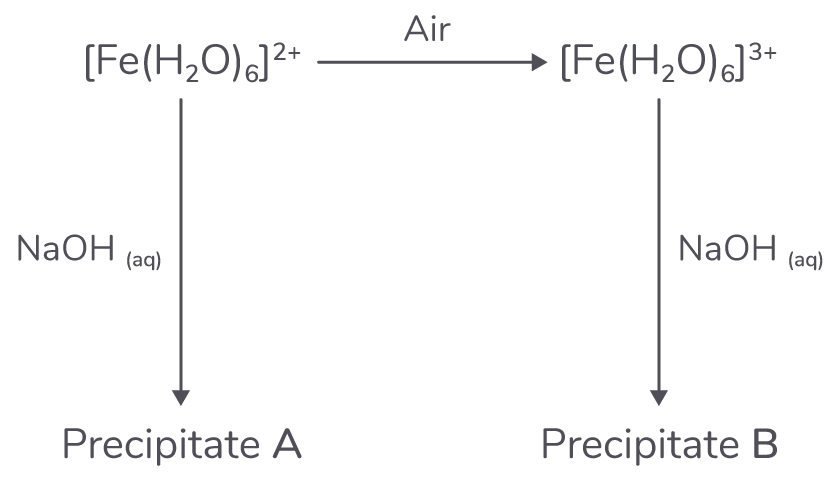
Give the formulae of A and B and state their colours.
The green precipitate A, Fe(OH)2, turned brown on standing in air.
Explain why.
When concentatd hydrochloric acid is added to aqueous Cu2+ ions, the following equilibirum is established.
[Cu(H2O)6]2+ + 4Cl- ⇌ [CuCl4]2- + 6H2O
State the colours of the [Cu(H2O)6]2+ and [CuCl4]2- complex ions.
Draw the shapes of the [Cu(H2O)6]2+ and [CuCl4]2- complex ions.
Give the name of the shape for each ion.
State the coordination numbers of the copper ion in [Cu(H2O)6]2+ and [CuCl4]2-.
Explain the change in coordination number in this equilibrium.
In aqueous solution, the [Cu(H2O)6]2+ ion reacts with an excess of ethane-1,2-diamine (en) to form the complex ion Z.
Write an equation for this reaction.
en = 1,2-diaminoethane
Explain, in terms of the chelate effect, why the complex ion Z is formed in preference to the [Cu(H2O)6]2+ complex ion.