Buffers and Neutralisation - exam practice
Buffers and Neutralisation
Question 1 of 7
L and M are acids. Y and Z are bases. The table below shows the strength of each acid and base.
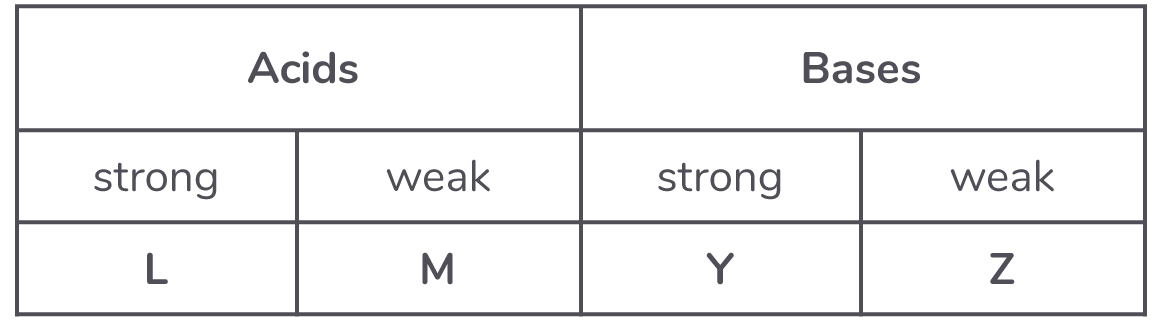
The two acids were titrated separately with the two bases using methyl orange as indicator.
The titrations were then repeated using phenolphthalein as indicator.
The pH range for methyl orange is 3.1– 4.4.
The pH range for phenolphthalein is 8.3 –10.0.
Select the correct statement about the indicator(s) that would give a precise end-point for the titration of:
Acid L with base Y.
Acid M with base Y.
Acid L with base Z.
Explain, why the end point of the reaction between acid M and base Z would be difficult to judge accurately using an indicator.
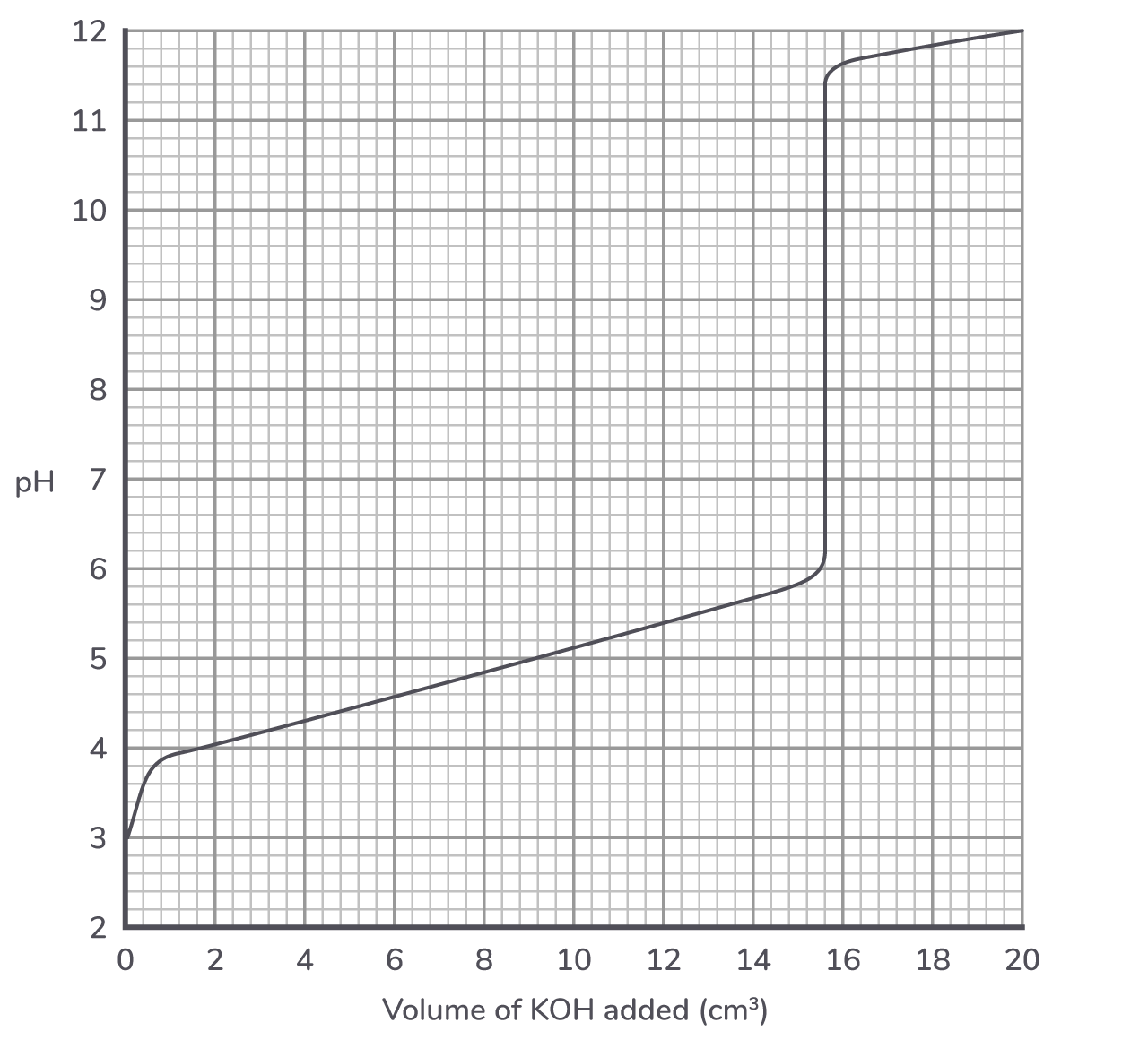
In a titration, a solution of potassium hydroxide was added gradually from a burette to a flask of ethanoic acid. The pH was measured and recorded at regular intervals.
The results are shown in the graph below.
The table below shows data about some indicators.
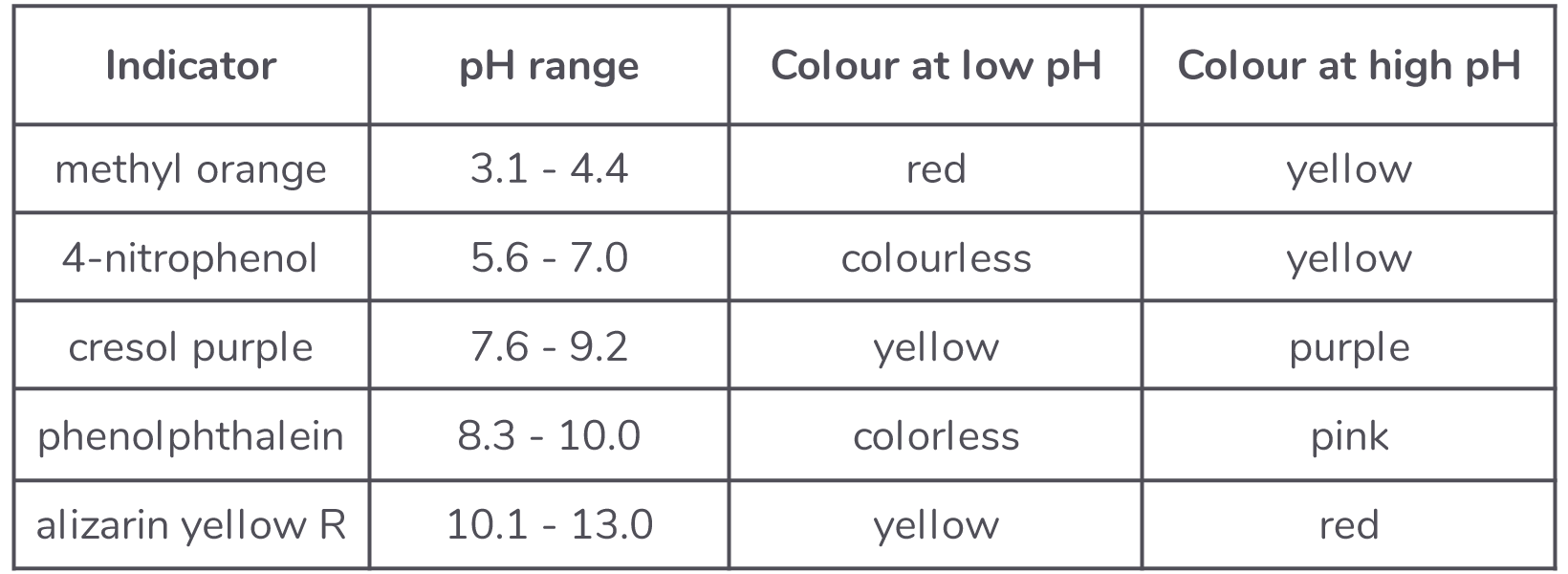
Explain which indicator(s) from the table would be suitable for this titration of ethanoic acid with potasium hydroxide.
A beaker contains 30 cm3 of a buffer solution at pH = 5.0.
Two drops of each of the five indicators in the table are added to this solution.
State the colour of the mixture of indicators in this buffer solution.
Assume that the indicators do not react with each other.
Acid–base titration pH curves can be used to help choose suitable indicators for the following titrations:
- Titration A: 0.200 mol dm-3 NaOH(aq) was added from a burette to 25.0 cm3 of 0.200 mol dm-3 HCl(aq) until the NaOH was in excess.
- Titration B: 0.200 mol dm-3 NaOH(aq) was added from a burette to 25.0 cm3 of 0.200 mol dm-3 HCOOH(aq) until the NaOH was in excess.
Sketch a pH acid–base titration curve to show how the pH changes during titration A.
Sketch a pH acid–base titration curve to show how the pH changes during titration B.
Explain how the choice of indicator is linked to the pH curve.
A buffer solution with a pH of 4.51 is prepared using ethanoic acid, CH3COOH, and sodium ethanoate, CH3COONa. In the buffer solution, the concentration of ethanoate ions is 0.186 mol dm-3.
Ka of ethanoic acid at 298 K = 1.74 x 10⁻⁵ mol dm-3.
Calculate the concentration of ethanoic acid in the buffer solution.
Give your answer to 3 significant figures.
In a different buffer solution, the concentration of ethanoic acid was 0.390 mol dm-3 and the concentration of ethanoate ions was 0.234 mol dm-3.
A 5.00 cm3 sample of 1.40 mol dm-3 sodium hydroxide was added to 500 cm3 of this buffer solution.
Calculate the pH of the buffer solution after the sodium hydroxide was added.
Give your answer to two decimal places.
A chemist plans to make up a buffer solution with a pH of 5.00.
The chemist adds solid sodium ethanoate, CH3COONa, to 500 cm3 of 0.250 mol dm-3 ethanoic acid.
Ka for ethanoic acid = 1.75 × 10⁻⁵ mol dm-3.
Calculate the mass of sodium ethanoate that the chemist needs to dissolve in the ethanoic acid to prepare this buffer solution.
Assume that the volume of the solution doesn't change on dissolving the sodium ethanoate.
The chemist prepares another CH3COOH/CH3COO- buffer solution containing 0.0300 mol of sodium ethanoate dissolved in 800 cm3 of 7.00 x 10⁻² mol dm-3 ethanoic acid.
Calculate the pH of the solution formed.
Give your answer to 2 decimal places.
A sample of 10.0 cm3 of 2.00 mol dm-3 hydrochloric acid is added to this buffer solution.
Calculate the pH of the buffer solution after this addition.
Give your answer to 2 decimal places.
Explain what is meant by the term buffer solution.
Carbonic acid, H2CO3, is a weak acid which, together with hydrogencarbonate ions, HCO3-, acts as a buffer to maintain the pH of blood.
Explain, in terms of equilibrium, how the carbonic acid–hydrogencarbonate mixture acts as a buffer in the control of blood pH.
Healthy human blood needs to be maintained at a pH of 7.40 for the body to function normally.
The p*K*<sub>a</sub> value for the dissociation of carbonic acid is 6.38.
Calculate the ratio of [HCO3-] : [H2CO3] in healthy blood.
A student adds 50.0 cm3 of 0.250 mol dm-3 methanoic acid, HCOOH, to 50.0 cm3 of 0.0500 mol dm-3 sodium hydroxide. A buffer solution forms.
Explain why a buffer solution forms.
Calculate the pH of this buffer solution at 298 K.
The Ka of methanoic acid is 1.78 x 10⁻⁴ mol dm-3 at 298 K.
Give your answer to 2 decimal places.
The student prepares another buffer solution using the same concentrations of methanoic acid and sodium hydroxide as above. They combine 25.0 cm3 solution of methnanoic acid with 25.0 cm3 solution of sodium hydroxide.
Suggest whether the pH of the buffer solution would be the same, greater than, or less than the pH calculated in part b).
Explain your reasoning.