Haloalkanes - exam practice
Haloalkanes
Question 1 of 9
2-Bromopropane reacts with aqueous potassium hydroxide to form potassium bromide and an alcohol.
Name the mechanism for this reaction.
Outline the mechanism for this reaction.
Name the alcohol formed in the reaction.
Identify the characteristic of the halogenoalkane that enables it to undergo this reaction.
This question is about the halogenoalkane 1-chloropentane.
1-chloropentane can be hydrolysed by aqueous sodium hydroxide.
Outline a mechanism for this reaction.
1-Chloropentane can be hydrolysed by water using aqueous silver nitrate in ethanol. This method can be used to compare the rates of hydrolysis of 1-chloropentane and 1-bromopentane.
State the measurement and observation required that would allow the rates of hydrolysis to be compared.
Explain why 1-bromopentane was found to react faster than 1-chloropentane.
1-Chloroethane can react with methoxide ions, CH3O−, by nucleophilic substitution.
Suggest how CH3O− ions can act as a nucleophile.
Outline the mechanism for this reaction.
1-Iodoethane also reacts with methoxide ions.
Explain how the use of 1-iodoethane instead of 1-chloroethane would affect the rate of reaction.
The ethanoate ion, CH3COO−, also acts as a nucleophile when it reacts with 1-chloroethane.
Name the organic product formed in this reaction and draw its skeletal formula.
This question is about the rate of hydrolysis of halogenoalkanes.
State and explain how the halogen in a halogenoalkane affects the rate of hydrolysis.
Name the halogenoalkane shown in the diagram below.
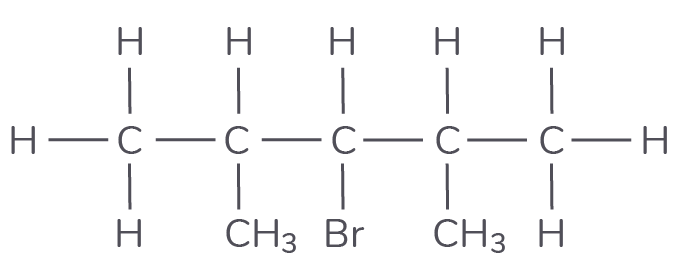
The reaction of the halogenoalkane in part b) with aqueous potassium hydroxide forms an alcohol.
Name and outline the mechanism for this reaction.
Explain why the reaction of 3-iodo-2,4-dimethylpentane with aqueous potassium hydroxide would be quicker than with the bromoalkane.
The diagram below shows the molecule 1,2-dichlorotetrafluoroethane.
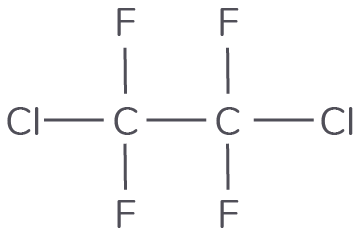
Complete the equation below to show the breakdown of one molecule of 1,2-dichlorotetrafluoroethane to form a chlorine radical and another species.
Write two equations to show how a chlorine radical can catalyse the decomposition of ozone in the atmosphere.
Bromoethane reacts with potassium cyanide, KCN, to form compound X and KBr.
Outline the mechanism for this reaction.
Name compound X.
The diagram below shows the structure of bromoalkane X.
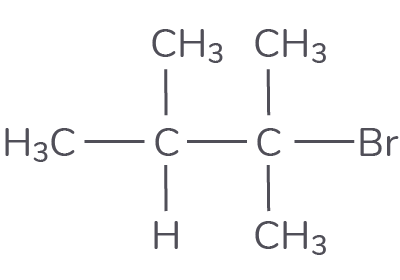
Name bromoalkane X.
Suggest one reason why 1-bromohexane has a higher boiling point than bromoalkane X.
Draw the displayed formula of 1,2-dichloro-2-methylpropane.
A student hydrolysed 1-bromobutane and 1-chlorobutane using aqueous sodium hydroxide.
State and explain the difference in the rates of hydrolysis of 1-bromobutane and 1-chlorobutane.
The molecular formula of an iodoalkane is C4H9I.
Draw the four possible structural isomers of this compound.
Outline the mechanism for the reaction between 1-iodobutane and aqueous sodium hydroxide.
Name the organic product formed in the reaction in part c).
The halogenoalkane 1-bromopropane can be converted into propan-1-ol in a one-step reaction.
State the reagent and condition needed for this reaction.
Outline a mechanism for this reaction.
This question is about the halogenoalkane 1-chloropropane.
Write a balanced equation for the reaction between 1-chloropropane and aqueous hydroxide ions.
The hydroxide ions act as a nucleophile in this reaction.
State two features of the hydroxide ion that enable it to act as a nucleophile.
Explain how the rate of reaction would change if 1-iodopropane was used as a reagent instead.