Acids, Bases and pH - exam practice
Acids, Bases and pH
Question 1 of 4
In a titration, a solution of potassium hydroxide was added gradually from a burette to 20 cm3 of 0.080 mol dm-3 propanoic acid at 298 K. The pH was measured and recorded at regular intervals.
The results are shown in the graph below.
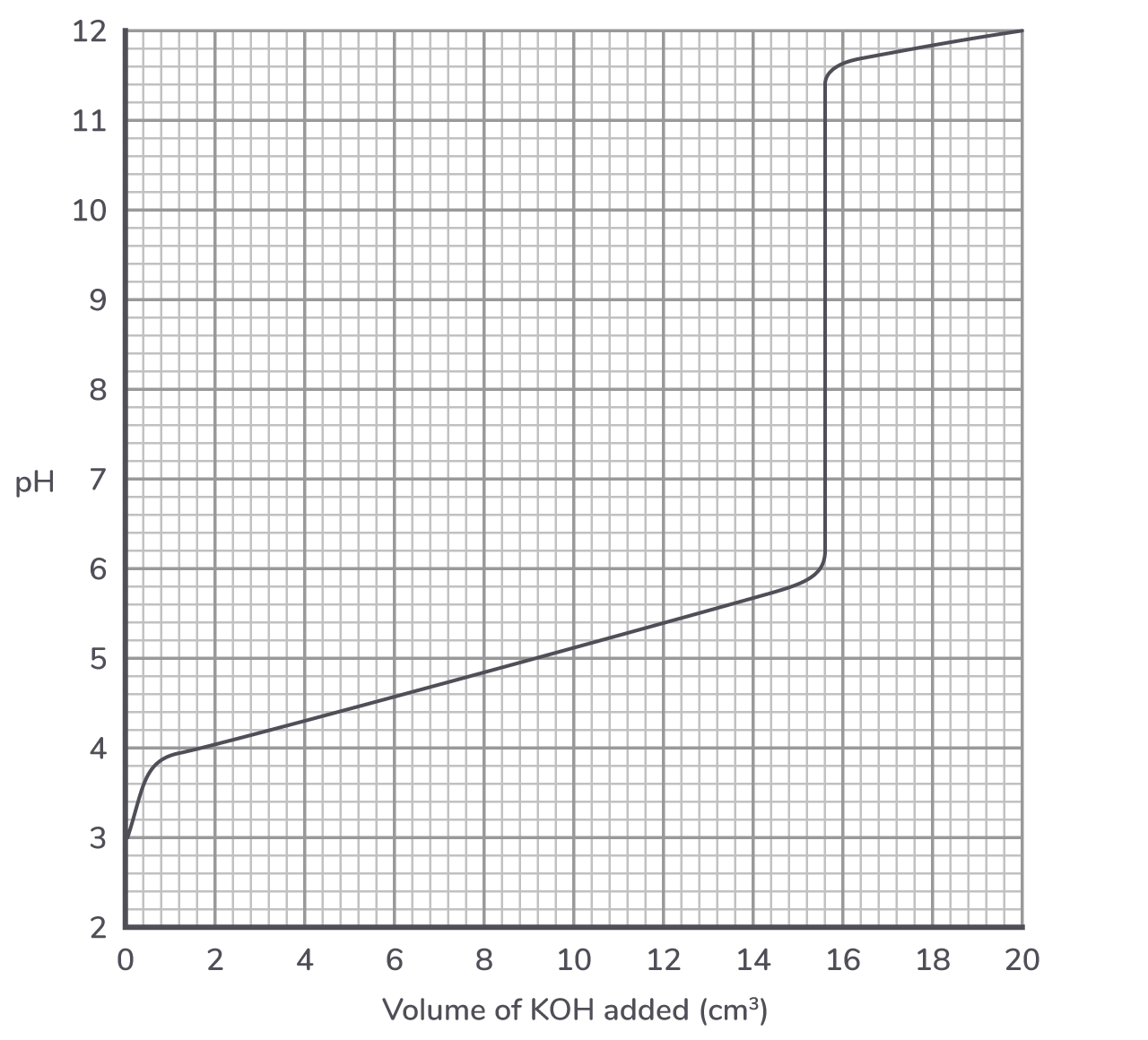
Use the graph to deduce the volume of KOH added at the end-point of the titration.
Use the graph to deduce the pH of the solution at the half-neutralisation point.
Give the expression for the acid dissociation constant, Ka, of propanoic acid, CH3CH2COOH.
Use your answers to parts b) and c) to determine the value of Ka for propanoic acid at 298 K.
Give your answer to 2 significant figures.
State the meaning of the term weak Brønsted-Lowry acid.
Boric acid, H3BO3, is a weak Brønsted acid which dissociates into ions in three stages in aqueous solution. The equation for the first dissociation is:
H3BO3(aq) ⇌ H+(aq) + H2BO3-(aq)
The pKa for this dissociation is 9.24.
Calculate the pH of a 6.50 x 10⁻² mol dm-3 solution of boric acid from the pKa value for the first dissociation.
Give your answer to 2 decimal places.
Explain the two approximations that are made in the calculation in part b).
Boric acid can undergo futher dissociation.
What is the conjugate acid of the HBO32- ion?
What is the conjugate base of the HBO32- ion?
Methanoic acid, HCOOH is added to butanoic acid, CH3(CH2)2COOH. A reaction takes place to form an equilibrium mixture containing two acid-base pairs.
The Ka of methanoic acid is 1.82 x 10⁻⁴ mol dm-3
The Ka of butanoic acid is 1.51 x 10⁻⁵ mol dm-3
Complete the equilibrium equation:
HCOOH + CH3(CH2)2COOH ⇌ ............................................ + .............................................
For each of the 3 equilibria shown below, write 'A' or 'B' on the dotted lines below each equation to indicate whether the substance is acting as a Brønsted–Lowry acid (A) or a Brønsted–Lowry base (B).
A 25.0 cm3 sample of 7.50 x 10⁻² mol dm-3 hydrochloric acid was placed in a beaker.
Distilled water was added until the pH of the solution was 1.35.
Calculate the total volume, in cm3, of the solution formed.
Give your answer to 3 significant figures.
Calculate the concentration of hydroxide ions, in mol dm-3, in the hydrochloric acid solution after the addition of distilled water.
Give your answer to 3 significant figures.
Kw = 1.00 × 10⁻¹⁴ mol2 dm-6
Water dissociates slightly according to the equation:
H2O(I) ⇌ H+(aq) + OH-(aq)
The ionic product of water, Kw, is given by the expression
Kw = [H+][OH-]
Explain why the expression for Kw does not include the concentration of water.
The graph below shows how Kw varies with temperature.
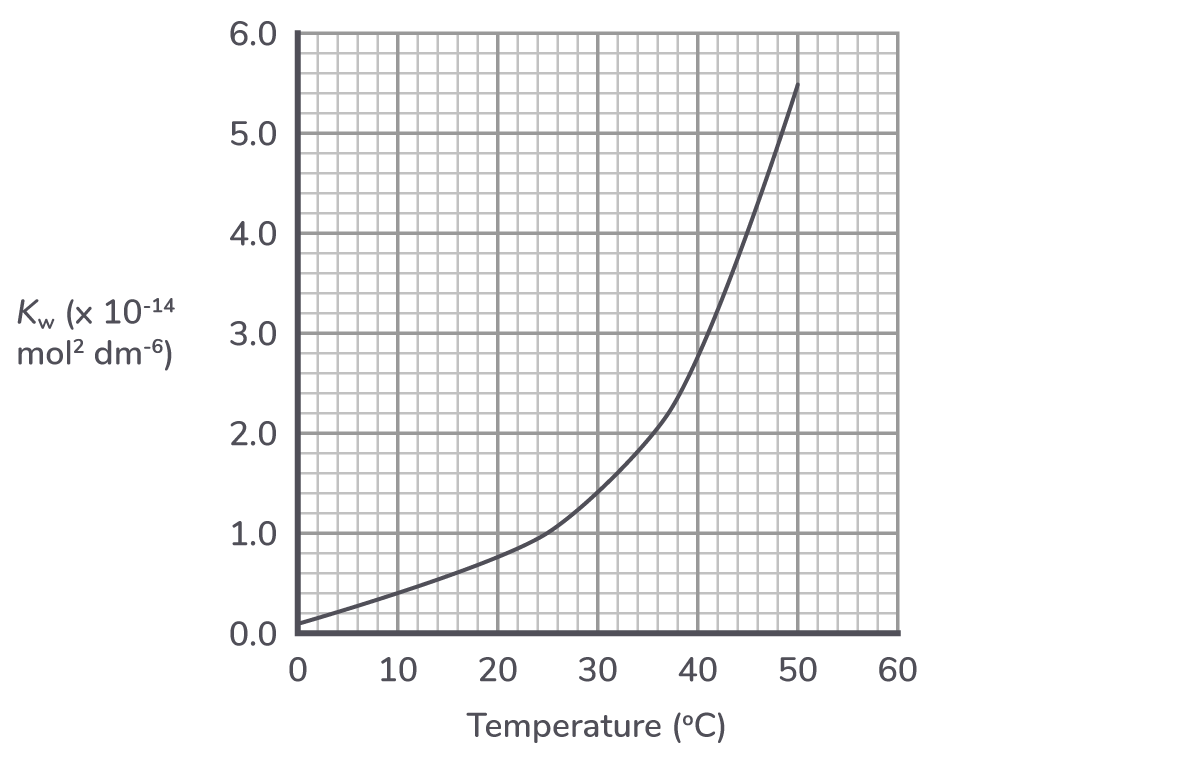
Use the graph above to calculate the pH of pure water at body temperature, 37°C.
Give your answer to 1 decimal place.
Calculate the pH of a 0.18 mol dm-3 solution of KOH at 37°C.
Give your answer to 1 decimal place.