Electrode Potentials - exam practice
Electrode Potentials
Question 1 of 18
1 of 18
The standard reduction potentials of two systems are
Sn4+(aq) + 2e- ⇌ Sn2+(aq) E⦵ = +0.15 V
Fe3+(aq) + e- ⇌ Fe2+(aq) E⦵ = +0.77 V
What is the value of E⦵cell for the system below?
Sn4+(aq) + 2Fe2+(aq) ➔ Sn2+(aq) + 2Fe3+(aq)
Question 2 of 18
2 of 18
In a hydrogen-oxygen fuel cell, the oxygen is
Question 3 of 18
3 of 18
The acid used in a standard hydrogen electrode to provide a 1 mol dm-3 solution of hydrogen ions is
Question 4 of 18
4 of 18
To measure the standard electrode potential for the Ag+(aq) | Ag(s) electrode, the most suitable chemical for the solution in a salt bridge to connect the two half cells is
Question 5 of 18
5 of 18
An electrochemical cell consists of a standard hydrogen electrode and a Cu2+(aq) | Cu(s) electrode which uses copper(II) sulfate solution.
Which one of the following does not affect the e.m.f. of the cell?
Question 6 of 18
6 of 18
The standard electrode potentials of two half reactions are shown below.
Cl2 + e- ⇌ Cl- E⦵ = +1.36 V
Co3+ + e- ⇌ Co2+ E⦵ = +1.82 V
Which of the following processes is thermodynamically favourable? The reaction of
Question 7 of 18
7 of 18
Which of the statements about a standard hydrogen electrode, for which E⦵ = 0 V, is correct?
Question 8 of 18
8 of 18
The table below gives the standard electrode potentials of three half cells.
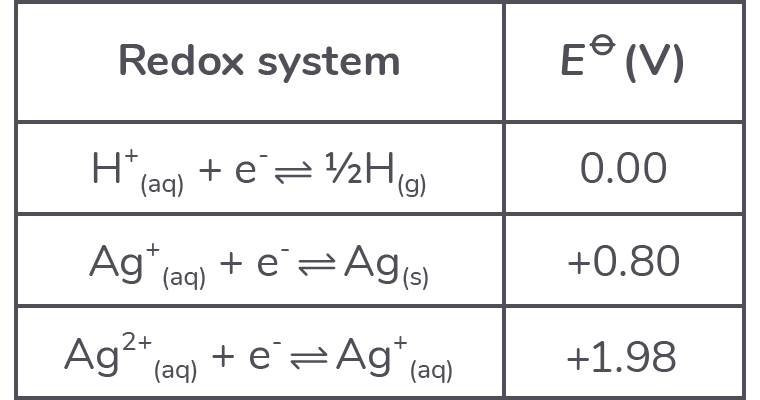
From these data it may be deduced that, under standard conditions,
Question 9 of 18
9 of 18
Which of the following statements about fuel cells is not true?
Question 10 of 18
10 of 18
A student is given the electrode potentials below.
Cu2+ + 2e- ⇌ Cu E⦵ = +0.34 V
Ag+ + e- ⇌ Ag E⦵ = +0.80 V
The student sets up a cell from the two half cells.
Which statement is correct?
Question 11 of 18
11 of 18
The redox equilibria for a hydrogen-oxygen fuel cell in alkaline solution are shown below.
2H2O(l) + 2e- ⇌ H2(g) + 2OH-(aq) E⦵ = –0.83 V
O2(g) + H2O(l) + 2e- ⇌ 2OH-(aq) E⦵ = +0.40 V
What is the equation for the overall cell reaction?
Question 12 of 18
12 of 18
The following cell has an e.m.f. of +0.46 V.
Cu | Cu2+ || Ag+ | Ag
Which statement is correct about the operation of the cell?
Question 13 of 18
13 of 18
The values for two electrodes are shown.
Fe2+(aq) + 2e- ⇌ Fe(s) E⦵ = -0.44 V
Cu2+(aq) + 2e- ⇌ Cu(s) E⦵ = +0.34 V
What is the e.m.f. of the cell Fe(s) | Fe2+(aq) || Cu2+(aq)| Cu(s)?
Question 14 of 18
14 of 18
Which describes the flow of electrons in a voltaic cell?
Question 15 of 18
15 of 18
Which is not a requirement of the standard hydrogen electrode (SHE)?
Question 16 of 18
16 of 18
Where does oxidation occur in a voltaic cell?
Question 17 of 18
17 of 18
Consider the following half-equations:
I2(s) + 2e- ⇌ 2I-(aq)
(brown) (colourless)
MnO4-(aq) + 8H+(aq) + 5e- ⇌ Mn2+(aq) + 4H2O(l)
(purple) (colourless)
Which statement is correct for the reaction between KMnO4(aq) and KI(aq) in acidic conditions?
Question 18 of 18
18 of 18
A voltaic cell is constructed from zinc and copper half-cells. Zinc is more reactive than copper.
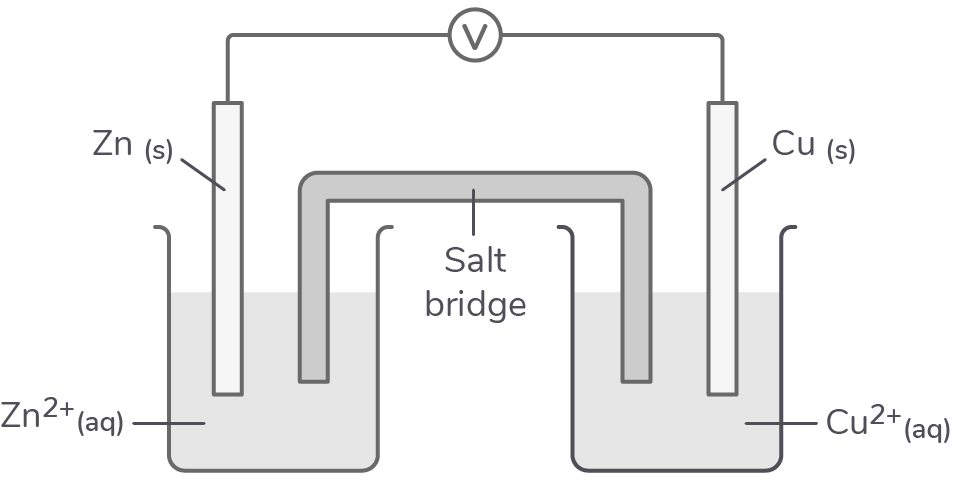
Which statement is correct when this cell produces electricity?