Aromatic Chemistry - exam practice
Aromatic Chemistry
Question 1 of 16
1 of 16
Bromine reacts more readily with phenol than with benzene. This is because the...
Question 2 of 16
2 of 16
The structure of compound G is
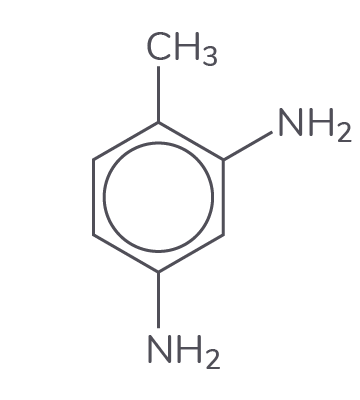
What is the systematic name of compound G?
Question 3 of 16
3 of 16
How many isomers containing a benzene ring are there with the molecular formula C6H3(NO2)2OH?
Question 4 of 16
4 of 16
Aluminium chloride catalyses the reaction of benzene and ethanoyl chloride. This is because aluminium chloride...
Question 5 of 16
5 of 16
Bromine reacts much faster with phenylamine than with benzene. This is because...
Question 6 of 16
6 of 16
X-ray diffraction provides evidence that benzene molecules have...
Question 7 of 16
7 of 16
Benzene is nitrated using a mixture of concentrated nitric and sulfuric acids. The sulfuric acid...
Question 8 of 16
8 of 16
Phenylamine (aniline), C6H5NH2, may be prepared from nitrobenzene, C6H5NO2.
The reagent normally used for this reaction is
Question 9 of 16
9 of 16
Benzocaine is used as a local anaesthetic.
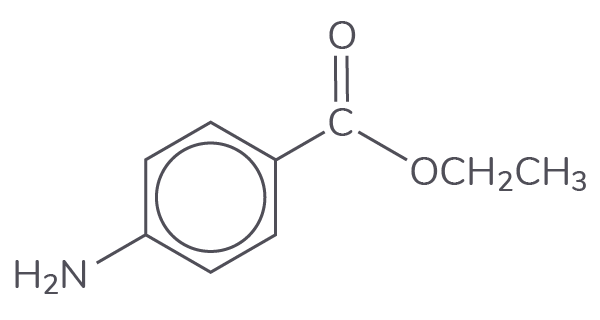
Separate samples of a solution of benzocaine are added to 2,4-dinitrophenylhydrazine, hot aqueous sodium hydroxide, and dilute hydrochloric acid.
Which chemicals react with benzocaine?
Question 10 of 16
10 of 16
Benzene (Tb = 80.1°C) has a higher boiling temperature than ethanol (Tb = 78.5°C).
This is because the..
Question 11 of 16
11 of 16
In the reaction of benzene with chloromethane, aluminium chloride is added because it reacts with...
Question 12 of 16
12 of 16
Which reaction does not occur?
Question 13 of 16
13 of 16
Benzene reacts with an organic reagent in the presence of a halogen carrier to form phenylethanone.
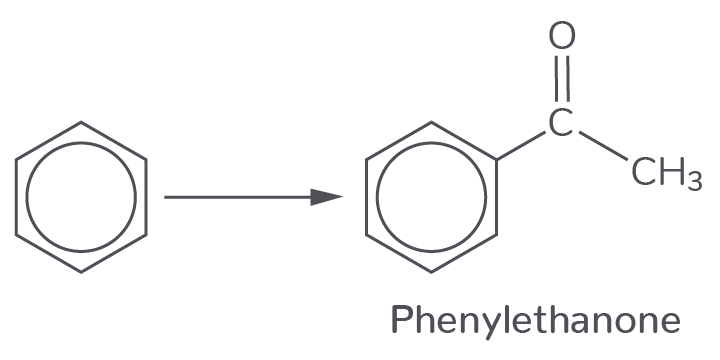
Which organic reagent is required?
Question 14 of 16
14 of 16
Which compound is produced when 1-phenylethanol reacts with acidified potassium dichromate(VI)?
Question 15 of 16
15 of 16
Methylbenzene reacts with a mixture of concentrated nitric acid and concentrated sulfuric acid.
What is the name of the mechanism for this reaction?
Question 16 of 16
16 of 16
The enthalpy change of hydrogenation of cyclohexene is 120 kJ mol-1.
What is the approximate enthalpy change of hydrogenation of benzene, in kJ mol-1?