12.1 - Introduction to Entropy
- 1
What entropy is and how it relates to disorder
- 2
The factors that affect entropy
- 3
The relationship between entropy and temperature
- 4
How entropy influences reaction feasibility
Entropy is a measure of disorder
Entropy (S) is a thermodynamic quantity that measures the degree of disorder or randomness in a system. It quantifies the random dispersal of molecules and the distribution of energy quanta among those molecules.
Key points about entropy:
- A high entropy value indicates a high level of disorder.
- Entropy is always positive and increases as disorder increases.
- The natural direction of change in any process is towards increasing total entropy (positive entropy change). For example, gases spread spontaneously through a room via diffusion, increasing the system's entropy.
Factors affecting entropy
Three factors influence the entropy of a substance:
1. Physical state
The physical state of a substance significantly impacts its entropy. In general, entropy increases as a substance transitions from solid to liquid to gas.
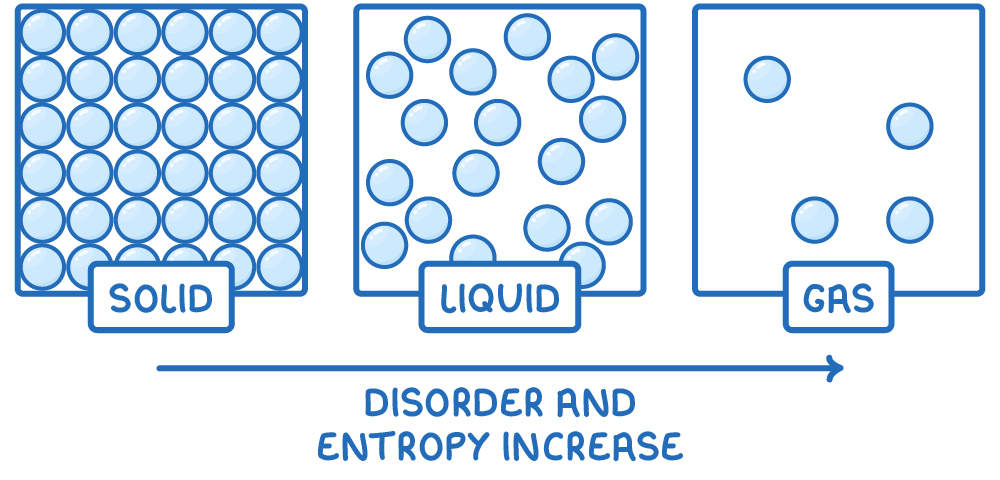
- Solids have the lowest entropy due to their highly ordered structure, with particles confined to fixed positions.
- Liquids have higher entropy than solids, as their particles have more freedom of movement.
- Gases have the highest entropy, with particles moving randomly and occupying a larger volume.
Examples:
-
The combustion of magnesium ribbon in air: 2Mg_(s)_ + O_2(g)_ ➔ 2MgO_(s)_ This reaction involves a gas reactant (O_2_) forming a solid product (MgO), resulting in a decrease in entropy.
-
The reaction between ethanoic acid and ammonium carbonate: 2CH_3_COOH_(aq)_ + (NH_4_)2_CO_3(s) ➔ 2CH_3_COONH_4(aq)_ + H_2_O_(l)_ + CO_2(g)_
This reaction produces a gas (CO_2_), leading to an increase in entropy.
2. Number of particles
Entropy increases with the number of particles in a system, as a larger number of particles leads to more possible arrangements and energy distributions.
Example:
The decomposition of nitrogen tetroxide: N2O4(g) ➔ 2NO2(g)
This reaction doubles the number of gas molecules, resulting in an entropy increase.
3. Dissolution
Dissolving a substance increases its entropy because the dissolved particles gain more freedom of movement compared to their solid state.
Example:
Dissolving ammonium nitrate in water: NH_4_NO_3(s)_ ➔ NH_4_^+^(aq)** + NO_3_^-^(aq)**
Entropy and temperature
- As temperature increases, the entropy of a substance also increases.
- Higher temperatures mean more energy in the system, leading to more ways of distributing that energy among particles.
- This increased energy distribution results in greater disorder and thus higher entropy.
- Entropy increases as substances change from solid to liquid to gas, due to increasing particle movement and disorder.
At the extreme low end of the temperature scale:
- At absolute zero (0 K), a perfect crystal has zero entropy.
- A perfect crystal has a completely ordered internal structure with no particle movement.
Entropy and reaction feasibility
Particles naturally tend towards more disordered states, as increased entropy provides greater energetic stability. This drive for disorder can make certain reactions feasible (able to proceed spontaneously) even when the enthalpy change is endothermic.
For example, the reaction between sodium hydrogencarbonate and hydrochloric acid is endothermic but still feasible:
NaHCO3(s) + HCl(aq) ➔ NaCl(aq) + CO2(g) + H2O(l)
The reaction produces gaseous carbon dioxide and liquid water, which have higher entropy than the solid reactant. This entropy increase overcomes the endothermic enthalpy change, allowing the reaction to occur spontaneously at room temperature.
This example demonstrates that enthalpy changes alone do not determine whether a reaction will occur spontaneously; reaction feasibility depends on the balance between enthalpy and entropy changes.