12.5 - Enthalpy Changes of Solution and Hydration
- 1
The enthalpy changes involved in dissolving ionic compounds
- 2
Defining enthalpy changes of hydration and solution
- 3
How to calculate enthalpy change of solution using Born-Haber cycles
- 4
Factors affecting the enthalpy of hydration
- 5
Explaining the solubility trends of group 2 compounds
Dissolving involves enthalpy changes
When an ionic solid dissolves in water, two key processes occur:
- Breaking bonds in the ionic lattice - The ionic bonds are broken to form gaseous ions. This process is endothermic and the enthalpy change is equal in magnitude but opposite in sign to the lattice enthalpy.
- Forming bonds between ions and water - New bonds form between the gaseous ions and water molecules to form hydrated ions. This process is exothermic and the enthalpy change is called the enthalpy of hydration.
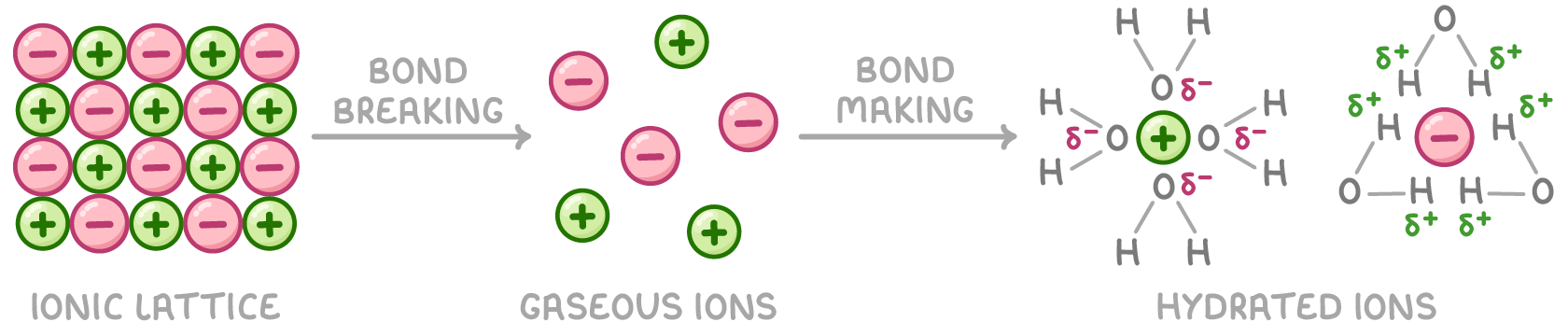
The overall enthalpy change when an ionic solid dissolves is called the enthalpy change of solution (ΔH⦵sol). It is the sum of the endothermic lattice breaking and exothermic hydration steps.
Defining enthalpy change of hydration and solution
- Enthalpy change of hydration (ΔH⦵hyd) - The enthalpy change when 1 mole of aqueous ions is formed from 1 mole of gaseous ions. For example: Li+(g) ➔ Li+(aq)
ΔH⦵hyd values are always exothermic as energy is released when the ions become surrounded by water molecules, forming ion-dipole interactions.
- Enthalpy change of solution (ΔH⦵sol) - The enthalpy change when 1 mole of solute is dissolved in sufficient water to form a very dilute solution. For example: LiCl(s) ➔ LiCl(aq)
ΔH⦵sol values can be either exothermic or endothermic, depending on the balance between the energy required to break the bonds in the solute and the energy released from the formation of new solute-solvent interactions.
For a substance to dissolve, the energy released from hydration must be similar to or greater than the energy required to break up the lattice. Therefore, soluble substances usually have exothermic enthalpies of solution.
Calculations involving enthalpy changes of solution and hydration
The enthalpy change of solution can be calculated using a modified Born-Haber cycle.
The key information needed is:
- The lattice enthalpy of the ionic compound.
- The enthalpies of hydration for the individual gaseous ions.
The enthalpy change of solution (ΔHsol) can be calculated using the formula:
ΔHsol = ΔHlatt + ΔHhyd
Worked example 1 - Calculating the enthalpy change of solution for lithium chloride
Calculate the enthalpy change of solution for lithium chloride (LiCl) using the following data:
| Enthalpy change | Value (kJ mol^-1^) |
|---|---|
| Lattice enthalpy of LiCl, ∆H_latt_ | -853 |
| Enthalpy of hydration for Li^+^, ∆H_hyd_(Li^+^) | -520 |
| Enthalpy of hydration for Cl^-^, ∆H_hyd_(Cl^-^) | -364 |
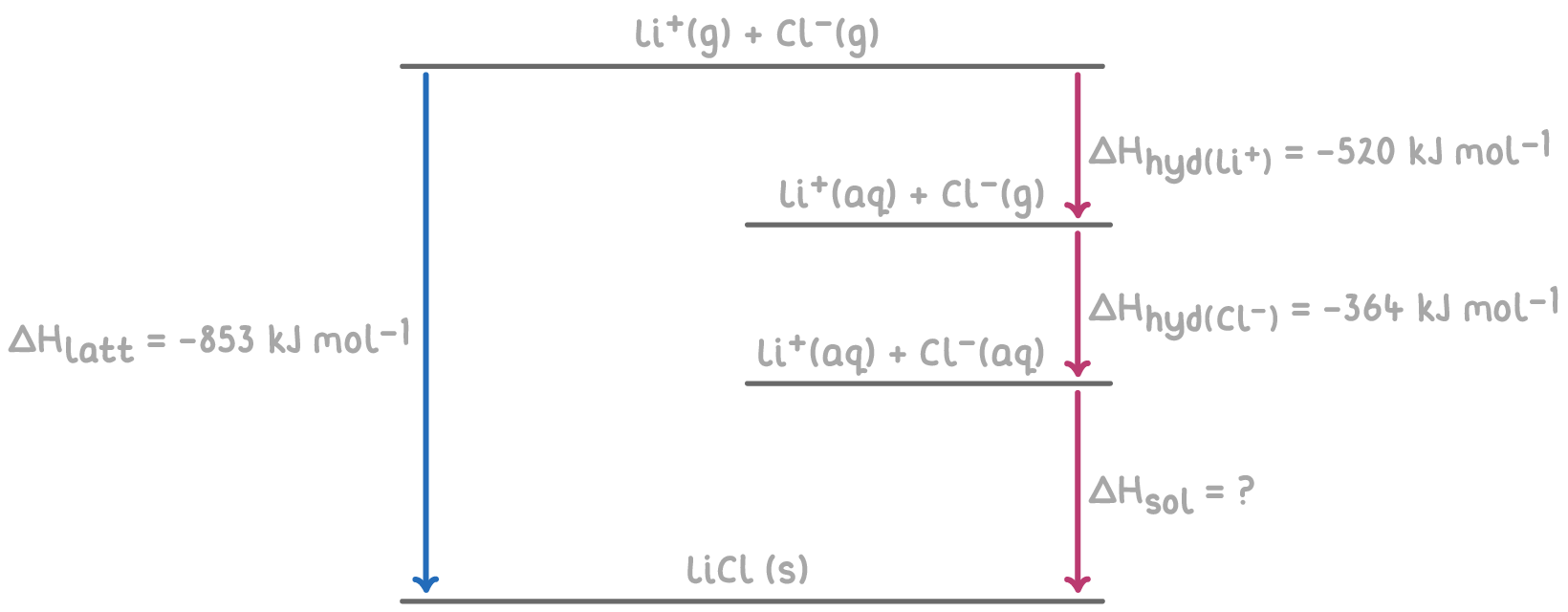
Step 1: Apply Hess's law for the Born-Haber cycle
The overall enthalpy change of solution of LiCl can be calculated by summing the enthalpy changes for each step of the Born-Haber cycle.
Step 2: Equation
ΔHsol = ΔHlatt + (ΔHhyd(Li+) + ΔHhyd(Cl-))
Step 3: Substitution and correct evaluation
ΔHsol =
= 853 884
ΔHsol = 31 kJ mol^-1^
The negative value indicates that dissolving LiCl in water is exothermic, explaining why LiCl dissolves readily in water.
Worked example 2 - Calculating the enthalpy change of solution for silver chloride
Calculate the enthalpy change of solution for silver chloride (AgCl) using the following data:
| Enthalpy change | Value (kJ mol^-1^) |
|---|---|
| Lattice enthalpy of AgCl, ∆H_latt_ | -905 |
| Enthalpy of hydration for Ag^+^, ∆H_hyd_(Ag^+^) | -464 |
| Enthalpy of hydration for Cl^-^, ∆H_hyd_(Cl^-^) | -364 |
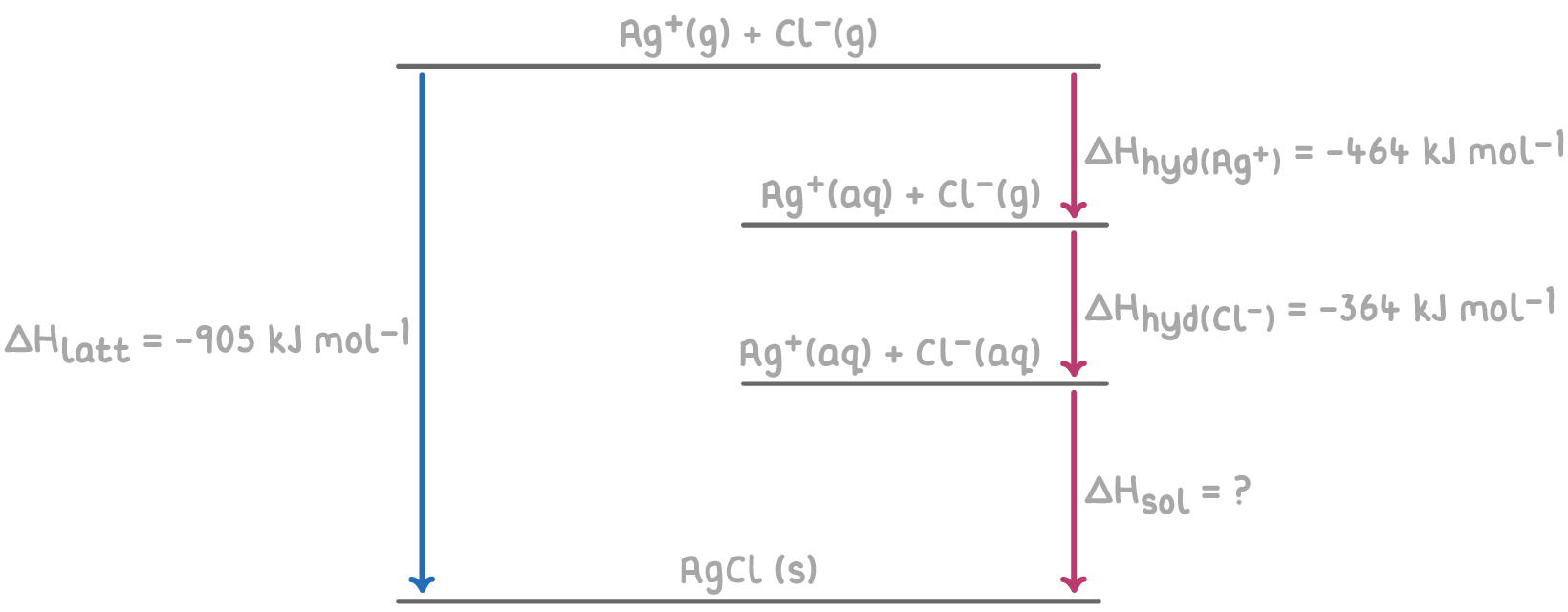
Step 1: Apply Hess's law for the Born-Haber cycle
The overall enthalpy change of solution of AgCl can be calculated by summing the enthalpy changes for each step of the Born-Haber cycle.
Step 2: Equation
ΔHsol = ΔHlatt + (ΔHhyd(Ag+) + ΔHhyd(Cl-))
Step 3: Substitution and correct evaluation
ΔHsol =
= 905 828
ΔHsol = +77 kJ mol-1
The positive value of +77 kJ mol-1 for the enthalpy change of solution indicates that dissolving AgCl in water is much less energetically favourable compared to LiCl, explaining why AgCl is insoluble in water.
Worked example 3 - Calculating the enthalpy of hydration of the Mg2+ ion
Calculate the enthalpy change of hydration for the magnesium ion (Mg2+) using the following data:
| Enthalpy change | Value (kJ mol^-1^) |
|---|---|
| Lattice enthalpy of MgCl_2_, ∆H_latt_ | -2,524 |
| Enthalpy of solution of MgCl_2_, ∆H_sol_ | -160 |
| Enthalpy of hydration for Cl^-^, ∆H_hyd_(Cl^-^) | -364 |
Step 1: Double the hydration enthalpy for chlorine
As MgCl2 contains two chloride ions, we need to double the enthalpy of hydration for Cl-:
2 x ΔHhyd(Cl-) = 2 x (728 kJ mol-1
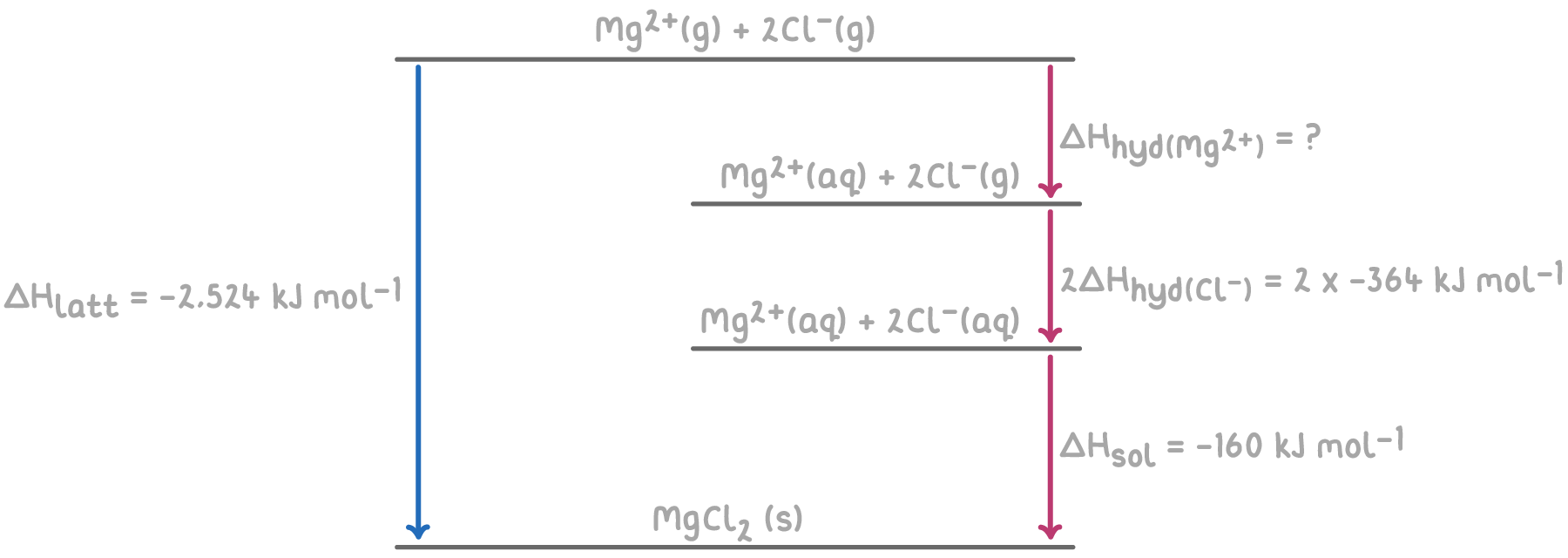
Step 2: Apply Hess's law for the Born-Haber cycle
The overall enthalpy change of hydration of Mg2+ can be calculated by summing the enthalpy changes for each step of the Born-Haber cycle.
Step 3: Equation
ΔHsol = ΔHlatt + (ΔHhyd(Mg2+) + 2ΔHhyd(Cl-))
Step 4: Rearrange equation
ΔHhyd⦵(Mg2+) = ΔHsol + ΔHlatt 2ΔHhyd(Cl-)
Step 4: Substitution and correct evaluation
ΔHhyd(Mg2+) = (
=
ΔHhyd(Mg2+) = 1,956 kJ mol-1
Therefore, the enthalpy of hydration for the Mg2+ ion is 1,956 kJ mol-1, indicating a highly exothermic process as energy is released when Mg2+ ions are hydrated by water molecules.
Factors affecting enthalpy of hydration
The same factors that influence lattice enthalpy also affect enthalpy of hydration:
-
Ionic charge - Ions with a greater charge have stronger electrostatic attractions to the polar water molecules. This leads to more energy being released when the ion-dipole forces form, resulting in a more exothermic enthalpy of hydration.
-
Ionic radius - Smaller ions have a higher charge density. This allows them to attract water molecules more strongly compared to larger ions. As a result, smaller ions have a more exothermic enthalpy of hydration.
For example, Mg2+ has a much more exothermic enthalpy of hydration than Na+:
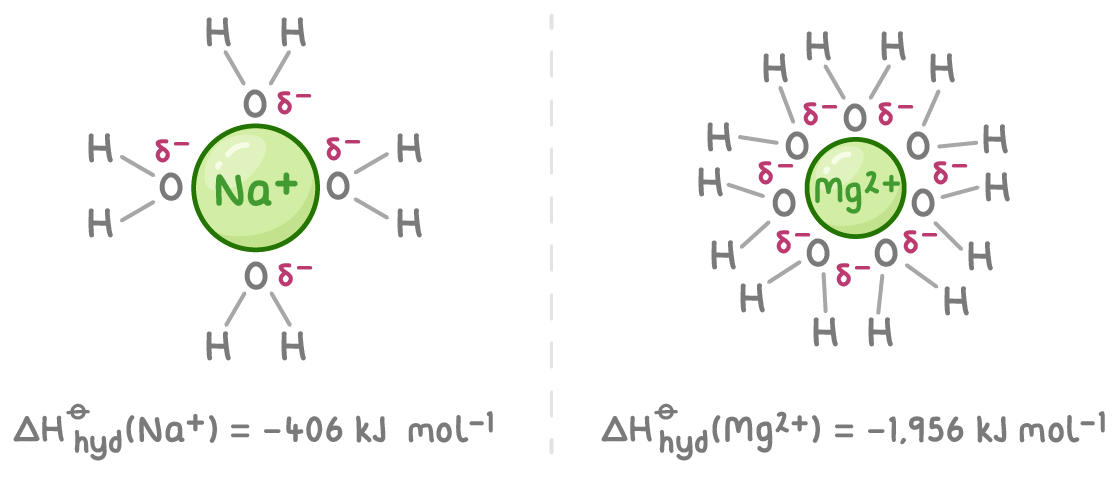
The magnesium ion has a greater charge (+2 vs. +1) and a smaller radius than the sodium ion. These factors combine to give magnesium a much more exothermic enthalpy of hydration.
Solubility depends on relative lattice energies and hydration enthalpies
The solubility of group 2 hydroxides and sulfates depend on their enthalpy change of solution (ΔHsol).
This can be related to solubility using Hess's law:
The more positive (or less negative) their ΔHsol value, the lower their solubility.
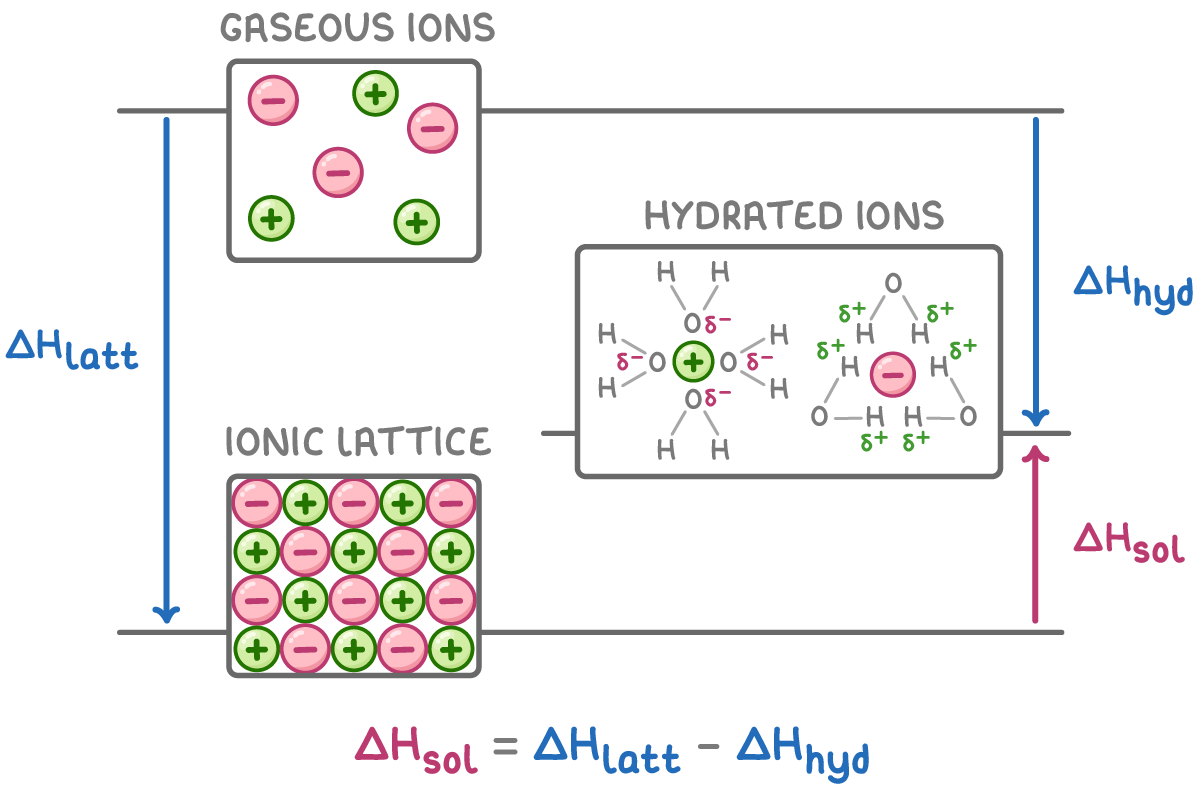
Therefore, solubility depends on the relative magnitudes of:
- Enthalpy change of hydration.
- Lattice energy.
Trend in solubility of group 2 hydroxides
The solubility of group 2 hydroxides increases down the group because:
- The charge density of the group 2 cation decreases down the group.
- This causes both the enthalpy change of hydration and the lattice energy to become less negative.
- The small hydroxide ion makes a relatively small contribution to the lattice energy so lattice energy is determined more by the larger group 2 cations.
- Lattice energy changes by a greater amount compared to the enthalpy change of hydration.
- ΔHsol becomes more negative (or less positive) down the group.
Trend in solubility of group 2 sulfates
The solubility of group 2 sulfates decreases down the group because:
- The charge density of the group 2 cation decreases down the group.
- This causes both the enthalpy change of hydration and the lattice energy to becomes less negative.
- The large sulfate ion makes a relatively large contribution to the lattice energy so lattice energy is determined more by the larger sulfate anion.
- Enthalpy change of hydration changes by a greater amount compared to the lattice energy.
- ΔHsol becomes less negative (or more positive) down the group.