19.3 - Amides and Polyamides
- 1
Amides as carboxylic acid derivatives
- 2
Making amides from acyl chlorides
- 3
Making polyamides via condensation polymerisation
- 4
Working out monomer and repeat unit structures
- 5
Physical properties of polyamides
- 6
The formation and uses of poly(propenamide) and poly(ethenol)
Amides are carboxylic acid derivatives
Amides are organic compounds that contain the functional group –CONH2. They are derived from carboxylic acids by replacing the hydroxyl group with an amino group.
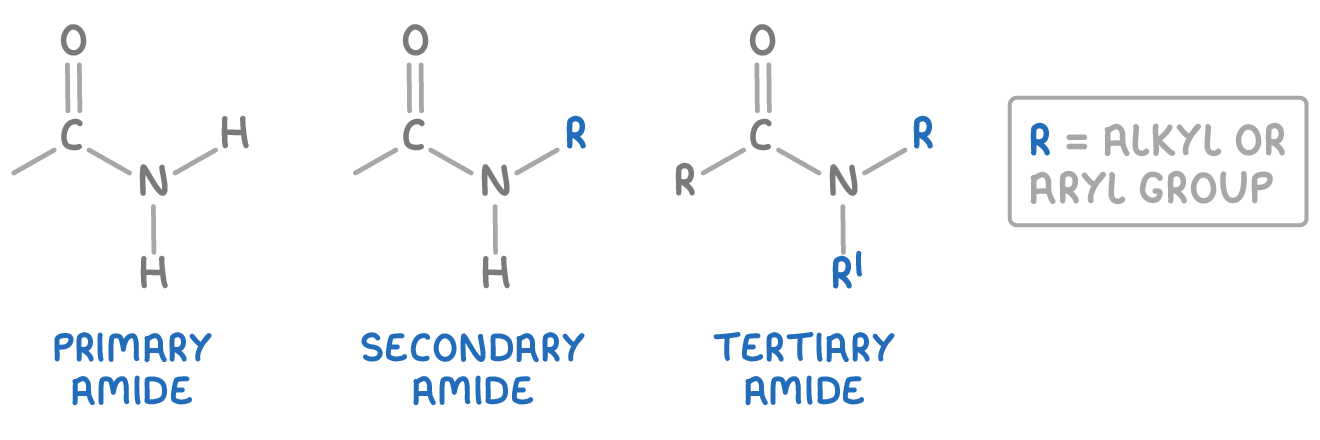
There are three main types of amide you should be familiar with:
- Primary amides - These are amides where the nitrogen atom is bonded to one carbonyl group (C=O) and two hydrogen atoms.
- Secondary amides - These are amides where the nitrogen atom is bonded to one carbonyl group (C=O), one hydrogen atom and one alkyl or aryl group.
- Tertiary amides - These are amides where the nitrogen atom is bonded to one carbonyl group (C=O), and two alkyl or aryl groups.
Making amides from acyl chlorides
Amides can be synthesised through the reaction of acyl chlorides with concentrated ammonia or primary amines, typically occurring at room temperature.
With ammonia:
The reaction between acyl chlorides and ammonia produces primary amides.
For example, ethanoyl chloride reacts with ammonia to give ethanamide and HCl:
CH3COCl + NH3 ➔ CH3CONH2 + HCl
With amines:
The reaction between acyl chlorides and primary amines produces secondary amides, also known as N-substituted amides.
For example, ethanoyl chloride reacts with methylamine to give N-methylethanamide and HCl:
CH3COCl + CH3NH2 ➔ CH3CONHCH3 + HCl
In these reactions, the produced HCl typically reacts with any excess ammonia or amine to form ammonium salts.
Formation of polyamides
Polyamides are a type of condensation polymer, formed from dicarboxylic acid and diamine monomers. The carboxyl and amine groups react, forming amide links within the polymer chain. A molecule of water is eliminated each time a linkage forms between monomers.
Examples of polyamides include:
- Nylon - Formed from hexanedioic acid and 1,6-diaminohexane. Nylon is commonly used for fibres in clothing, ropes and parachutes.

- Kevlar - Formed from benzene-1,4-dicarboxylic acid and 1,4-diaminobenzene. Kevlar is used for bulletproof vests and sports equipment.

Working out monomer and repeat unit structures
Drawing monomers from a polymer
To deduce the monomers that form a polyamide, follow these steps:
- Identify the amide (HN-CO) linkage between repeat units.
- Cut the link in the middle to separate the polymer chain.
- Add a H atom or -OH group to both ends of the molecules. H atoms are added to N atoms, and -OH groups to C atoms.
The monomers that form a particular polyamide can be identified from its polymer structure:

Drawing repeat units from monomers
To draw the repeat unit from condensation monomers, follow these steps:
- Place the structures of the two monomers side by side.
- Remove an H atom from the diamine and an -OH group from the dicarboxylic acid, forming a H2O molecule as a by-product.
- Connect the monomers via an amide linkage.
- To indicate continuity, remove another H atom and OH group from the opposite ends.
The repeating unit of a polyamide can be deduced from its monomers' structures:

Polyamide properties and uses
Polyamides are typically semi-crystalline, strong, and resistant to heat and chemicals. However, they tend to absorb moisture, which increases their flexibility but decreases their tensile strength.
The strong covalent bonds and hydrogen bonding in polyamides give them high tensile strength. This makes them useful for:
- Durable fibres (such as in clothing, fishing lines, and carpets).
- Tough packaging films.
- High temperature applications.
However, polyamides can be hydrolysed by strong acids or bases, which break down the amide linkages.
Addition polymers with functional side groups
While condensation polymers like nylon and Kevlar are well-known, poly(propenamide) and poly(ethenol) are two notable examples of addition polymers. These contains amide and alcohol functional groups as side chains, respectively, giving them unique properties and applications.
Poly(propenamide)
Poly(propenamide) is formed via the addition polymerisation of 2-propenamide:
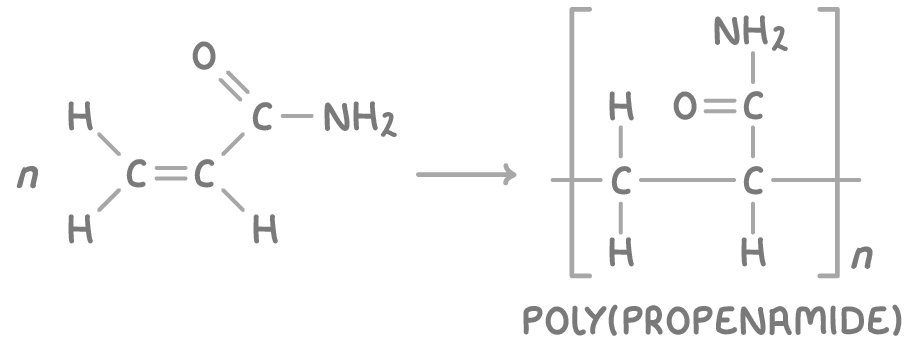
Poly(propenamide) is commonly used as a thickener, filler, and in water treatment. When the chains undergo cross-linking, a hydrogel is produced, which is used in soft contact lenses.
Poly(ethenol)
Poly(ethenol) is synthesised in two steps:
- Addition polymerisation of ethenyl ethanoate.
- Ester exchange of with methanol.
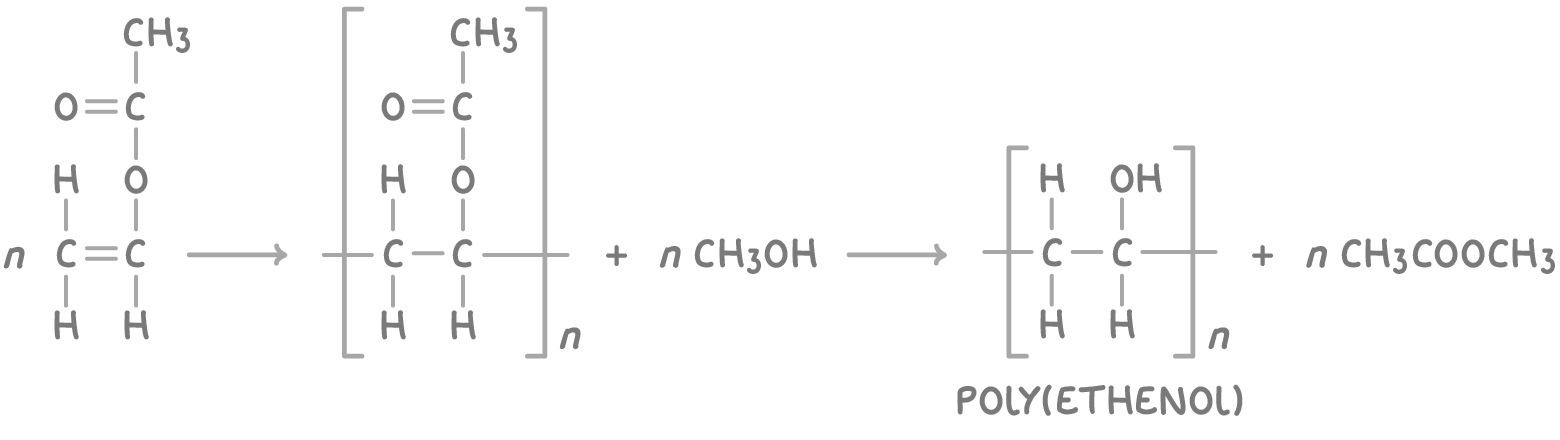
The -OH groups created allow hydrogen bonding with water, making poly(ethenol) soluble. Its solubility depends on how many ester groups are converted to OH groups during the ester exchange step - the more converted, the more soluble the polymer becomes.
Poly(ethenol) is used in water-soluble laundry bags and in liquid detergent capsules (liquitabs).
Comparing addition and condensation polymerisation
The mechanisms of addition and condensation polymerisation differ significantly:
| Polymerisation type | Addition | Condensation |
|---|---|---|
| Monomers used | Alkenes | Dicarboxylic acids, diamines, diols |
| Polymer chain | Continuous chain of carbon atoms | Contains ester or amide bonds |
| Products formed | Polymer only | Polymer and small molecule (e.g. H2O) |
- Addition polymers are made from alkene monomers, which form chains containing only carbon atoms.
- Condensation polymers are made from monomers with functional groups like -COOH, -NH2, or -OH, resulting in chains with ester or amide linkages.